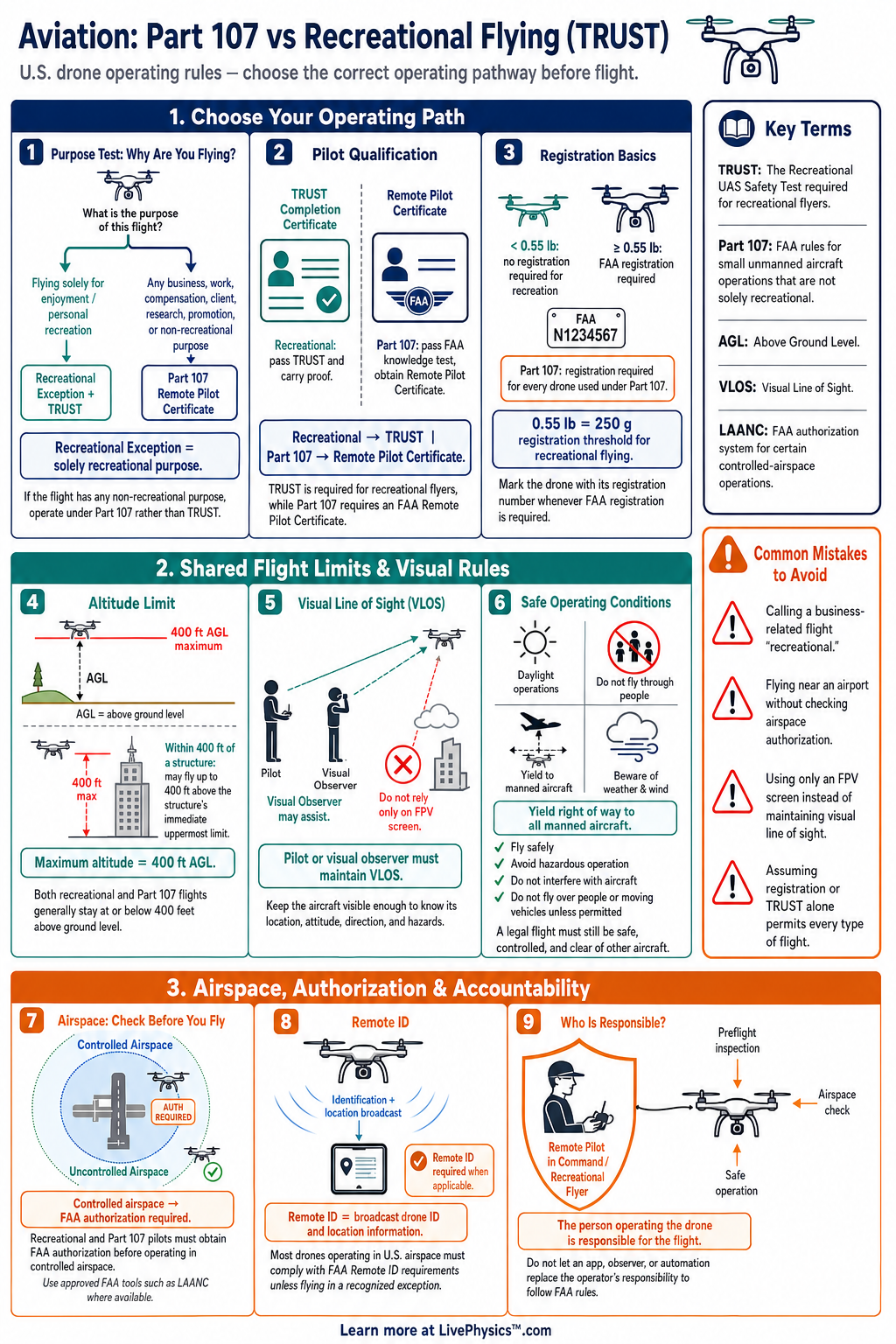
This cheat sheet explains the two main FAA pathways for flying small drones in the United States. Part 107 applies to most non-recreational drone operations, including flights for work, business, or other non-recreational purposes. The Recreational Flyer Exception applies only when a flight is strictly for fun.
Students need to know the difference because the correct pathway determines the training, paperwork, and operating rules they must follow.
Part 107 pilots must earn a Remote Pilot Certificate by passing an FAA knowledge test. Recreational flyers must complete the free TRUST safety test and carry proof of completion. Both types of pilots must follow important safety rules, including visual line of sight, airspace requirements, registration rules, and Remote ID rules when applicable.
The purpose of both pathways is to protect people, aircraft, property, and the national airspace system.
Key Facts
- Use Part 107 when a small drone flight is not conducted solely for recreation.
- A Part 107 remote pilot must be at least 16 years old and must hold an FAA Remote Pilot Certificate.
- A recreational flyer must pass TRUST and carry proof of TRUST completion when flying under the Recreational Flyer Exception.
- Both recreational and Part 107 pilots must keep the drone within visual line of sight during normal operations.
- The standard maximum altitude is 400 feet above ground level, written as maximum altitude equals 400 feet AGL.
- Controlled airspace requires FAA authorization before flight, whether the operation is recreational or under Part 107.
- Registration is generally required for recreational drones weighing more than 0.55 pounds and for drones flown under Part 107.
- Remote ID is generally required unless the drone is flown in an FAA recognized identification area or another FAA exception applies.
Vocabulary
- Part 107
- Part 107 is the FAA rule set that governs most non-recreational small unmanned aircraft operations.
- TRUST
- TRUST is the free FAA recreational drone safety test required for recreational flyers.
- Remote Pilot Certificate
- A Remote Pilot Certificate is the FAA credential that allows a qualified person to act as pilot in command under Part 107.
- Visual line of sight
- Visual line of sight means the pilot or visual observer can see the drone directly well enough to control it safely.
- Controlled airspace
- Controlled airspace is airspace where FAA authorization is required before a drone may fly.
- Remote ID
- Remote ID is a system that broadcasts identification and location information from a drone during flight.
Common Mistakes to Avoid
- Assuming that an unpaid flight is always recreational is wrong because the purpose of the flight, not payment alone, determines whether Part 107 applies.
- Using TRUST for a business, client, or school-related drone mission is wrong because TRUST only supports flights conducted solely for recreation.
- Flying near an airport without checking airspace is unsafe because controlled airspace requires FAA authorization before the flight.
- Treating 400 feet as permission to fly any height above nearby structures is wrong because the general limit is 400 feet above ground level and special Part 107 structure rules are limited.
- Believing that drone registration removes other requirements is wrong because registration does not replace TRUST, Part 107 certification, Remote ID, or airspace authorization.
Practice Questions
- 1 A pilot flies a 0.8 pound drone only for personal fun at a park. What training and registration requirements are likely to apply before flight?
- 2 A photographer uses a drone to take free images for a local company's advertising campaign. Which FAA pathway applies, and why?
- 3 A Part 107 pilot plans to fly at 450 feet above ground level in open terrain. Is this within the standard altitude limit?
- 4 Explain why the purpose of a drone flight matters more than whether the pilot receives payment.
Understanding Part 107 vs Recreational Flying (TRUST)
The first decision is based on the purpose of the flight. A flight is recreational only when it is flown solely for personal enjoyment. A drone flight for a client, a job, a business, research, school work, promotion, or another non-recreational reason usually requires Part 107.
Payment is not the only factor. A pilot can need Part 107 even when no money changes hands if the flight supports a business or organized activity.
Part 107 requires the pilot in command to hold a Remote Pilot Certificate. A person must be at least 16 years old to qualify for this certificate. The usual path includes studying aviation rules, airspace, weather, loading, and emergency procedures, then passing the FAA aeronautical knowledge test.
A certificated remote pilot is responsible for deciding whether each flight can be completed safely. This includes checking the drone, weather, location, airspace, people on the ground, and possible hazards before takeoff.
Recreational flyers use the statutory Recreational Flyer Exception. They must pass The Recreational UAS Safety Test, commonly called TRUST, before flying under this exception. They must also follow the safety guidelines of an FAA recognized Community Based Organization.
Recreational flying still has firm limits. The pilot must keep the drone within visual line of sight, give way to manned aircraft, avoid careless or reckless operations, and obtain airspace authorization when flying in controlled airspace.
Many safety requirements apply to both pathways. Drones that must be registered need a registration number displayed on the aircraft. Most drones also need to meet Remote ID requirements unless an FAA exception applies, such as flying in a recognized identification area.
Flights in controlled airspace require FAA authorization, often requested through LAANC. The normal maximum altitude is 400 feet above ground level, although Part 107 has a limited structure inspection allowance. Good pilots plan every flight, use current FAA information, and stop operations when conditions become unsafe.