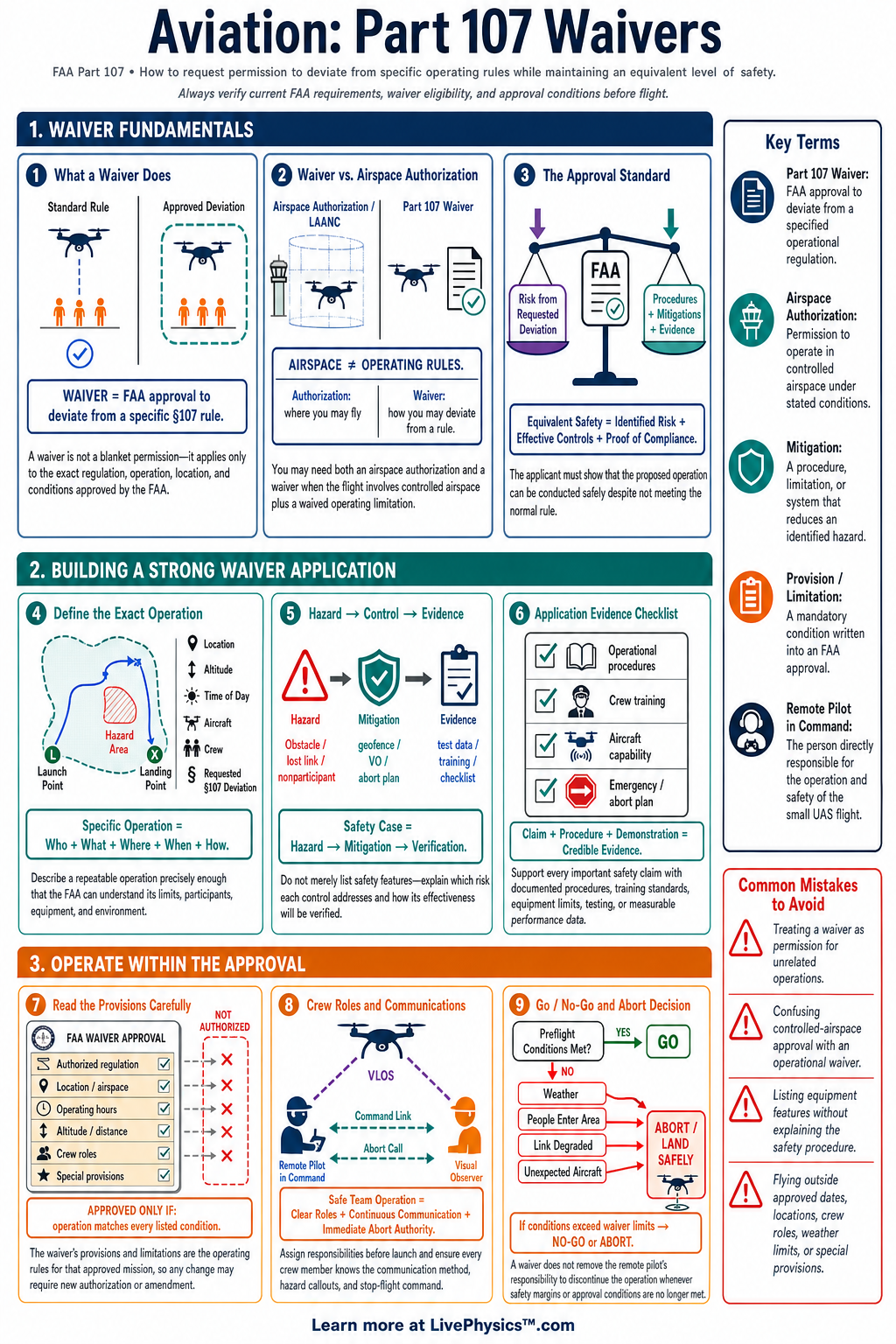
Part 107 waivers allow a remote pilot to request permission to deviate from certain Federal Aviation Regulations when a proposed drone operation can be conducted safely. This cheat sheet helps advanced students and remote pilots separate waivers from airspace authorizations and normal operating rules. It organizes the key planning steps needed before submitting an FAA request.
It also highlights the evidence that makes a safety case more credible.
A waiver is not automatic permission to fly any mission. The applicant must identify the specific rule involved, describe the operation, analyze hazards, and provide safeguards that achieve an acceptable level of safety. Common waiver topics include beyond visual line of sight operations, operations from moving vehicles, and some operations over people or at night when standard rule requirements cannot be met.
FAA approval is operation-specific and may include detailed conditions and limitations.
Key Facts
- Under 14 CFR section 107.200, the FAA may issue a waiver when the applicant shows that the proposed operation can be conducted safely under the terms of the waiver.
- A Part 107 waiver changes a specific operating rule, while an airspace authorization permits access to controlled airspace.
- A waiver application should state the exact regulation to be waived, the operating area, aircraft, crew roles, procedures, and safety mitigations.
- Visual line of sight is normally required by 14 CFR section 107.31, so beyond visual line of sight operations generally require an FAA waiver.
- The remote pilot in command remains directly responsible for the safety of the operation, even when visual observers or other crew members assist.
- An approved waiver applies only within its stated conditions and limitations, so exceeding those limits can make the operation noncompliant.
- Routine night operations do not require a waiver when the remote pilot meets applicable training requirements and the aircraft uses required anti-collision lighting.
- A safety case should link each hazard to a mitigation, such as a defined abort procedure, crew communication plan, geofence, or emergency landing area.
Vocabulary
- Part 107 waiver
- An FAA approval that permits a remote pilot to deviate from a specific waiver-eligible Part 107 operating rule under stated conditions.
- Airspace authorization
- FAA permission to operate a drone in controlled airspace subject to location, altitude, and other limits.
- Safety case
- A structured explanation supported by evidence that shows an operation can be performed with an acceptable level of safety.
- Visual line of sight
- A condition in which the remote pilot or visual observer can see the unmanned aircraft well enough to control it and avoid hazards.
- Mitigation
- A procedure, technology, limit, or training measure used to reduce the likelihood or severity of a hazard.
- Condition and limitation
- A binding requirement written into an FAA approval that defines how, where, and when the approved operation may occur.
Common Mistakes to Avoid
- Treating a waiver as permission for all similar flights is wrong because each approval applies only to the operation and limits described by the FAA.
- Confusing a controlled-airspace authorization with a waiver is wrong because airspace access and deviation from an operating rule are separate regulatory issues.
- Submitting a vague safety plan is a mistake because the FAA needs specific hazards, crew actions, equipment details, and abort procedures to evaluate safety.
- Claiming that technology removes all risk is wrong because an application must explain the technology’s limits, failure modes, testing, and human backup procedures.
- Using an old waiver checklist without checking current rules is a mistake because some activities now have standard Part 107 compliance requirements instead of waiver requirements.
Practice Questions
- 1 A pilot plans a beyond visual line of sight inspection route that extends 1.8 miles from the launch point. Which normal Part 107 rule is likely involved, and what type of FAA approval is generally needed?
- 2 A proposed operation occurs in controlled airspace near an airport at 150 feet above ground level and also requires beyond visual line of sight flight. How many different types of FAA approvals may be needed?
- 3 List three hazards for a beyond visual line of sight operation and give one practical mitigation for each hazard.
- 4 Explain why a detailed abort procedure can make a waiver safety case stronger than a statement that the pilot will use good judgment.
Understanding Part 107 Waivers
Part 107 is the main U.S. rule set for small unmanned aircraft operations conducted for purposes other than recreation. Most routine flights can be completed by following the standard operating rules. A waiver is needed only when an operation cannot meet a waiver-eligible rule.
The FAA reviews whether the proposed method provides safety equal to or better than the rule being waived. This makes the waiver process a risk management exercise, not simply a form request.
A strong application starts with a precise operating concept. The applicant defines the aircraft, mission purpose, locations, airspace, flight altitude, distances, crew roles, and expected flight conditions. The description should explain what happens before, during, and after each flight.
Vague statements make it hard for the FAA to evaluate risk. Specific limits make the operation easier to approve and easier for the crew to follow.
The safety case identifies hazards and connects each hazard to a control. For a beyond visual line of sight mission, hazards can include loss of separation from aircraft, loss of command link, navigation error, and an unplanned landing. Controls may include trained visual observers, detect and avoid procedures, geographic boundaries, reliable communications, aircraft performance checks, and clear abort criteria.
A good safety case also explains how the crew verifies that each control works. Written checklists, training records, maintenance logs, and test results can support these claims.
Airspace approval and a Part 107 waiver are different approvals. An airspace authorization addresses access to controlled airspace near certain airports. A waiver addresses deviation from a specific operating rule.
A flight near an airport may need both approvals if it is in controlled airspace and uses a waiver activity. Remote pilots must read all approval documents carefully because conditions may limit altitude, time, location, crew duties, or communication methods.
Some topics that once commonly required waivers now have standard compliance paths. For example, routine night operations may be conducted under Part 107 when the remote pilot meets current training requirements and the aircraft has required anti-collision lighting. Operations over people also have rule-based categories with specific aircraft and operating requirements.
Students should verify the current regulation before seeking a waiver. When a waiver is appropriate, study the exact rule, design conservative limits, and build an operation that can be repeated safely in real conditions.