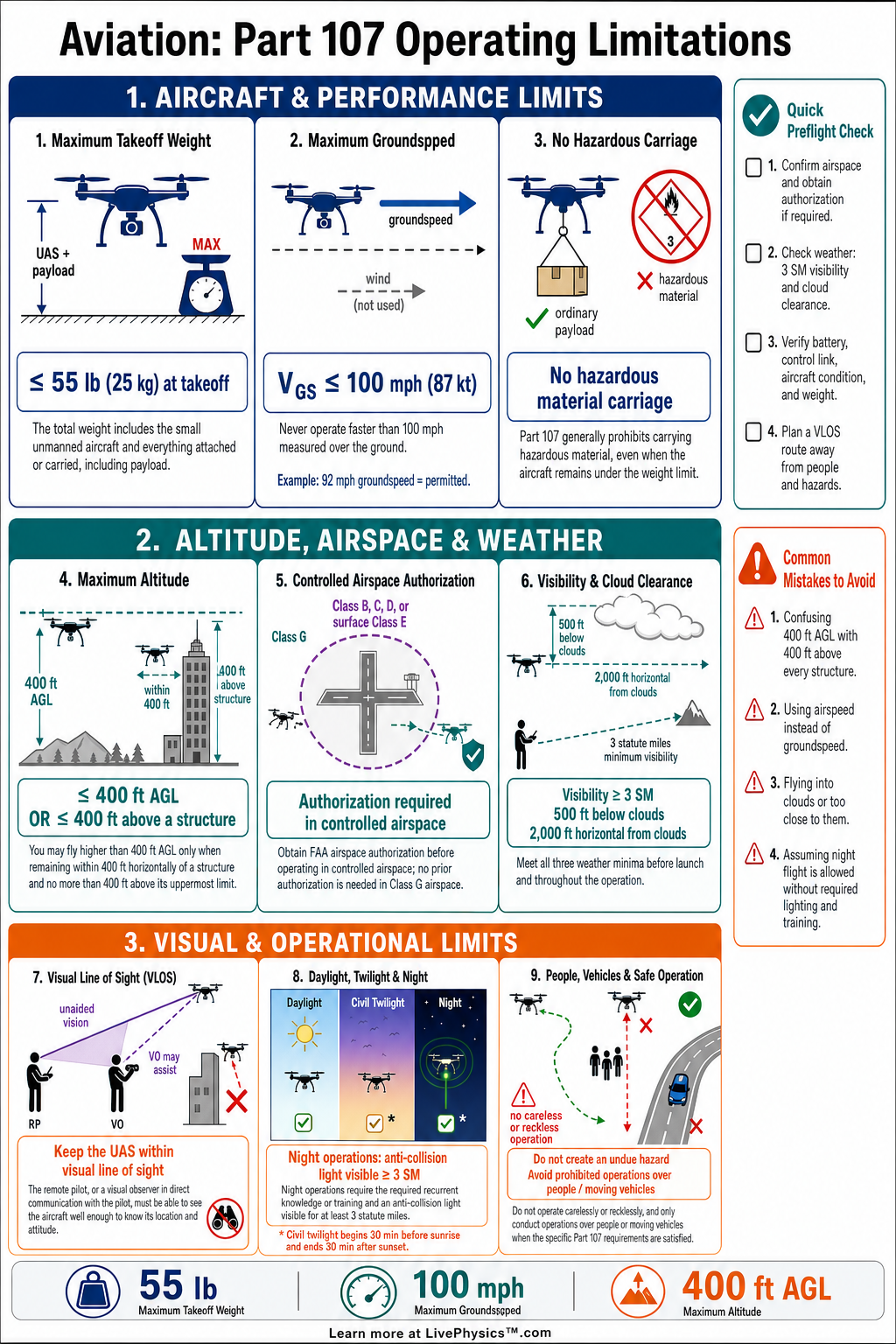
FAA Part 107 sets the operating limits for most small unmanned aircraft flights conducted for work, business, or other nonrecreational purposes. Remote pilots must know these limits before each flight because legal operations depend on more than safely controlling the aircraft. This cheat sheet organizes the most tested and most useful limits into a quick reference for planning and conducting a mission.
The rules cover aircraft weight, maximum groundspeed, altitude, visibility, cloud clearance, visual line of sight, and time of operation. They also control where a pilot may fly, who may be near the operation, and when a waiver or other FAA authorization is needed. A remote pilot in command remains responsible for checking the conditions and ensuring every part of the flight meets the applicable rule.
Key Facts
- A small unmanned aircraft operating under Part 107 must weigh less than 55 pounds at takeoff, including everything attached to or carried by the aircraft.
- The maximum permitted groundspeed under Part 107 is 100 miles per hour, which equals 87 knots.
- The standard maximum altitude is 400 feet above ground level.
- An aircraft may fly higher than 400 feet above ground level when it stays within 400 feet of a structure's uppermost limit.
- Minimum flight visibility from the control station is 3 statute miles.
- The aircraft must remain at least 500 feet below clouds, 2,000 feet horizontally from clouds, and 500 feet above clouds.
- The remote pilot in command or visual observer must maintain visual line of sight with the unmanned aircraft throughout the flight.
- Operations in controlled airspace require FAA airspace authorization unless another FAA rule or authorization applies.
Vocabulary
- Remote pilot in command
- The certificated person directly responsible for the safe operation of a small unmanned aircraft.
- Above ground level
- A height measurement based on the surface directly below the aircraft.
- Visual line of sight
- The ability of the remote pilot or visual observer to see the aircraft directly and monitor its flight.
- Controlled airspace
- Airspace where air traffic control provides services and where Part 107 operations often need FAA authorization.
- Civil twilight
- The period before sunrise and after sunset when the sun is no more than 6 degrees below the horizon.
- Waiver
- FAA approval to conduct a Part 107 operation that does not meet a specific standard operating rule.
Common Mistakes to Avoid
- Treating 400 feet above ground level as an absolute ceiling is wrong because Part 107 allows flight within 400 feet of a structure's uppermost limit.
- Using the drone camera feed as visual line of sight is wrong because the pilot or visual observer must directly see the aircraft during the operation.
- Confusing statute miles with nautical miles is wrong because the Part 107 visibility minimum is 3 statute miles.
- Assuming a flight is legal because it is below 400 feet is wrong because controlled airspace may still require FAA authorization.
- Ignoring cloud clearance after checking ground visibility is wrong because pilots must meet both the 3 statute mile visibility minimum and the required distances from clouds.
Practice Questions
- 1 A drone weighs 48 pounds with its battery and payload installed. Does it meet the Part 107 small unmanned aircraft weight limit?
- 2 A remote pilot plans to fly 450 feet above the ground next to a 600 foot tower. What condition must be met for this altitude to fit the structure exception?
- 3 The control station visibility is 2.5 statute miles. Can the pilot begin a standard Part 107 operation under the visibility rule?
- 4 A pilot can see the aircraft only on the controller screen because it is too far away to see directly. Explain why this operation does not meet the visual line of sight requirement.
Understanding Part 107 Operating Limitations
Part 107 applies to small unmanned aircraft systems used in civil operations when no different FAA rule applies. The aircraft must weigh less than 55 pounds at takeoff, including payload and attached equipment.
A remote pilot in command must inspect the system before flight and must stop or avoid a flight when an unsafe condition exists. The pilot is responsible for the whole operation, even when a visual observer assists with scanning the airspace.
The standard altitude limit is 400 feet above ground level. An important exception permits flight higher than 400 feet when the aircraft remains within 400 feet of the uppermost limit of a structure.
This rule supports inspections of tall buildings, towers, and similar objects. The pilot must still consider controlled airspace, local restrictions, and the risk that manned aircraft may operate near the structure.
Visual line of sight is a central Part 107 requirement. The remote pilot or visual observer must be able to see the aircraft throughout the flight without binoculars or similar vision-enhancing devices. Normal corrective lenses are allowed.
Seeing a video feed on a controller is useful, but it does not replace direct visual observation. Direct sight helps the crew judge the aircraft position, direction, altitude, nearby obstacles, and possible traffic conflicts.
Weather limits protect both the aircraft and other airspace users. The minimum flight visibility from the control station is 3 statute miles. The aircraft must stay at least 500 feet below clouds, 2,000 feet horizontally from clouds, and 500 feet above clouds.
These limits reduce the chance of an encounter with a manned aircraft emerging from cloud cover. Pilots should also account for wind, precipitation, sun angle, and changing visibility, even when the stated minimums are met.
Operations are generally permitted during daylight and civil twilight with the required anti-collision lighting. The aircraft maximum groundspeed is 100 miles per hour, and the maximum altitude is normally 400 feet above ground level.
Flights over people, moving vehicles, or in certain airspace may require meeting additional conditions or obtaining FAA authorization. Strong study habits focus on identifying the rule, checking for an exception, and deciding whether a planned operation remains within the standard limits or needs a waiver or authorization.