
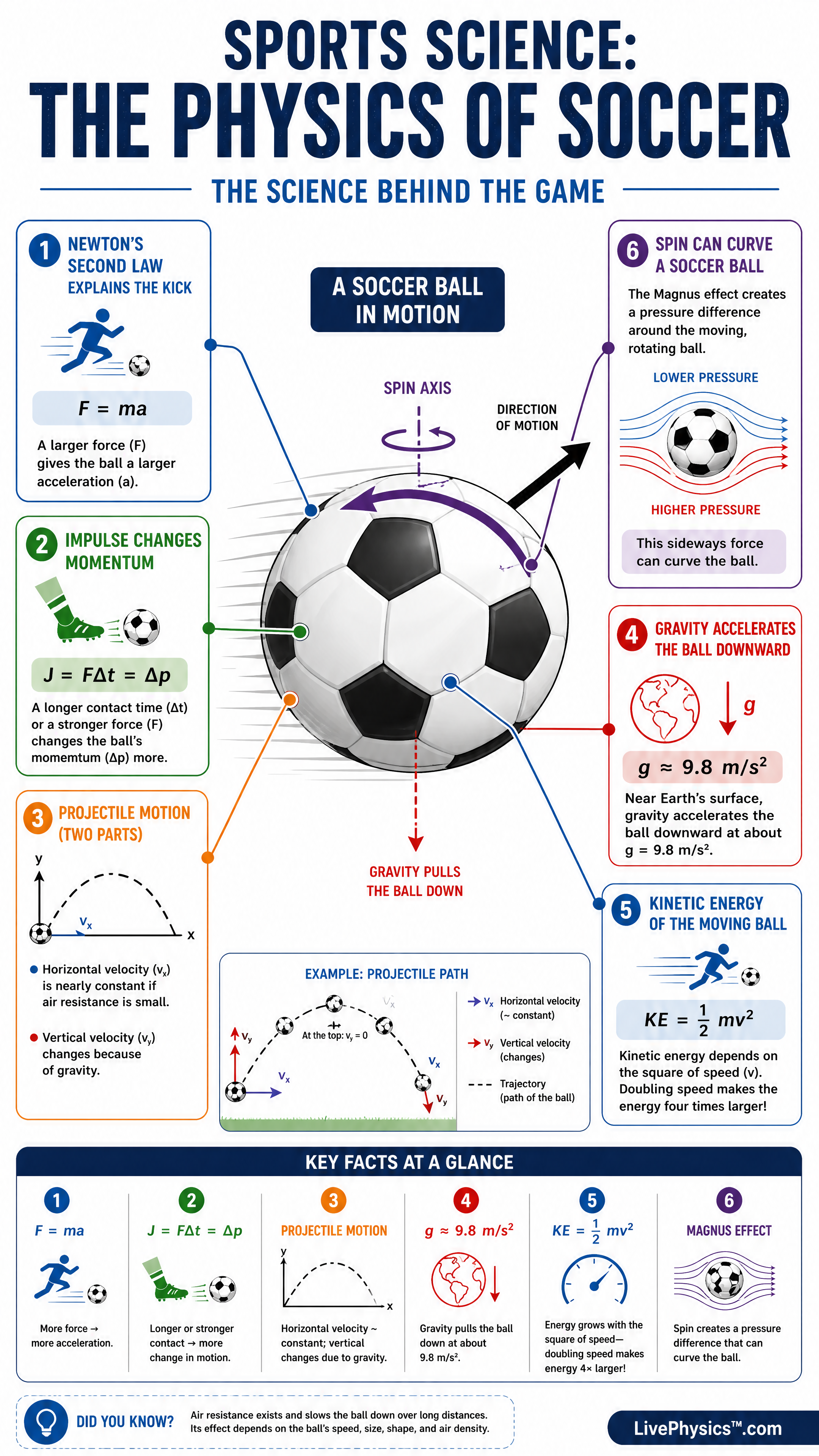
Soccer is a fast, exciting game, but every pass, shot, save, and header follows the laws of physics. A kicked ball changes speed and direction because forces act on it during the foot contact and while it flies through the air. Players use ideas like motion, energy, spin, and friction even when they are making quick decisions on the field.
Understanding the science behind the game helps students connect sports action to physics, biology, and statistics.
When a player kicks the ball, the foot applies a force for a short time, creating an impulse that changes the ball's momentum. After the ball leaves the foot, gravity pulls it downward, air resistance slows it, and spin can curve its path through the Magnus effect. Biology also matters because muscles produce force, joints guide motion, and reaction time affects passing, shooting, and goalkeeping.
Statistics help teams study shot speed, launch angle, pass accuracy, and player performance using real data.
Understanding Sports Science, The Physics of Soccer
A soccer kick is not just about leg strength. The player first plants the support foot, then rotates the hips and swings the lower leg. This sequence transfers motion from the body to the foot.
A firm ankle matters because a loose ankle absorbs part of the collision instead of sending it into the ball. The part of the foot used changes the result. The instep gives a large, direct push for a powerful shot.
The inside of the foot gives more control because it presents a broader, steadier surface. Good technique helps a player direct the force through the ball rather than wasting energy in unwanted body movement.
The ball does not need to be hit in its center. A strike below the center produces backspin, which can help a long pass stay in the air. A strike near one side produces sidespin.
Air moving around the spinning ball is disturbed unevenly, so the ball bends toward one side. This is why free kicks can travel around a wall. Spin has limits.
Too much sidespin may reduce forward speed or make the ball harder to place accurately. The surface matters too. A wet ball, a soft ball, and a ball with different panel textures can behave differently in the air and when they meet a boot.
When the ball reaches the ground, friction becomes especially important. Rolling friction and air resistance gradually reduce its speed. On grass, the ball slows faster than on a smooth indoor court.
A firm, dry field usually allows a faster roll than a long or wet field. Bounces depend on how much energy is returned after impact. Some energy becomes sound, heat, and temporary deformation of the ball and ground.
A player receiving a fast pass often moves the foot backward at contact. This increases the stopping time, reducing the force felt by the foot and making the first touch easier to control.
Goalkeeping shows how physics and human reaction work together. A goalkeeper must read body position before the shot happens. The angle of the hips, the planting foot, and the approach to the ball can give clues about direction.
Once the ball is moving, there may be very little time to react. A ball hit faster reaches the goal sooner, while a curved ball changes its path during flight. Goalkeepers try to place their body where it covers the largest useful area, then use their hands or arms to redirect the ball safely.
Students should notice that real plays involve many linked factors. Speed alone does not decide the outcome. Contact point, launch direction, spin, field conditions, timing, and control all affect what happens next.
Key Facts
- Newton's second law explains the kick, F = ma, so a larger force gives the ball a larger acceleration.
- Impulse changes momentum, J = FΔt = Δp, where a longer or stronger contact changes the ball's motion more.
- Projectile motion has horizontal and vertical parts, horizontal velocity is nearly constant if air resistance is small, while vertical velocity changes because of gravity.
- Gravity accelerates the ball downward at about g = 9.8 m/s^2 near Earth's surface.
- Kinetic energy of the moving ball is KE = 1/2 mv^2, so doubling speed makes the energy four times larger.
- Spin can curve a soccer ball because the Magnus effect creates a pressure difference around the moving, rotating ball.
Vocabulary
- Force
- A push or pull that can change an object's speed, direction, or shape.
- Impulse
- The product of force and contact time that measures how much an object's momentum changes.
- Projectile motion
- The curved motion of an object moving through the air under the influence of gravity.
- Magnus effect
- The sideways or upward force on a spinning ball caused by differences in air pressure around it.
- Reaction time
- The time between sensing an event and beginning a physical response.
Common Mistakes to Avoid
- Thinking the ball keeps moving because a force from the foot stays with it. The foot only acts during contact, and after that gravity, air resistance, and other external forces control the motion.
- Ignoring air resistance and spin for every soccer shot. This can be useful for simple problems, but real curved free kicks and long passes are strongly affected by drag and the Magnus effect.
- Confusing speed with velocity. Speed tells how fast the ball moves, while velocity includes both speed and direction, which matters for passes, shots, and rebounds.
- Assuming a harder kick always gives better accuracy. A larger force can increase speed, but accuracy also depends on contact point, body position, spin, timing, and control.
Practice Questions
- 1 A soccer ball has a mass of 0.43 kg and leaves the foot at 20 m/s. What is its kinetic energy?
- 2 A player applies an average force of 500 N to a ball for 0.020 s. What impulse is delivered to the ball, and what change in momentum does this produce?
- 3 A free kick curves around a defensive wall. Explain how the direction of spin, air pressure differences, and the Magnus effect can change the path of the ball.