Simple Machines Physics Calculator
Explore all six classic simple machines. Enter the geometry and input force, then see how ideal mechanical advantage (IMA) compares to actual mechanical advantage (AMA) as friction is added. Grades 3-7.
Select Machine
Diagram
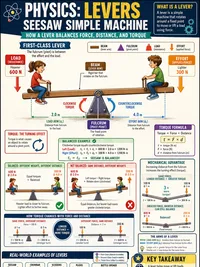
Class 1 Lever
Fulcrum is between the effort and the load.
Examples Scissors, seesaw, crowbar, pliers
IMA can be greater than, equal to, or less than 1 depending on arm lengths.
Parameters
Lever Class
Results
Work (per 1 m output distance)
IMA Formula for this machine
Efficiency
Reference Guide
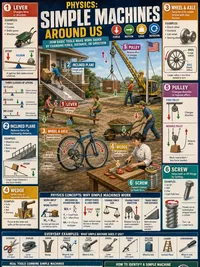
The 6 Classic Simple Machines
Lever
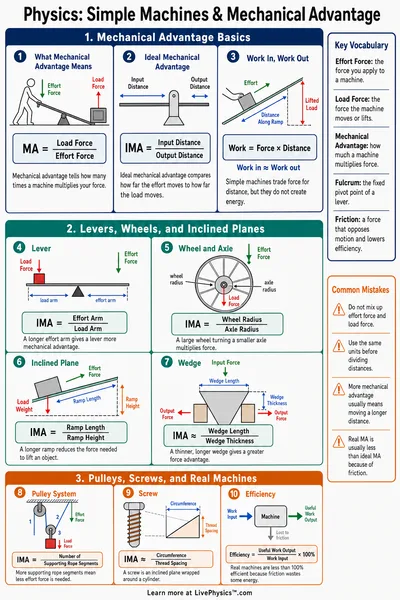
A rigid bar pivoting on a fulcrum. IMA = effort arm / load arm. Three classes based on where the fulcrum, effort, and load are placed.
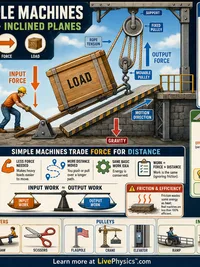
Inclined Plane
A sloped ramp that reduces the force needed to raise an object. IMA = ramp length / height. A longer, shallower ramp provides more mechanical advantage.
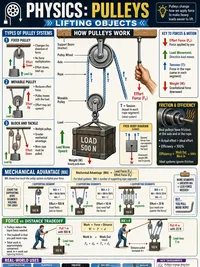
Pulley
A wheel with a rope or chain. Fixed pulleys redirect force; movable pulleys multiply it. IMA = number of rope segments supporting the load.
Wheel and Axle
A large wheel attached to a smaller axle. IMA = wheel radius / axle radius. Steering wheels and doorknobs use this principle.
Wedge
Two back-to-back inclined planes. Converts downward force into sideways splitting force. IMA = wedge length / thickness.
Screw
An inclined plane wrapped around a cylinder. IMA = (2 x pi x effort arm radius) / thread pitch. Smaller pitch means higher IMA.
IMA vs AMA
Ideal Mechanical Advantage (IMA)
Calculated from geometry alone with no friction losses assumed. IMA = input distance / output distance. This is the theoretical maximum force multiplication a machine can provide.
Actual Mechanical Advantage (AMA)
Measured from the actual forces in a real machine, AMA = output force / input force. Always less than IMA due to friction between moving parts.
Why AMA is less than IMA
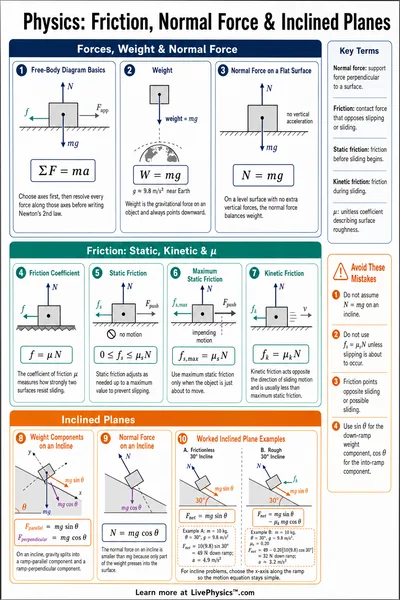
Friction converts some input work into heat. The more friction (rough surfaces, worn bearings, tight fits), the greater the gap between IMA and AMA, and the lower the efficiency.
Key relationship
AMA = IMA x (1 - friction losses)
Efficiency = (AMA / IMA) x 100%
Efficiency and Energy Conservation
What efficiency measures
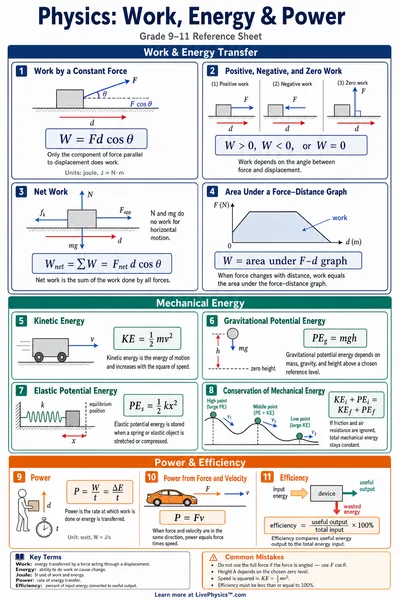
Efficiency = (useful work output / total work input) x 100%. A 75% efficient machine converts 75% of input work into useful output; the remaining 25% is lost as heat from friction.
No machine has 100% efficiency
Every real machine loses some energy to friction, deformation, vibration, and heat. A well-lubricated ball bearing system might achieve 90-95%, while a dry wooden inclined plane might only reach 50-60%.
The trade-off
Simple machines cannot create energy. A large IMA means a small input force is multiplied into a large output force, but the input moves a greater distance. Work = Force x Distance is conserved.
- Efficiency above 80% - well designed, minimal friction
- Efficiency 50-80% - moderate friction, room for improvement
- Efficiency below 50% - high friction, redesign recommended
Lever Classes
Class 1 - Fulcrum in middle
Effort and load on opposite sides of the fulcrum. IMA greater or less than 1 depending on arm lengths.
Examples, scissors, seesaw, crowbar, pliers
Class 2 - Load in middle
Load between fulcrum and effort. Effort arm is always longer than load arm. IMA always greater than 1.
Examples, wheelbarrow, nutcracker, bottle opener
Class 3 - Effort in middle
Effort between fulcrum and load. Load arm is always longer. IMA always less than 1 - trades force for speed and range.
Examples, tweezers, fishing rod, human forearm