Cell Biology Lab
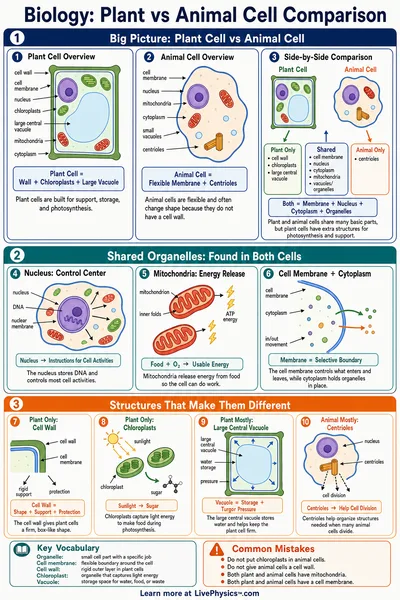
Toggle between an animal cell and a plant cell, then click any organelle to read its job. Find the cell wall, chloroplasts, and the giant central vacuole that make plant cells different from animal cells.
Guided Experiment Animal vs Plant Cells
What three organelles do you predict a plant cell has that an animal cell does not? What jobs do those organelles do?
Write your hypothesis in the Lab Report panel, then click Next.
Animal Cell (click an organelle)
Nucleus
Control center of the cell. Holds DNA and directs all activity by sending instructions to make proteins.
Data Table
(0 rows)| # | Trial | Cell | Organelle | Function | Found in |
|---|
Reference Guide
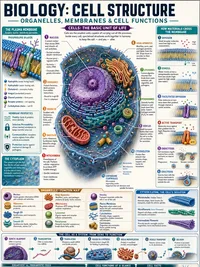
The Cell Is the Unit of Life
Every living thing is made of cells. Bacteria are single cells. A human body has trillions of them.
Each cell has tiny structures called organelles. Each organelle has a specific job, like the rooms of a tiny factory.
Animal Cells
Animal cells are usually round and flexible. They take in food, water, and oxygen across their cell membrane.
They have a nucleus, mitochondria, ribosomes, endoplasmic reticulum, and small vacuoles. They cannot make their own food, so they eat plants or other animals.
Plant Cells
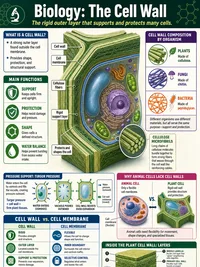
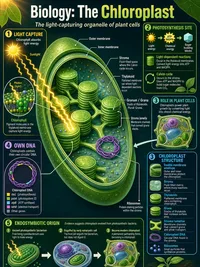
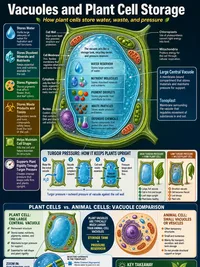
Plant cells share every organelle with animal cells but add three big extras, a rigid cell wall, chloroplasts for photosynthesis, and a huge central vacuole.
The wall plus the vacuole give plants their shape and let them stand up against gravity without bones.
Energy and Information
The nucleus stores DNA, the instruction manual for the cell. Ribosomes read those instructions and build proteins.
Mitochondria turn food into ATP, the cell's energy currency. In plant cells, chloroplasts make sugar from sunlight first, then mitochondria turn it into ATP.