Nonstandard Measurement Lab
Pick an object and a measuring unit -- paper clips, erasers, blocks, or crayon widths. Watch how the tile ruler fills in and discover, when the unit gets bigger, the count goes down. Record your measurements and find out why we need standard units.
Guided ExperimentMeasurement Investigation
Before you start, predict, if you use a bigger unit, will the count go up or down? Write your prediction.
Write your hypothesis in the Lab Report panel, then click Next.
Controls
Pick an Object to Measure
Pick a Measuring Unit
Measuring Pencil ✏️
8 Paper ClipsThe pencil is 8 paper clips long.
Reference Guide
What Is Measurement?
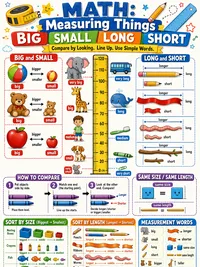
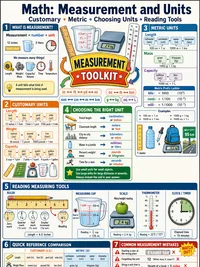
Measurement means finding out how long, tall, or wide something is. You can measure with standard units (centimeters, inches) or nonstandard units (paper clips, steps, hands).
When you measure, you line up units end-to-end from one side to the other and count how many fit.
- Start at one end -- no gaps before the first unit.
- No overlaps between units.
- Count every unit all the way to the other end.
Nonstandard Units
Nonstandard units are everyday objects used for measuring. They are a great way to practice the idea of measurement before learning inches and centimeters.
- Paper Clip - Small, about 3 cm long.
- Eraser - Medium, about 5 cm long.
- Block - Medium, about 4 cm long.
- Crayon Width - Small, about 2.5 cm wide.
Comparing Lengths
When you measure the same object with two different units, the counts will be different -- but the object is exactly the same length both times.
Key insight, a bigger unit fits fewer times (smaller count). A smaller unit fits more times (bigger count).
This is called an inverse relationship, as unit size goes up, the count goes down.
Why Units Matter
Imagine two students measure the same pencil. One says it is 8 paper clips long. The other says it is 5 erasers long. Are they wrong? No -- they used different units!
This is why we use standard units like inches or centimeters. Standard units are the same everywhere, so two people always get the same number for the same object.
- Always say which unit you used.
- Standard units help people share and compare measurements.