Ordinal Numbers & Sequence Lab
Line up animals and record the ordinal word for each position. Explore how 1st, 2nd, and 3rd differ from later ordinals, and see how the same position changes when the line gets longer or shorter.
Guided ExperimentOrdinal Numbers Investigation
Ordinal words name positions (1st, 2nd, 3rd, and so on). Do you think every ordinal word is just the number plus 'th'? Write your prediction before you investigate.
Write your hypothesis in the Lab Report panel, then click Next.
Build a Lineup
Animal Lineup
Tap any animal to select its position.
Controls
Reference Guide
What Is an Ordinal Number
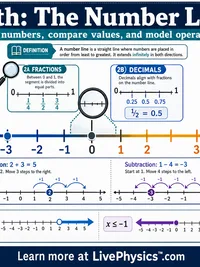
An ordinal number names the position of something in a sequence. It tells you where something is, not how many.
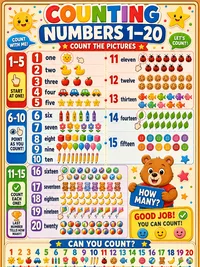
Counting numbers (1, 2, 3) answer the question "how many". Ordinal numbers answer the question "which one".
Special Words
The first three ordinal words do not follow the plus-th pattern. They each have their own special ending.
Starting at 4, the pattern is number plus "th". So 4 becomes 4th, 5 becomes 5th, and so on.
From Start or From End
The same animal can have two different ordinal names. One counts from the start of the line, the other counts from the end.
To find the position from the end, take the line length and subtract the position, then add 1.
Ordinal vs Counting
Counting numbers measure quantity. Ordinal numbers describe rank or order in a sequence.
The word "last" is also an ordinal. In a line of 5 the last animal is 5th. In a line of 10 the last animal is 10th.