Partial Quotients and Remainders Lab
Explore division using the partial quotients strategy. Break dividends into chunks, record what remains, and discover the pattern that remainders always follow.
Guided Experiment Partial Quotients and Remainders Investigation
Before you start, predict, when you divide a number by 5, will the remainder always be 0, 1, 2, 3, or 4? Write your prediction.
Write your hypothesis in the Lab Report panel, then click Next.
Quick Presets
The number being divided
The number dividing by
Enter a dividend and divisor, then click Calculate to see the partial quotients steps.
Controls
Reference Guide
What Is Division?
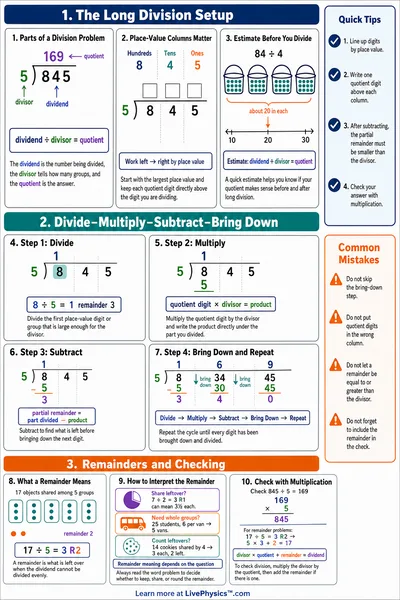
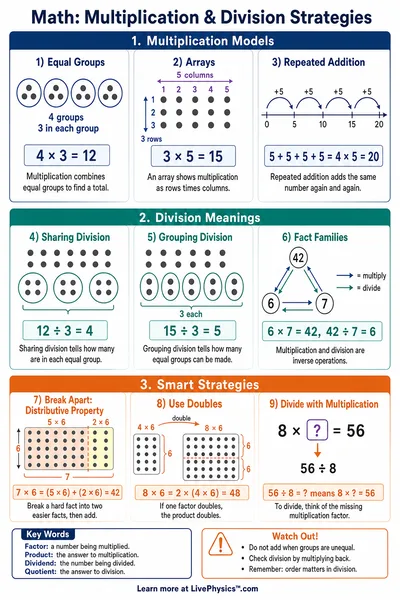
Division splits a number (the dividend) into equal groups of a given size (the divisor). The result is how many complete groups fit (the quotient) and how much is left over (the remainder).
For example, 17 divided by 5 means asking, how many groups of 5 fit in 17? Three groups of 5 make 15, with 2 left over. So 17 / 5 = 3 remainder 2.
Division is the inverse of multiplication. If 3 times 5 equals 15, then 15 / 5 equals 3.
The Partial Quotients Method
Instead of dividing all at once, partial quotients works by subtracting manageable chunks of the divisor at a time. Start with the largest chunk that still fits, subtract it, and repeat until nothing is left.
Example, 84 / 7
- 70 fits in 84 (10 groups of 7). Subtract 70. Left, 14.
- 14 fits the rest (2 groups of 7). Subtract 14. Left, 0.
- Total partial quotients, 10 + 2 = 12. Remainder, 0.
This method builds number sense by connecting division to repeated subtraction.
Understanding Remainders
A remainder is the amount left after dividing as evenly as possible. It is always smaller than the divisor. If the remainder equaled the divisor, you could fit one more group.
When the remainder is zero, the dividend is evenly divisible by the divisor. This means the divisor is a factor of the dividend.
Example. 20 / 4 = 5 remainder 0 (4 is a factor of 20). 21 / 4 = 5 remainder 1. 23 / 4 = 5 remainder 3. The remainder is always 0, 1, 2, or 3 for divisor 4.
Patterns in Remainders
When you divide consecutive numbers by the same divisor, the remainders follow a repeating cycle. Dividing by 5 always gives remainders of 0, 1, 2, 3, or 4 in order.
The key rule. The remainder is always less than the divisor. If the divisor is 6, possible remainders are 0 through 5. If the divisor is 9, possible remainders are 0 through 8.
Numbers with remainder 0 are called multiples of the divisor. For divisor 5, the multiples are 5, 10, 15, 20, and so on.