Partial Quotients & Remainders Explorer
Learn division by taking it one friendly chunk at a time. Subtract multiples you know, stack the partial quotients, and figure out what to do with what is left over.
Problem 158 ÷ 7Click "Show Next Step" to see how we subtract one friendly multiple at a time.
Division Scaffold
7
)
158
Partial quotients
We start with 158. Watch as we subtract multiples of 7.
Division Reference
Partial Quotients Strategy
Instead of guessing the exact quotient, subtract easy multiples
- 158 ÷ 7: subtract 7×10=70 → 88 left
- 88 ÷ 7: subtract 7×10=70 → 18 left
- 18 ÷ 7: subtract 7×2=14 → 4 left
- 4 is less than 7, so we stop
- Quotient, 10+10+2=22, Remainder, 4
What to Do With Remainders
Remainders mean different things in different problems
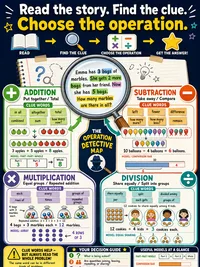
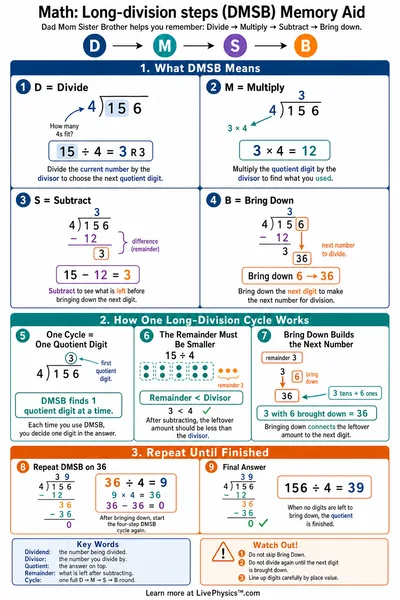
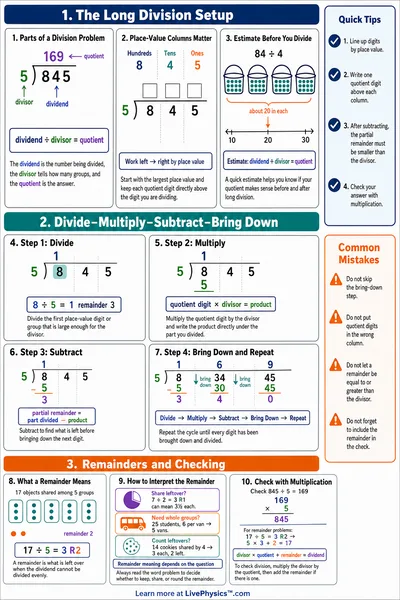
- Buses 132 ÷ 8 = 16 R4 → need 17 buses (round up)
- Sharing 27 ÷ 4 = 6 R3 → each gets 6, 3 left over
- Cutting 25 ÷ 4 = 6 R1 → get 6 full pieces
Always read the question to decide!
Related Content
Related Tools
MAP Growth Grade 3 Math Practice
Original independent MAP Growth Grade 3 Math skill practice with explanations, adjustable difficulty and first-attempt progress; no official RIT score.
MAP Growth Grade 4 Math Practice
Original independent MAP Growth Grade 4 Math skill practice with explanations, adjustable difficulty and first-attempt progress; no official RIT score.
MAP Growth Grade 5 Math Practice
Original independent MAP Growth Grade 5 Math skill practice with explanations, adjustable difficulty and first-attempt progress; no official RIT score.
MAP Growth Grade 6 Math Practice
Original independent MAP Growth Grade 6 Math skill practice with explanations, adjustable difficulty and first-attempt progress; no official RIT score.
Related Labs
Partial Quotients & Remainders Lab
Divide numbers using the partial quotients strategy. Record quotients and remainders, discover patterns, and understand what remainders tell us. Grades 4-5.
Bar Model Word Problems Lab
Use bar models to represent and solve word problems. Explore part-part-whole and comparison models and discover when each model helps most. Grades 2-5.
Classroom Store Lab
Run a virtual classroom store - count coins and bills, calculate totals, make correct change, and explore money math with real-world shopping scenarios