Pixel Art and Secret Messages Lab
Paint pixel art on an 8x8 grid, then encode and decode secret messages using a letter-number cipher. Discover how computers store pictures and hide information as numbers.
Guided Experiment Pixels and Secret Messages Investigation
Before you start, predict, how do you think a computer stores a picture? Is it stored as colors, as numbers, or as something else?
Write your hypothesis in the Lab Report panel, then click Next.
8x8 Pixel Grid
0 colored pixelsControls
Color Palette
Selected Black (code 1)
Record This Drawing
Reference Guide
What Is a Pixel?
A pixel is the smallest dot of color on a screen. Every image you see on a computer or phone is made of millions of tiny pixels arranged in a grid.
Each pixel stores a single color. When you zoom way in on any photo, you can see the individual colored squares that make up the picture.
- Resolution. More pixels means sharper images.
- Grid size. An 8x8 grid holds 64 pixels.
- Color code. Computers store each pixel as a number.
Numbers as Colors
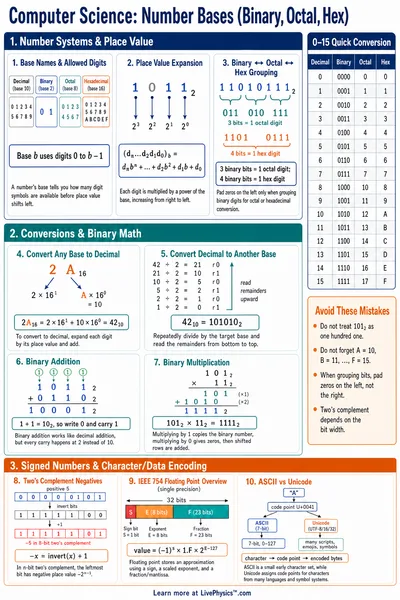
Computers do not see colors the way humans do. They store every color as a number. This is how digital images are saved and sent across the internet.
- 0 = White (empty pixel)
- 1 = Black
- 2 = Red, 3 = Blue, 4 = Green
- 5 = Yellow, 6 = Orange, 7 = Purple
The Letter-Number Cipher
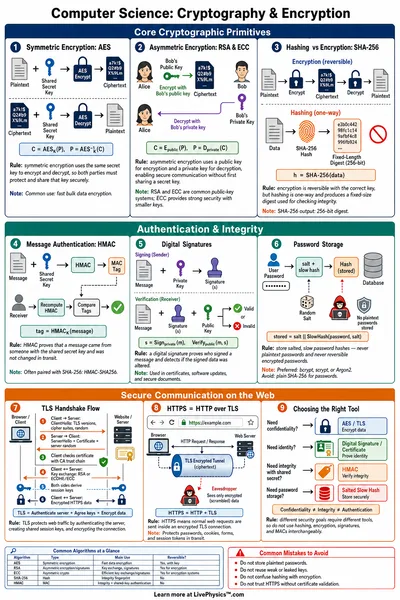
A cipher is a system for hiding messages by replacing letters with something else. The simplest cipher maps each letter to its position in the alphabet.
- A = 1, B = 2, C = 3 ... Z = 26
- CAT becomes 3 1 20
- Only someone who knows the rule can decode it.
Adding a shift makes the code harder to crack. With shift 3, A becomes 4, B becomes 5, and so on.
Data and Encoding
Encoding means converting information into a different format so it can be stored or sent. Computers encode everything as numbers.
- Images. Stored as grids of color numbers.
- Text. Each letter has a numeric code (like ASCII).
- Sound. Stored as thousands of numbers per second.