Angle Relationships Lab
Explore four types of angle relationships. Set Angle A with a slider, watch Angle B update instantly, and record pairs to uncover the numerical rules that connect complementary, supplementary, vertical, and parallel-line angles.
Guided ExperimentAngle Relationships Lab
Before you explore, predict what complementary and supplementary angles have in common and how they differ from vertical angles.
Write your hypothesis in the Lab Report panel, then click Next.
Relationship Explorer
Controls
Data Table
(0 rows)| # | Relationship | Angle A (°) | Angle B (°) | A + B (°) | Rule |
|---|
Reference Guide
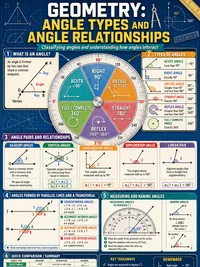
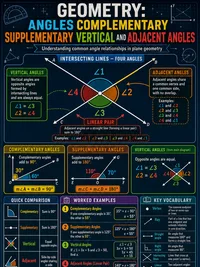
Complementary Angles
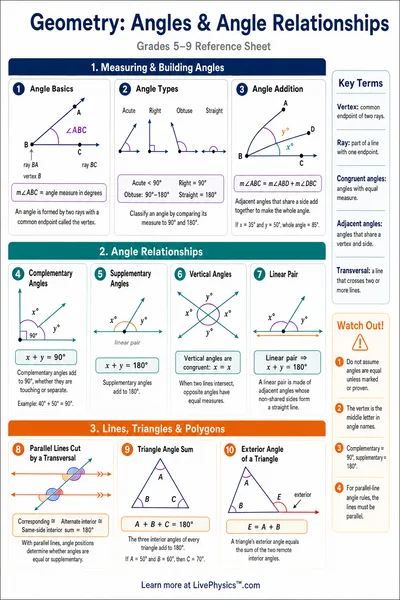
Two angles are complementary when they add up to exactly 90°. They fit together to form a right angle.
Rule, A + B = 90°, so B = 90° - A.
Example, 30° and 60° are complementary.
Supplementary Angles
Two angles are supplementary when they add up to exactly 180°. They fit together to form a straight line.
Rule, A + B = 180°, so B = 180° - A.
Example, 60° and 120° are supplementary.
Vertical Angles
When two straight lines cross, they form two pairs of vertical angles (also called opposite angles). Vertical angles are always equal.
Rule, opposite angles are equal. Adjacent angles are supplementary.
Example, if one angle is 70°, the angle directly across is also 70°.
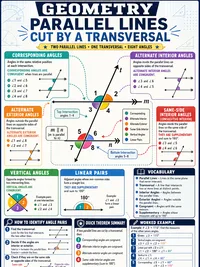
Parallel Lines and Transversal
A transversal crossing two parallel lines creates 8 angles. These fall into two equal groups, all the acute angles are equal, and all the obtuse angles are equal.
Corresponding angles. Same position at each intersection. Always equal.
Alternate interior angles. On opposite sides of the transversal. Always equal.
Co-interior angles. Same side of transversal, between the lines. Sum to 180°.