Shape Classifier Lab
Examine 12 shapes one at a time. Study their sides, angles, parallel pairs, and lines of symmetry, then sort them into families, triangles, quadrilaterals, and polygons.
Guided ExperimentShape Classifier Lab
Before you explore, predict, what properties do you think all quadrilaterals share? How are triangles different from quadrilaterals?
Write your hypothesis in the Lab Report panel, then click Next.
Shape 1 of 12: Square
Properties
Controls
Data Table
(0 rows)| # | Shape Name | Sides | Right Angles | Parallel Pairs | Lines of Symmetry | Family |
|---|
Reference Guide
Triangle Families
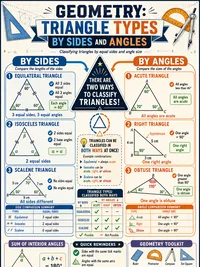
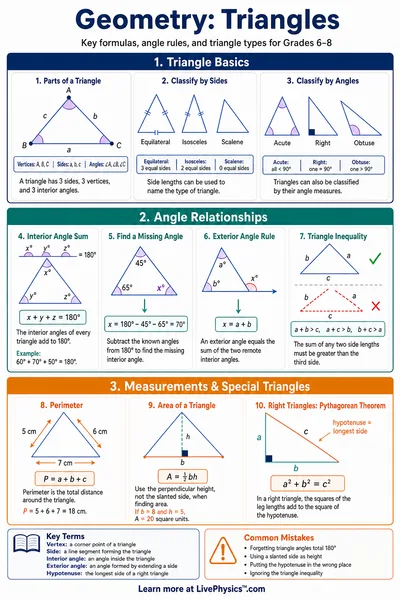
Equilateral. All 3 sides are equal and all 3 angles are equal (60° each). Three lines of symmetry.
Isosceles. Two sides are equal. One line of symmetry running through the apex.
Scalene. No sides are equal and no angles are equal. Zero lines of symmetry.
Right. One angle is exactly 90°. Zero lines of symmetry.
Quadrilateral Hierarchy
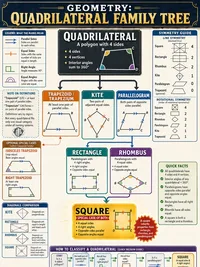
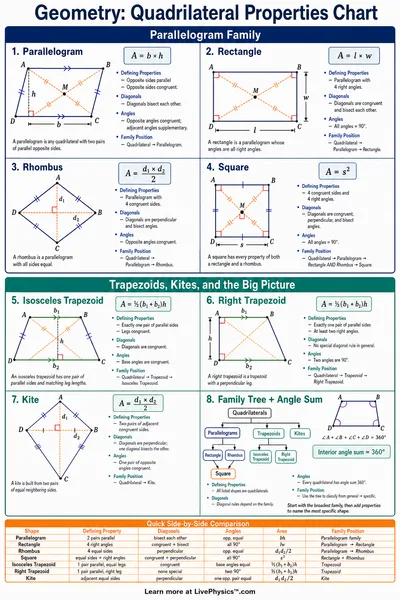
Parallelogram. Two pairs of parallel sides. Opposite sides and angles are equal.
Rectangle. A parallelogram where all four angles are right angles (90°).
Rhombus. A parallelogram where all four sides are equal in length.
Square. All four right angles AND all four sides equal. Both a rectangle and a rhombus.
Properties to Watch
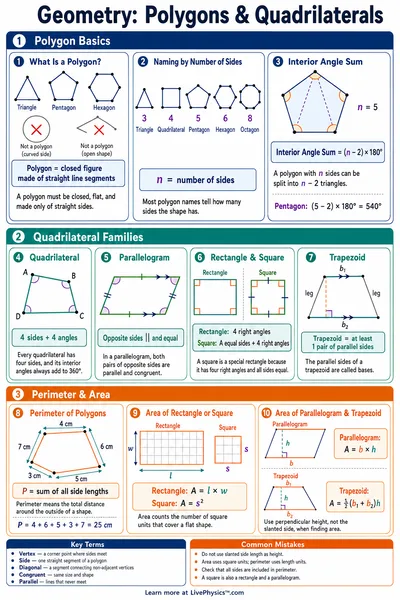
Parallel pairs. Sides that run in the same direction and never meet, no matter how far they are extended.
Right angles. Corners that measure exactly 90°. A small square symbol in the corner marks them.
Lines of symmetry. Imaginary fold lines that split the shape into two mirror-image halves.
Analysis Questions
- Which quadrilaterals have all sides equal? Which have all angles equal? Which have both?
- How does the number of lines of symmetry relate to the number of sides in regular polygons?
- What makes a square different from a rectangle? What makes a rhombus different from a parallelogram?
- Why does the circle stand apart from all the other shapes in terms of symmetry?