Symmetry & Pattern Blocks Lab
Explore lines of symmetry in 10 different shapes. Toggle fold lines to discover whether each shape has vertical, horizontal, or diagonal symmetry, then record your data and look for patterns.
Guided ExperimentSymmetry & Pattern Blocks Lab
Before you start exploring, write a prediction, which shapes do you think will have the most lines of symmetry, and why?
Write your hypothesis in the Lab Report panel, then click Next.
Shape 1 of 10: Square
Toggle each symmetry line to test whether it folds this shape onto itself perfectly. Green means it is a real line of symmetry. Red means it is not.
Symmetry lines
Controls
Data Table
(0 rows)| # | Shape | Vertical Line? | Horizontal Line? | Diagonal Line? | Total Lines |
|---|
Reference Guide
What Is a Line of Symmetry?
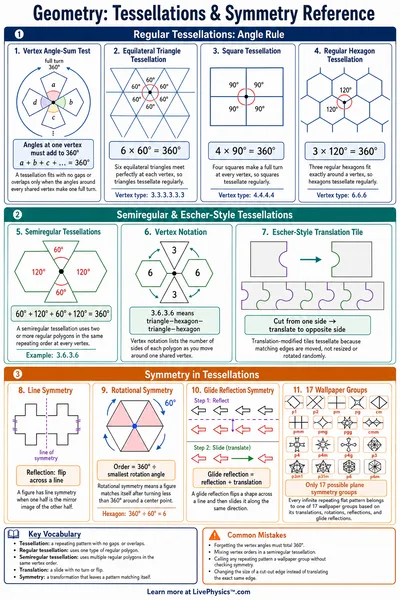
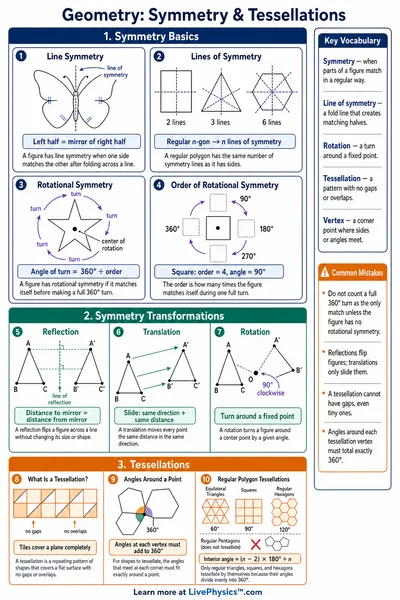
A line of symmetry divides a shape into two halves that are exact mirror images of each other. If you fold the shape along that line, both sides match perfectly.
Vertical A fold line running top to bottom through the center.
Horizontal A fold line running left to right through the center.
Diagonal A fold line running corner to corner at 45 degrees.
Shapes in This Lab
Square 4 lines of symmetry (vertical, horizontal, 2 diagonal).
Rectangle 2 lines (vertical, horizontal only).
Equilateral Triangle 3 lines (one per vertex).
Circle Infinite lines through the center.
5-Point Star 5 lines, one per point.
Pattern to Watch For
Regular polygons (all sides equal, all angles equal) have the same number of lines of symmetry as they have sides.
A square (4 equal sides) has 4 lines. An equilateral triangle (3 equal sides) has 3 lines. A regular hexagon would have 6 lines.
Irregular shapes and letters often break this pattern, which is why they are interesting to study.
Analysis Questions
1. Which shape has the most lines of symmetry? Why?
2. Can two shapes with the same number of sides have different symmetry counts?
3. Do any shapes have horizontal symmetry but not vertical? What do they look like?
4. Why does the circle have infinite lines of symmetry?