Sun, Shadows and Daylight Lab
Watch how shadows change as the sun moves across the sky throughout the day. Compare summer and winter daylight hours and discover why noon shadows are the shortest.
Guided ExperimentSun and Shadows Investigation
Before you start, predict, when during the day do you think shadows are longest? When are they shortest? Write your prediction.
Write your hypothesis in the Lab Report panel, then click Next.
Controls
Choose a season
Choose a time of day
Sun Position
High
Season
summer
Data Table
(0 rows)| # | Time | Season | Shadow Length | Shadow Direction | Sun Position |
|---|
Reference Guide
How Shadows Form
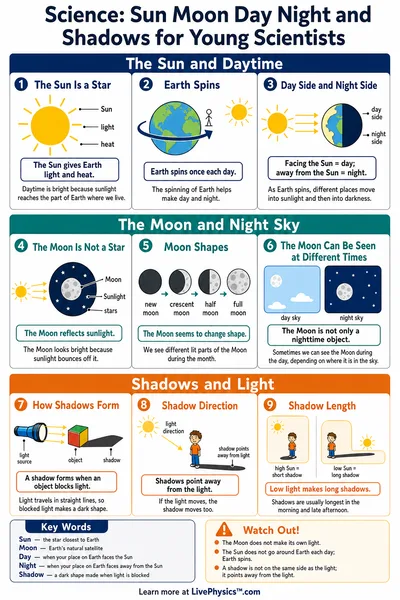
A shadow forms when an object blocks sunlight. The sun shines in a straight line, so anything solid casts a dark area behind it.
- Low sun. Long shadows form because the sun's rays hit at a steep angle from the side.
- High sun. Short shadows form because the rays come nearly straight down from above.
- No sun. No shadow forms at night because there is no sunlight to block.
The Sun Across the Sky
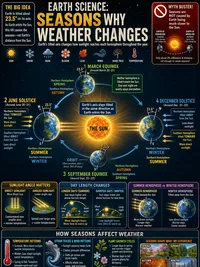
The sun appears to move across the sky each day because Earth rotates. It rises in the east, moves upward until noon, then arcs back down toward the west.
- Morning (east). Sun is low; shadows point west.
- Noon (south). Sun is highest; shadows point north and are shortest.
- Afternoon (west). Sun drops back down; shadows point east and grow longer.
Seasons and Daylight
The tilt of Earth changes how high the sun gets and how many hours of daylight each day has.
- Summer. The sun travels a higher arc, daylight lasts about 14 hours, and noon shadows are shorter.
- Winter. The sun travels a lower arc, daylight lasts about 10 hours, and noon shadows are longer.
- In winter the sun may still be below the horizon at 6am and 6pm, so there is no shadow at those times.
Measuring Shadows
Scientists describe shadows using two measurements.
- Length. How long is the shadow? It is compared to the height of the object that made it. Short noon shadows may be less than half the object's height; very long morning shadows can be twice as long.
- Direction. Which way does the shadow point? Morning shadows point west; afternoon shadows point east; noon shadows point north.