Sign in to save

Bookmark this page so you can find it later.

Sign in to save

Bookmark this page so you can find it later.

Sun, Shadows & Daylight Explorer

See how shadows change through the day. Move the time slider and watch the sun travel across the sky while shadows grow and shrink. Compare daylight hours across seasons and locations.

Try a preset

9 AM
6 AM12 PM6 PM8 PM
Object:
Sun angle: 64°Shadow length: 30 unitsHigher sun = shorter shadow
9 AMSun angle: 64°

Shadow Challenge

At what time of day is your shadow the shortest?

Reference Guide

How Shadows Form

Light travels in straight lines from the sun. When an object blocks the light, a dark area called a shadow appears on the opposite side. Shadows always point away from the light source.

In the morning the sun is in the east, so shadows point west. In the afternoon the sun moves to the west, so shadows point east.

Sun Angle and Shadow Length

When the sun is high in the sky (like at noon), it shines almost straight down. This makes short shadows. When the sun is low (morning or evening), it shines at a steep angle and makes long shadows.

The higher the sun, the shorter the shadow. The lower the sun, the longer the shadow. At noon, shadows are the shortest they will be all day.

The Sun's Path

The sun appears to move across the sky from east to west during the day. It rises in the east, climbs to its highest point around noon, then sinks toward the west by sunset.

The sun does not actually move around us. Earth spins on its axis, which makes the sun appear to travel across the sky.

Daylight Through the Year

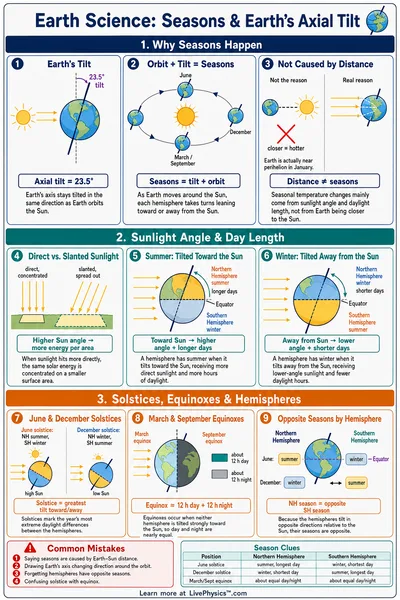
Summer has longer days because Earth is tilted on its axis. In summer, your part of Earth tilts toward the sun, so the sun stays up longer and days have more daylight hours.

Near the equator, days are about 12 hours long all year. Farther from the equator (like the US or Europe), summer days can be 15 hours and winter days only 9 hours.

Related Content

Related Tools

Earthquake Magnitude Calculator
Four modes: magnitude scales (Richter Mₗ, moment magnitude M𝑤, energy), energy comparison (each step = 31.6× more energy, logarithmic bar chart), Modified Mercalli Intensity I-XII with descriptions, and Richter magnitude from seismograph amplitude. Presets include Minor M3 through Great M8, 1906 San Francisco M7.9, and 2011 Japan M9.1.
Carbon Footprint Calculator
Estimate annual CO₂ emissions from transportation (car miles, fuel type, flights), home energy (electricity, heating, AC), diet (meat consumption, food waste), and lifestyle (shopping, recycling). Pie chart breakdown, country comparison bar chart, trees-to-offset and equivalent-driving metrics. Five presets: Average American, Eco-Conscious, Heavy Commuter, Frequent Flyer, Work from Home.
Star Lifecycle Visualizer
Three modes: interactive HR diagram with 23 real stars (click to see properties), stellar evolution pathway from nebula to end state (white dwarf, neutron star, or black hole based on initial mass), and star properties calculator (luminosity L∝M^3.5, radius, lifetime t∝M^-2.5, apparent magnitude). Six presets: Sun, Red Dwarf (0.3 M☉), Sirius A (2 M☉), Blue Giant (20 M☉), Betelgeuse (15 M☉), Supergiant (50 M☉). Includes spectral class colour strip and SVG star visualization.
H-R Diagram Explorer
Three modes: plot a single star on the Hertzsprung-Russell diagram from temperature, radius, and mass (Stefan-Boltzmann luminosity, spectral class O-M, absolute magnitude, HR region); compare multiple stars side by side; and browse the spectral atlas with typical properties for each class. 23 reference stars plotted, 6 presets from Proxima Centauri to Rigel.