Understanding Mechanism Design Explorer
A mechanism is a set of rigid parts connected so that motion is controlled rather than random. Designers use mechanisms when a motor must produce a particular path, timing, or force direction.
A planar mechanism moves mostly in one flat plane, like the linkage inside a windshield wiper or a folding desk lamp. Treating the motion as flat makes the geometry easier to calculate and draw.
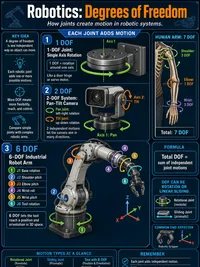
Degrees of freedom describe how many independent inputs a mechanism needs. A common four-bar linkage has one degree of freedom, so turning one link fixes the position of every other link.
This count matters because a mechanism with too many free motions may wobble or need extra control. A mechanism with no available motion is a structure, which can be useful for a bridge but not for a moving machine.
Link length choices decide whether a four-bar can rotate continuously or must rock back and forth. This is important in pumps, pedals, engine parts, and packaging machines where repeated motion must not jam.
The shortest link may act as a crank when the link lengths meet the required relationship. If that condition is not met, the links can reach a limiting position and reverse direction instead of completing a full turn.
The transmission angle shows how effectively one moving link pushes another through a joint. When this angle becomes very small or very large, the mechanism can need more force and can become sensitive to friction or bending.
Students should watch for positions where the links nearly line up in a straight line. These are called toggle positions, and they can create a strong locking effect or cause motion to become difficult to start.
A coupler point is any marked point attached to a moving link between two joints. Its path can be a loop, an arc-like curve, or a shape with sharp changes in direction, which makes it useful for guiding tools or moving objects.
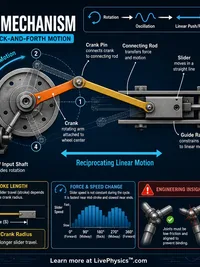
Crank-slider mechanisms change rotary motion into straight-line motion. A piston in an engine is a familiar example, where a rotating crank makes the piston move back and forth inside a cylinder.
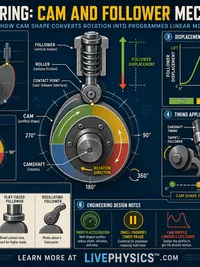
Cam-follower systems use a shaped rotating cam to prescribe motion at chosen times. The cam profile can create a smooth rise, a pause called dwell, then a return, as used in valves, automated feeders, and mechanical toys.
Smooth motion is not only about position because sudden changes in speed or acceleration create vibration and noise. When comparing designs, pay attention to extreme angles, rapid follower motion, and whether the required path is achieved without impractical link lengths.