Full Pendulum Investigation Lab
A full-workflow physics investigation. Choose an investigation, state your hypothesis, identify the independent and dependent variables, collect replicated trials, fit a regression line, and analyze residuals and percent error.
Choose an Investigation
Investigation A. Period vs Length (derive g)
How does pendulum period depend on length, and what does the slope of T² vs L tell us about gravity?
Length L (vary from 0.25 m to ~1.5 m)
Period T (averaged from 3 timing trials)
- Mass (constant)
- Release angle (small, ~10°)
- Local gravity g (assumed constant)
Predict the shape of the T vs L curve. What relationship should appear when you plot T² vs L? What does the slope represent?
T² vs L is linear with slope 4π²/g. On Earth this slope is ≈ 4.027 s²/m. R² should exceed 0.99 with careful timing.
- Record 6 to 8 trials at different lengths (keep mass and angle fixed)
- Verify T² vs L is linear (R² near 1)
- Calculate g from the slope: g = 4π² / slope
- Compute percent error vs the accepted local gravity
- Identify which trials contributed the largest residuals
Setup
Each "Record Trial" simulates 3 stopwatch timings of 10 oscillations with realistic reaction-time scatter (±0.08 s). The recorded T is the average of those three trials.
Current Setup
T² (s²) vs Length L (m)
Record at least 2 trials (or load sample data) to see the regression line.
Regression & Error Analysis
Record at least 2 trials to compute the regression. For a defensible fit you should collect 6 or more trials across the full range of the IV.
Data Table
(0 rows)| # | Trial | Length (L)(m) | Mass (m)(kg) | Angle (θ)(°) | Period T (avg of 3)(s) | T std dev(s) | T²(s²) | Derived g(m/s²) |
|---|
Reference Guide
Investigation Workflow
A scientific investigation needs more than a single measurement. It needs a hypothesis, a clear independent and dependent variable, repeated trials, a fit line, and an honest error analysis.
- State a testable hypothesis
- Identify IV, DV, and controlled variables
- Record at least 6 replicated trials across the range of the IV
- Fit a regression line and inspect residuals
- Quote a final value with uncertainty and percent error
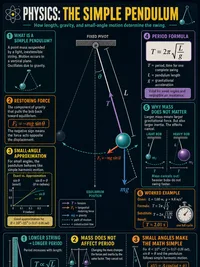
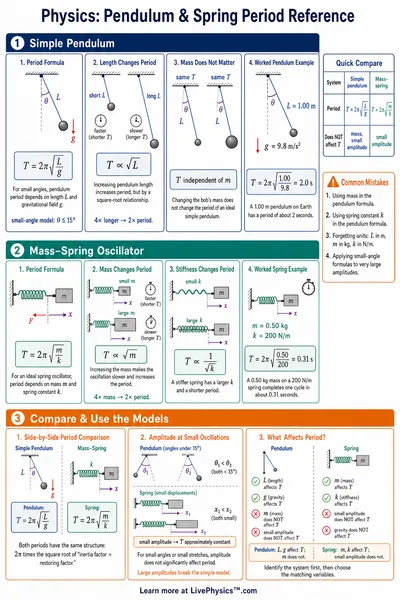
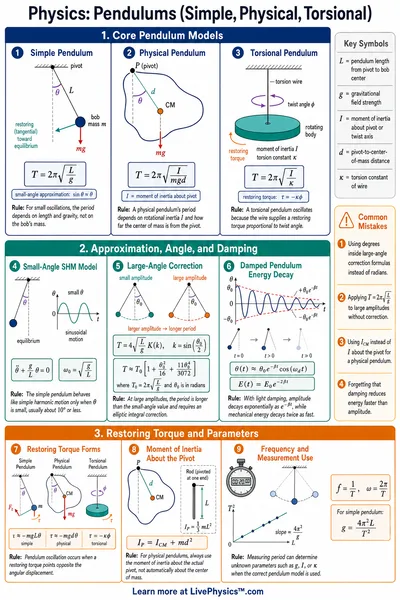
Pendulum Period
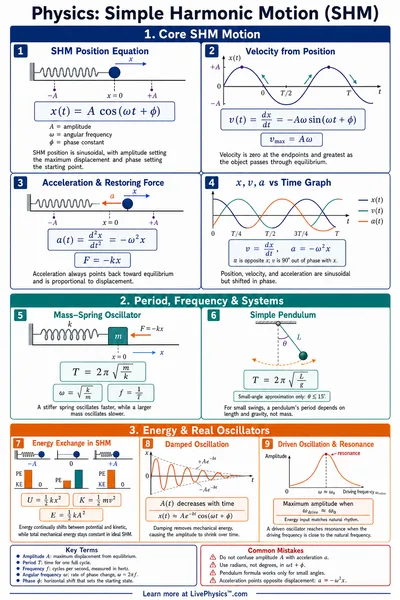
For a small initial angle, the period of a simple pendulum is
Period grows with length and shrinks with gravity. Mass cancels out of the equation of motion, so changing the bob mass should not change the period.
Deriving g from T² vs L
Squaring the period formula gives a linear relationship in L
The slope of T² vs L equals 4π²/g, so the experimental gravity is
A higher R² and smaller slope uncertainty give a more reliable derived g. With careful timing R² should exceed 0.999.
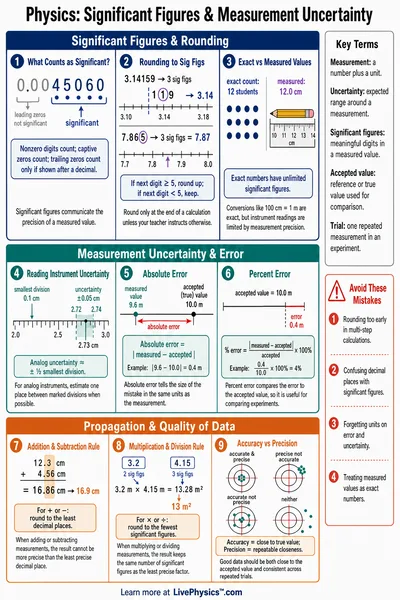
Error Analysis
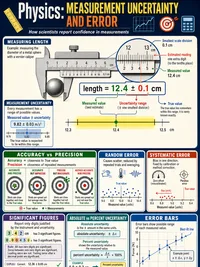
Quote the derived value with both uncertainty and percent error
Slope uncertainty propagates to g via the relative-error rule δg/g = δslope/slope. Inspect residuals for systematic patterns; a U-shape points to a large-angle effect, while a linear drift can indicate a miscalibrated length measurement.