Practice solving separable, linear, logistic, and second-order differential equations, and interpret solutions using initial conditions and models.
Read each problem carefully. Show your work in the space provided. State any constants of integration and use initial conditions when given.
Solving and interpreting first-order and second-order differential equations
Calculus - Grade advanced
- 1
Solve the separable differential equation dy/dx = 3x^2 y, where y > 0.
- 2
Find the particular solution to dy/dx = 2x(y + 1) with initial condition y(0) = 3.
- 3
Solve the linear differential equation dy/dx + 2y = e^x.
- 4
Solve the initial value problem dy/dx - y = x, with y(0) = 2.
- 5
A population P satisfies the exponential growth model dP/dt = 0.08P. If P(0) = 500, find P(t) and determine the population after 10 years.
- 6
A cooling object follows Newton's law of cooling: dT/dt = -0.2(T - 20), where T is measured in degrees Celsius and t is measured in minutes. If T(0) = 80, find T(t).
- 7
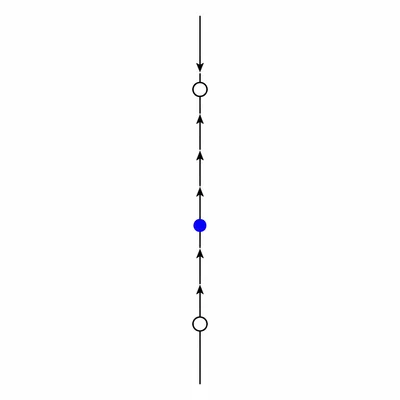
For the logistic equation dP/dt = 0.4P(1 - P/1000), identify the carrying capacity and determine whether P is increasing or decreasing when P = 300.
- 8
Solve the logistic differential equation dP/dt = 0.5P(1 - P/200) with P(0) = 50.
- 9
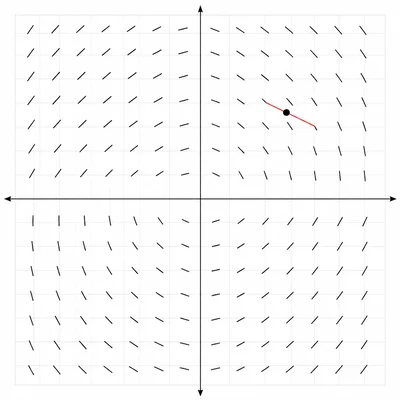
Use the slope field for dy/dx = x - y to estimate the sign of the slope at the point (2, 5), and explain what that means for a solution curve passing through that point.
- 10
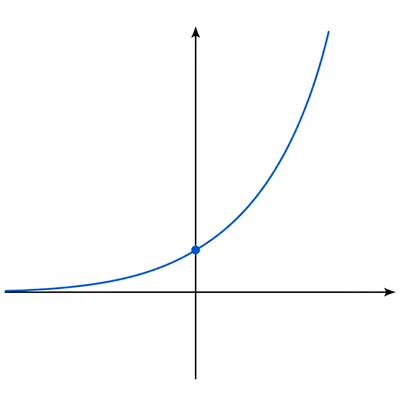
Sketch or describe the solution curve through (0, 1) for the differential equation dy/dx = y. What is the exact solution?
- 11
Solve the second-order differential equation y'' - 5y' + 6y = 0.
- 12
Solve the second-order differential equation y'' + 4y = 0.
- 13
Solve y'' + 2y' + 5y = 0.
- 14
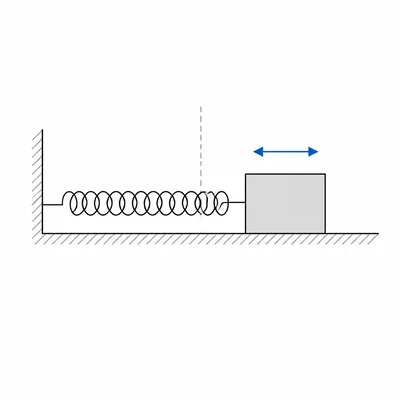
A mass-spring system is modeled by x'' + 9x = 0, where x is displacement from equilibrium. If x(0) = 2 and x'(0) = 0, find x(t).
- 15
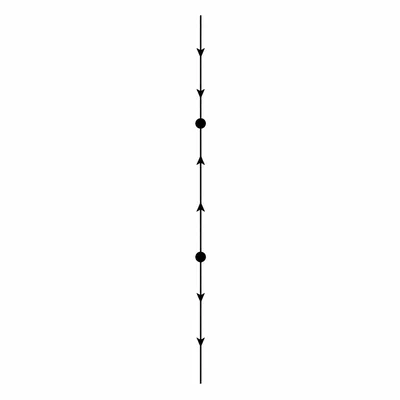
Match the phase line behavior for dP/dt = P(4 - P): identify the equilibrium solutions and classify each as stable or unstable.