Practice interpreting phylogenetic trees, identifying clades, using outgroups, and applying cladistic reasoning to evolutionary relationships.
Read each problem carefully. Use evidence from the tree, character data, or description to support your answer. Show your reasoning in the space provided.
Reading evolutionary relationships using shared derived traits
Biology - Grade 9-12
- 1
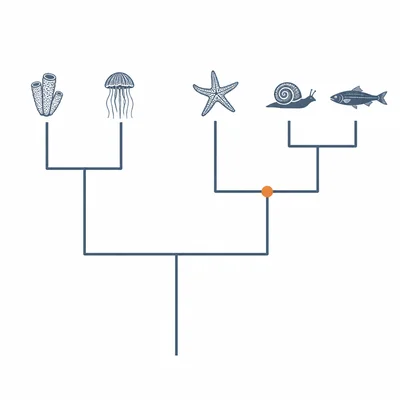
In a phylogenetic tree, what does a node represent, and what do the branch tips usually represent?
- 2
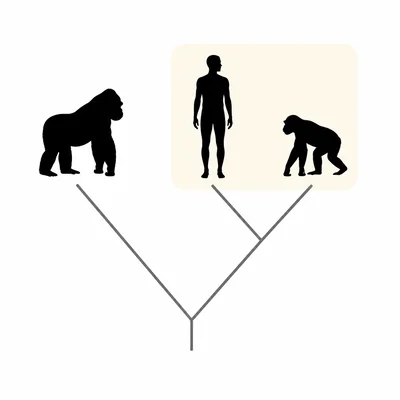
A tree shows that humans and chimpanzees share a more recent common ancestor with each other than either shares with gorillas. Which two groups are sister taxa?
- 3
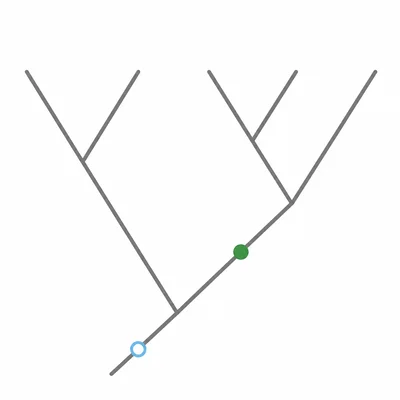
Explain the difference between an ancestral trait and a derived trait in cladistics.
- 4
Use this character information: Species A has a backbone only. Species B has a backbone and four limbs. Species C has a backbone, four limbs, and amniotic eggs. Species D has a backbone, four limbs, amniotic eggs, and hair. Which species is most closely related to Species D?
- 5
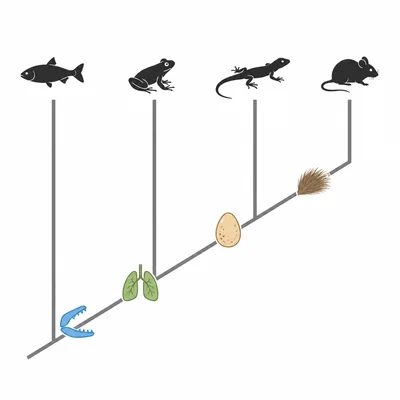
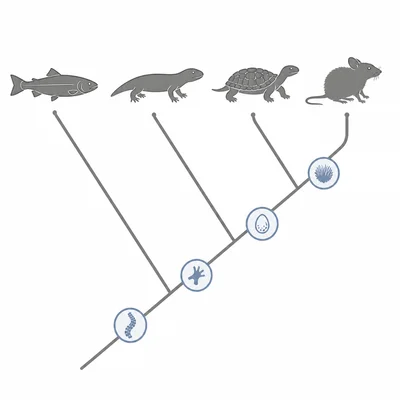
A cladogram places a fish, frog, lizard, and mouse in that order from the outgroup toward the most derived branch. The derived traits appear in this order: jaws, lungs, amniotic egg, hair. Which trait separates lizard and mouse from fish and frog?
- 6
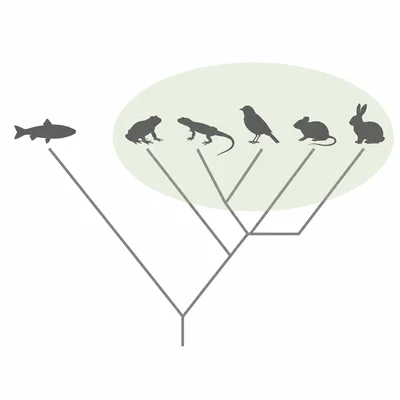
Why is an outgroup included when building or interpreting a phylogenetic tree?
- 7
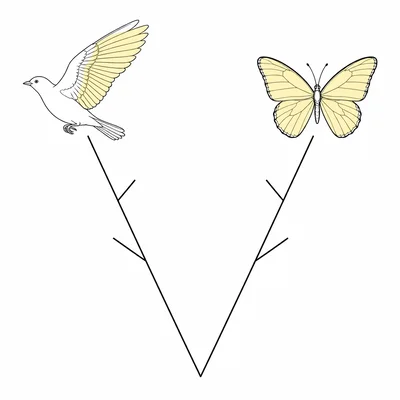
Two organisms both have wings: a bird and a butterfly. Explain why wings in this case may not be strong evidence that birds and butterflies are close relatives.
- 8
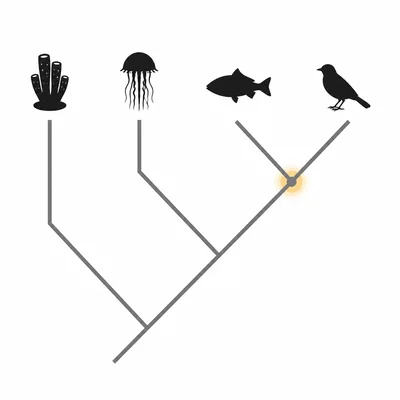
A phylogenetic tree shows Species X branching off first, then Species Y, while Species Z and Species W share the most recent node. Which species is least closely related to Species W?
- 9
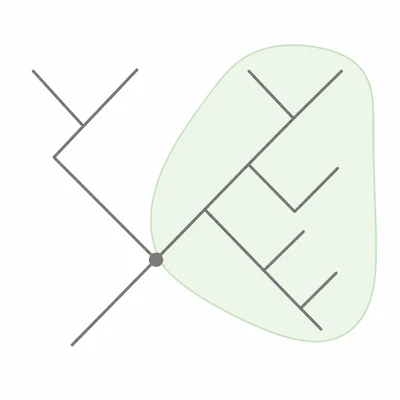
What is a clade?
- 10
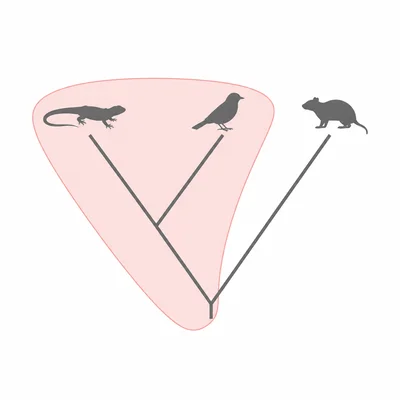
A group includes reptiles and birds but excludes mammals. If the common ancestor of reptiles, birds, and mammals is included in the group, is this group a clade? Explain.
- 11
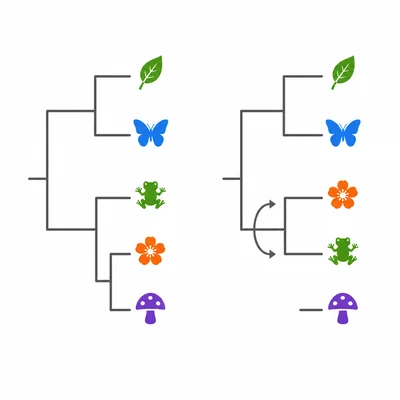
Two trees show the same relationships among A, B, C, and D. In one tree, B and C are drawn on opposite sides of a node compared with the other tree. Does rotating branches around a node change the evolutionary relationships? Explain.
- 12
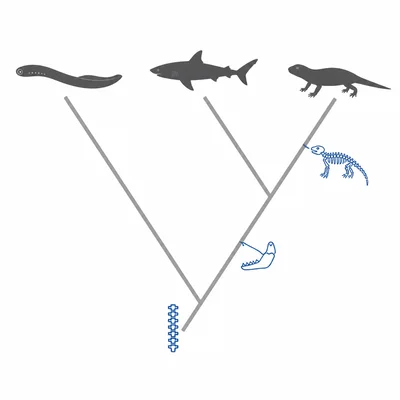
A character matrix shows that Species 1, 2, and 3 all have a vertebral column. Species 2 and 3 have a hinged jaw. Only Species 3 has a bony skeleton. Which trait is the most derived among these traits?
- 13
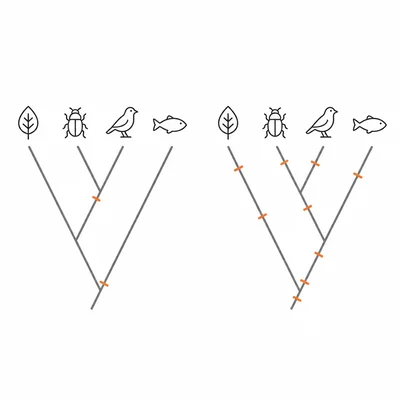
Explain how the principle of parsimony is used in cladistics.
- 14
A DNA comparison shows that Species A and Species B differ by 4 nucleotide changes, Species A and Species C differ by 18 changes, and Species B and Species C differ by 20 changes. Which two species are most closely related based on this evidence?
- 15
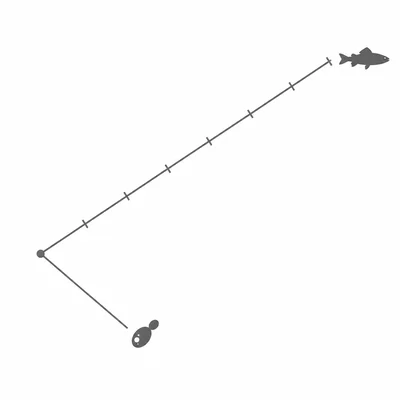
A phylogenetic tree has branch lengths proportional to genetic change. Branch A is much longer than Branch B. What does the longer branch length suggest?