Practice interpreting absorption spectra and applying the Beer-Lambert law to quantitative chemistry problems.
Read each problem carefully. Show your work and include units where appropriate.
Using absorbance, concentration, path length, and spectra
Chemistry - Grade 9-12
- 1
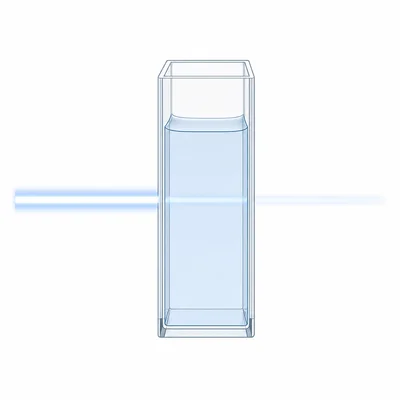
State the Beer-Lambert law and identify what each variable represents.
- 2
A solution has a molar absorptivity of 1.50 x 10^4 L mol^-1 cm^-1 at 520 nm. If the path length is 1.00 cm and the concentration is 2.00 x 10^-5 M, calculate the absorbance.
- 3
A sample in a 1.00 cm cuvette has an absorbance of 0.742 at its wavelength of maximum absorbance. The molar absorptivity is 3.71 x 10^3 L mol^-1 cm^-1. Calculate the concentration of the sample.
- 4
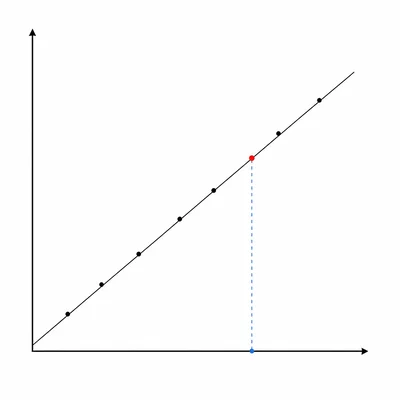
A calibration curve for a colored ion gives the equation A = 2450c + 0.012, where c is in mol/L. An unknown solution has an absorbance of 0.502. Calculate the concentration of the unknown.
- 5
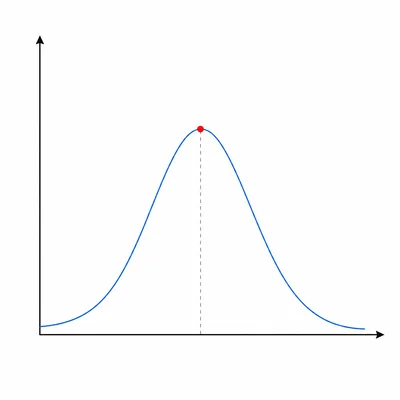
Explain why the wavelength of maximum absorbance, λmax, is usually chosen for quantitative spectrophotometric analysis.
- 6
A solution transmits 25.0 percent of the incident light at a certain wavelength. Calculate its absorbance.
- 7
Two solutions of the same absorbing species are measured in the same 1.00 cm cuvette at the same wavelength. Solution 1 has concentration 1.20 x 10^-4 M and absorbance 0.360. Solution 2 has concentration 2.40 x 10^-4 M. Predict the absorbance of solution 2.
- 8
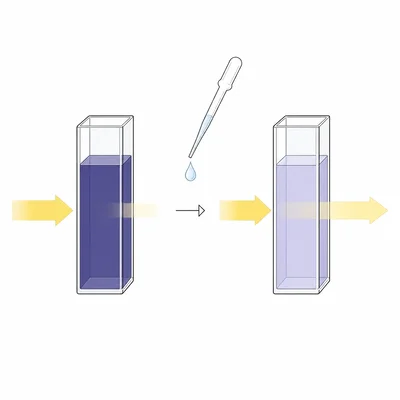
A student measures the absorbance of a solution and obtains A = 1.95. Explain why the student might dilute the solution before making a final concentration determination.
- 9
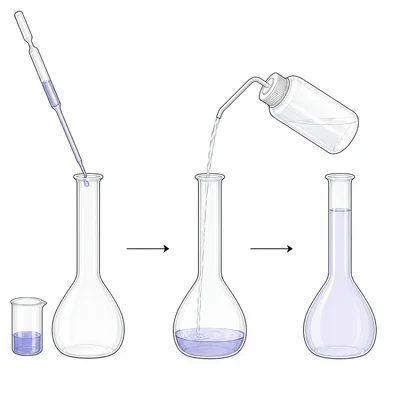
A 10.00 mL sample of an unknown solution is diluted to 50.00 mL. The diluted solution has a concentration of 3.60 x 10^-5 M based on spectrophotometric data. Calculate the concentration of the original unknown solution.
- 10
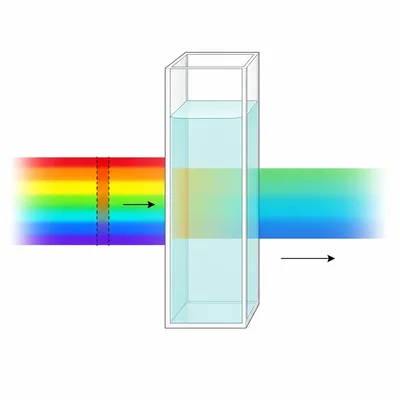
An absorption spectrum shows a strong peak at 620 nm. What color of visible light is most strongly absorbed, and what color might the solution appear to the eye?
- 11
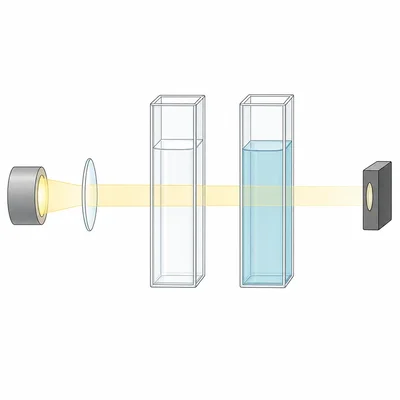
A blank cuvette is not used to zero a spectrophotometer before measuring samples. Describe one likely effect on the measured absorbance values and explain why this matters.
- 12
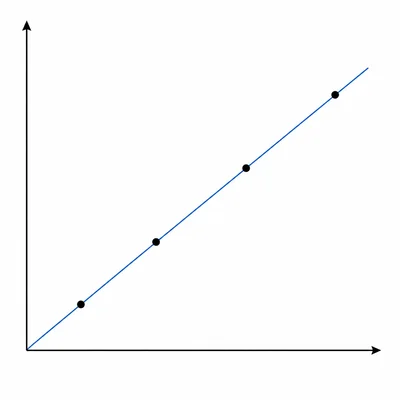
The following calibration data are collected for an absorbing species in a 1.00 cm cuvette: 0.00 x 10^-5 M gives A = 0.000, 1.00 x 10^-5 M gives A = 0.115, 2.00 x 10^-5 M gives A = 0.230, and 3.00 x 10^-5 M gives A = 0.345. Determine the molar absorptivity ε.