Practice evaluating hyperbolic functions, proving identities, graphing key features, and working with inverse hyperbolic functions.
Read each problem carefully. Show your work in the space provided. Use exact values when possible and round decimals to three decimal places when needed.
Using definitions, identities, graphs, and inverse functions
Math - Grade 9-12
- 1
Use the definitions sinh x = (e^x - e^(-x))/2 and cosh x = (e^x + e^(-x))/2 to find exact expressions for sinh(ln 3) and cosh(ln 3).
- 2
Prove the identity cosh^2 x - sinh^2 x = 1 using the exponential definitions of sinh x and cosh x.
- 3
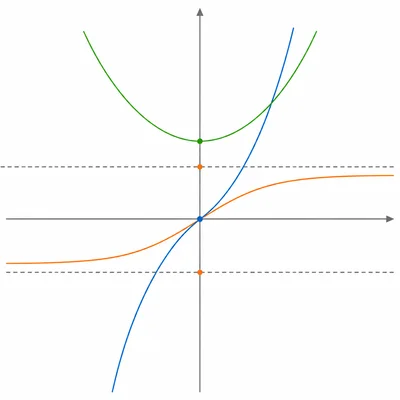
Evaluate tanh 0, sinh 0, and cosh 0. Explain what each value means on the graphs of the functions.
- 4
Use a calculator to approximate sinh 2, cosh 2, and tanh 2 to three decimal places.
- 5
Show that tanh x = sinh x/cosh x can be written as tanh x = (e^(2x) - 1)/(e^(2x) + 1).
- 6
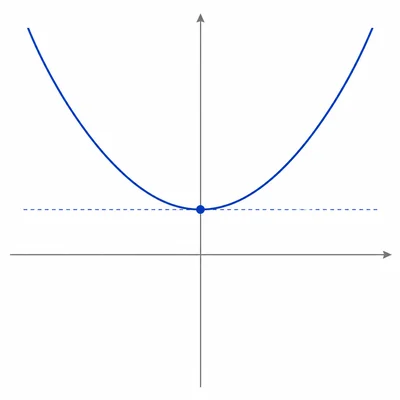
Describe the domain, range, and symmetry of y = cosh x.
- 7
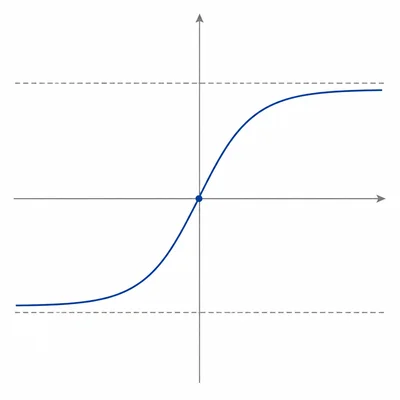
Describe the domain, range, horizontal asymptotes, and symmetry of y = tanh x.
- 8
Solve sinh x = 4 exactly. Write your answer using an inverse hyperbolic function and then as a natural logarithm.
- 9
Solve cosh x = 3. Give the exact solutions.
- 10
Find the exact value of arcosh(5/3).
- 11
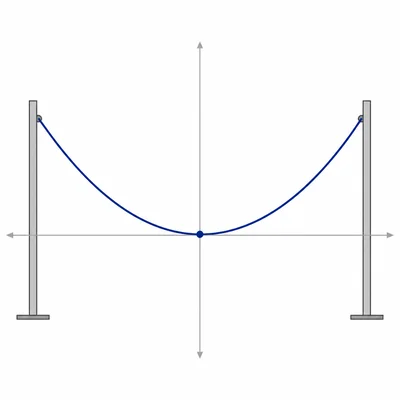
A hanging cable can be modeled by y = 2 cosh(x/2). Find the lowest point of the cable and the height of the cable at x = 4. Round the height to three decimal places.
- 12
Find the derivative of f(x) = arctanh(3x). State the interval of x-values where the function is defined.