Function Transformations Lab
See how changing parameters a, b, h, and k transforms a function's graph. Explore vertical and horizontal shifts, stretches, compressions, reflections, and inverse functions, all on a live coordinate plane.
Guided ExperimentVertical vs. Horizontal Shifts
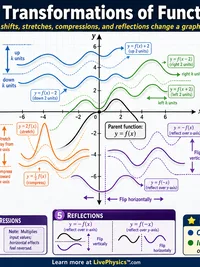
How do the parameters h and k affect the graph of a function? How does the direction of the shift relate to the sign of the parameter?
Write your hypothesis in the Lab Report panel, then click Next.
Graph
Controls
Transformed Function
Transformation Summary
No transformation (identity)
Inverse Function
Key Points
| Parent (x, y) | → | Transformed (x, y) |
|---|---|---|
| (-2, 4) | → | (-2, 4) |
| (-1, 1) | → | (-1, 1) |
| (0, 0) | → | (0, 0) |
| (1, 1) | → | (1, 1) |
| (2, 4) | → | (2, 4) |
Data Table
(0 rows)| # | Trial | Parent | a | b | h | k | Transformed Equation | Domain | Range |
|---|
Reference Guide
Vertical Transformations
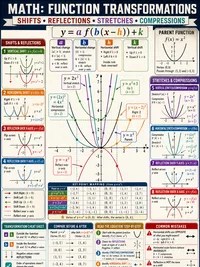
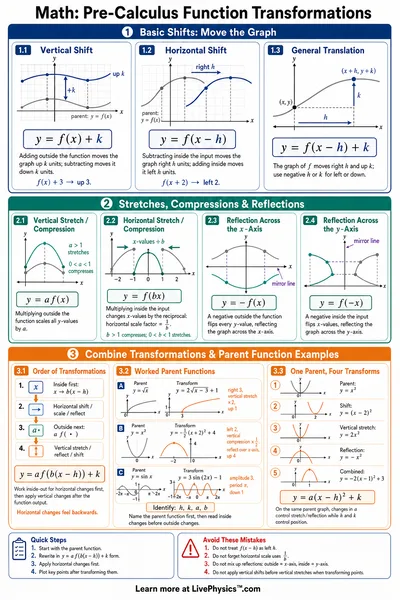
The parameter a stretches or compresses the graph vertically. The parameter k shifts it up or down.
When |a| > 1 the graph stretches taller. When 0 < |a| < 1 it compresses. Adding k shifts every point up (k > 0) or down (k < 0).
Horizontal Transformations
The parameter b compresses or stretches horizontally. The parameter h shifts left or right.
When |b| > 1 the graph compresses horizontally. Replacing x with (x - h) shifts right by h units. The horizontal direction is opposite to the sign.
Reflections
Negative values of a or b create reflections across the axes.
Setting a = -1 flips the graph over the x-axis. Setting b = -1 flips it over the y-axis. Both can be combined for a 180-degree rotation about the origin.
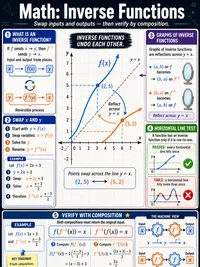
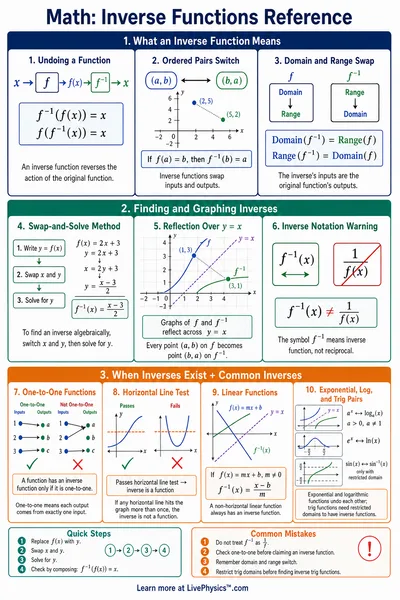
Inverse Functions
The inverse of a function "undoes" the original. Graphically, it reflects the function over the line y = x.
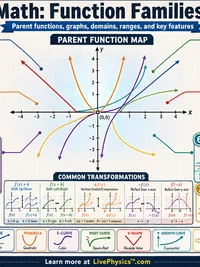
Only one-to-one functions have inverses that are also functions. Quadratic and absolute value require domain restrictions to have an inverse.