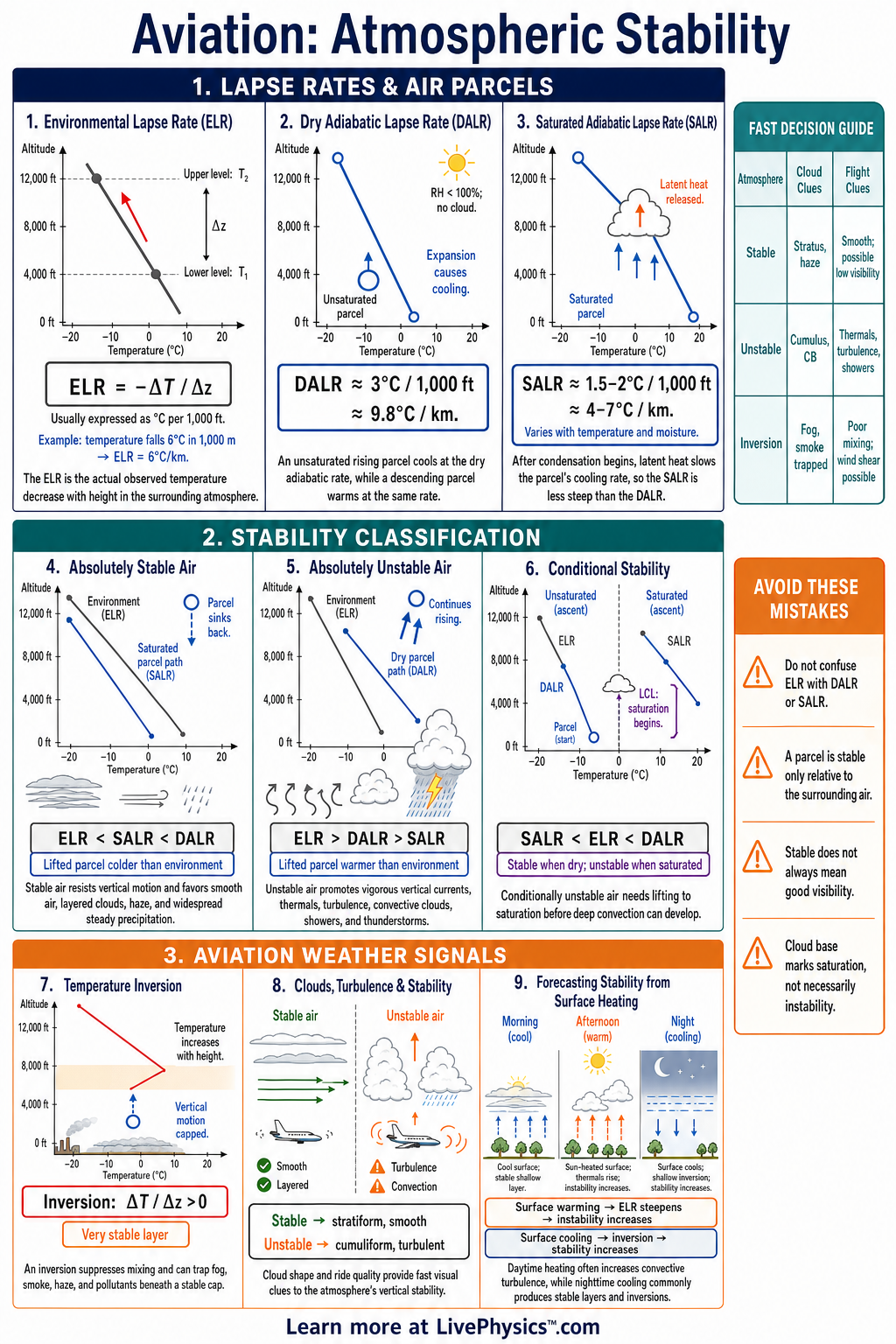
Atmospheric stability describes whether a lifted parcel of air keeps rising, sinks back, or stays near its new level. Pilots use stability to predict cloud forms, visibility, turbulence, precipitation, and the likely strength of vertical air currents. This cheat sheet organizes the key comparisons between parcel temperature and surrounding air temperature.
It supports practical weather interpretation before and during flight.
The central idea is the environmental lapse rate, which is the rate at which outside air temperature changes with height. A rising unsaturated parcel cools at the dry adiabatic lapse rate, while a saturated parcel cools more slowly at the moist adiabatic lapse rate. Stable air resists vertical movement, and unstable air supports it.
Temperature inversions are especially stable layers that can trap haze, smoke, and low cloud.
Key Facts
- Atmospheric stability is the tendency of displaced air to return to its original level or continue moving away from it.
- The environmental lapse rate is the actual rate at which surrounding air temperature changes with altitude.
- An unsaturated rising parcel cools at the dry adiabatic lapse rate of about 3 degrees Celsius per 1,000 feet.
- A saturated rising parcel cools at the moist adiabatic lapse rate of about 1.5 degrees Celsius per 1,000 feet.
- Air is unstable when a lifted parcel remains warmer and less dense than the surrounding air.
- Air is stable when a lifted parcel becomes cooler and denser than the surrounding air.
- A temperature inversion exists when air temperature increases with height through a layer.
- Unstable air commonly produces cumulus clouds, showers, thunderstorms, and turbulence, while stable air commonly produces stratus, haze, and smooth air.
Vocabulary
- Air parcel
- An air parcel is an imagined small body of air used to study how air moves and changes temperature.
- Atmospheric stability
- Atmospheric stability is the resistance or tendency of air to move vertically after being lifted or lowered.
- Environmental lapse rate
- The environmental lapse rate is the actual change in surrounding air temperature with increasing altitude.
- Dry adiabatic lapse rate
- The dry adiabatic lapse rate is the cooling rate of an unsaturated rising air parcel, about 3 degrees Celsius per 1,000 feet.
- Moist adiabatic lapse rate
- The moist adiabatic lapse rate is the slower cooling rate of a saturated rising parcel because condensation releases heat.
- Temperature inversion
- A temperature inversion is a layer where temperature rises rather than falls with increasing altitude.
Common Mistakes to Avoid
- Treating the environmental lapse rate as a fixed value is wrong because it is the observed temperature profile and can vary greatly between weather situations.
- Using the dry adiabatic lapse rate after cloud forms is wrong because a saturated parcel cools more slowly at the moist adiabatic lapse rate.
- Assuming stable air always means good flying weather is wrong because stable air can produce fog, low stratus, haze, icing, and poor visibility.
- Assuming every inversion creates clear weather is wrong because inversions can trap moisture and pollutants, causing low cloud and haze below the layer.
- Judging stability only from surface temperature is wrong because stability depends on the temperature relationship through the vertical atmosphere.
Practice Questions
- 1 An unsaturated parcel rises 3,000 feet. Using a dry adiabatic lapse rate of 3 degrees Celsius per 1,000 feet, how much does its temperature decrease?
- 2 A saturated parcel rises 4,000 feet. Using a moist adiabatic lapse rate of 1.5 degrees Celsius per 1,000 feet, how much does its temperature decrease?
- 3 An environmental lapse rate is 4 degrees Celsius per 1,000 feet. State whether this steep temperature decrease is more likely to support stable or unstable conditions.
- 4 Explain why a nighttime surface inversion can produce smooth air while also causing poor visibility near an airport.
Understanding Atmospheric Stability
Air stability is determined by comparing a displaced air parcel with the environmental air around it. An air parcel is a small imagined volume of air that rises or sinks without immediately mixing with its surroundings. If a lifted parcel is warmer than the surrounding air, it is less dense and continues to rise.
This creates instability. If the parcel is cooler and denser than its surroundings, it sinks toward its original level. This creates stability.
The environmental lapse rate is the actual temperature change measured in the atmosphere with increasing altitude. It changes by location, time, and weather situation. The dry adiabatic lapse rate applies to an unsaturated parcel.
It cools by about 3 degrees Celsius per 1,000 feet as it rises. The moist adiabatic lapse rate applies after condensation begins. It is usually about 1.5 degrees Celsius per 1,000 feet because released latent heat slows the cooling.
A steep environmental lapse rate means the outside air gets colder rapidly with height. This often makes a lifted parcel warmer than the air around it, so the parcel keeps rising. This condition favors thermals, cumulus clouds, showers, thunderstorms, and bumpy flying conditions.
Surface heating on a sunny afternoon can strengthen this pattern. Glider pilots often seek these rising currents, while pilots of small aircraft prepare for turbulence and changing cloud development.
A shallow lapse rate creates more stable conditions. Stable air tends to spread sideways rather than rise far upward. It commonly produces layered stratus clouds, smooth air, widespread fog, haze, and steady precipitation.
These conditions can reduce visibility for long periods. Stable air is not always safe or simple for aviation because fog, icing, and low ceilings may create major operational limits.
An inversion occurs when temperature increases with height through a layer. It is a strong form of stability because a rising parcel quickly becomes cooler than the air above it. Inversions often form overnight when the ground loses heat and cools the air near the surface.
They can also occur ahead of warm fronts or beneath sinking high pressure air. An inversion can cap convective clouds, but it can also trap pollutants, smoke, and moisture below it.
When studying, focus on reading a temperature sounding and comparing the parcel path with the environmental temperature profile. This comparison connects a chart directly to expected clouds and ride quality.