Understanding Gas Laws Lab
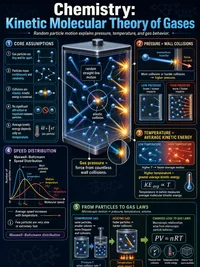
Gas behavior comes from countless particles moving randomly and colliding with container walls. Each collision gives a tiny push to a wall, and the combined pushes create pressure. Faster particles hit harder and more often, so heating a gas changes its behavior.
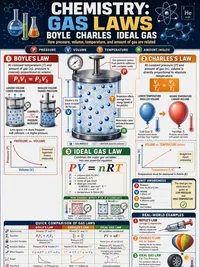
Volume is the space available for particles to travel. When the same number of particles is squeezed into less space, they reach the walls more frequently. This explains why pressure rises when a sealed gas is compressed at a steady temperature.
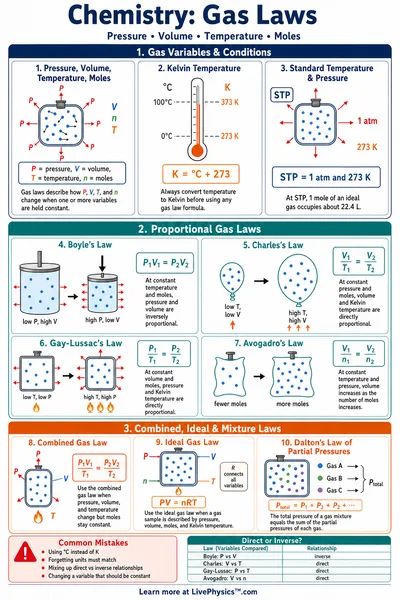
For temperature comparisons, scientists use kelvin rather than degrees Celsius. Kelvin begins at absolute zero, the theoretical point where particle motion is at its minimum. A temperature change of ten kelvin always represents the same size change, unlike a comparison using Celsius ratios.
A gas sample must be sealed when studying how pressure changes with temperature. If particles can escape, the amount of gas changes and the result no longer shows one clear relationship. A rigid container is useful because its volume stays fixed during heating or cooling.
A movable piston makes volume changes easier to study. External pressure pushes on the piston while gas particles push outward from inside. The piston settles when these pushes balance, which is why adding weights can compress the gas.
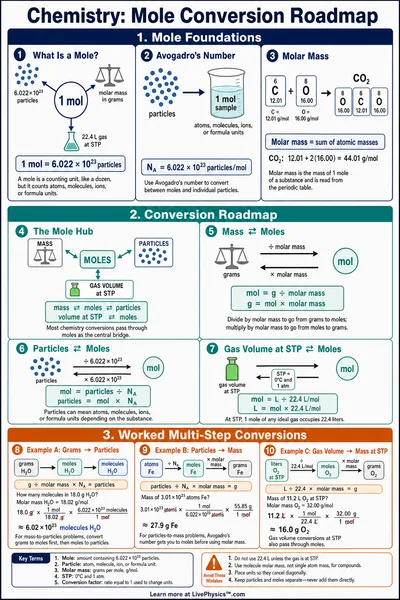
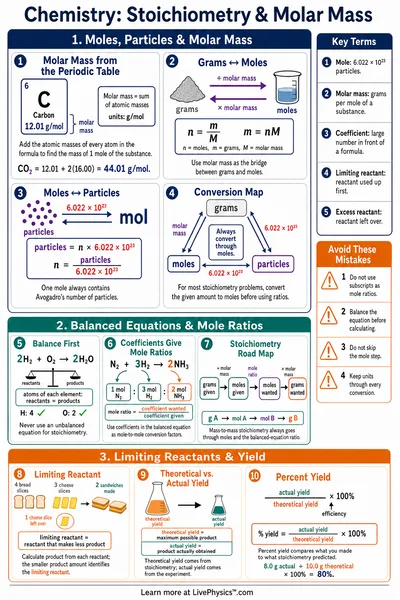
The number of moles tells how much gas is present. Adding more gas particles to the same container causes more wall collisions. At unchanged volume and temperature, this produces a greater pressure.
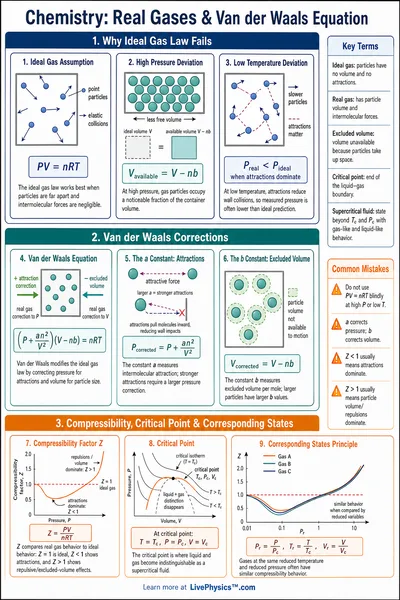
The ideal gas law combines the main variables in one model. It states that pressure times volume equals the number of moles times the gas constant times temperature. This model works best when particles are far apart and their attractions are weak.
Real gases do not behave perfectly under every condition. At very high pressure, particles take up a noticeable amount of space. At low temperature, attractive forces between particles matter more, especially when a gas is close to becoming a liquid.
Good laboratory tests change only one variable at a time. If temperature is meant to stay constant, wait long enough for the gas and its container to reach the same temperature. Record several trials because one measurement can be affected by reading errors or a small leak.
Graphs help reveal the pattern hidden in data. Pressure versus volume often makes a curved graph for a fixed gas sample. Plotting pressure against the reciprocal of volume produces a straighter pattern, which makes the relationship easier to test.
Gas laws appear in bicycle pumps, aerosol cans, car tires, and hot air balloons. A pump reduces volume and raises pressure, while a warmed balloon expands because its particles move faster. Tire pressure changes on cold days because the air inside has a lower temperature.
Pay close attention to units when solving gas law problems. Pressure may be measured in atmospheres or kilopascals, while volume may use liters. Convert values before calculating, and check whether the final answer makes physical sense for the situation.