Sign in to save

Bookmark this page so you can find it later.

Sign in to save

Bookmark this page so you can find it later.

Gas Collection over Water & Partial Pressure Lab

When a gas is collected by displacing water, the gas you trap is mixed with water vapor. Pick a gas, set the water-bath temperature, atmospheric pressure, and collected volume, and the lab subtracts the water vapor pressure to find the dry-gas partial pressure, then uses the ideal gas law to give the moles and mass of gas you actually collected.

Guided Experiment: Correcting for Water Vapor in Gas Collection

A gas is collected by displacing water in an inverted graduated cylinder. The space above the water is not pure gas. What else is mixed in with it, and how do you think that affects the pressure reading you would use in the ideal gas law?

Write your hypothesis in the Lab Report panel, then click Next.

Gas Collection over Water

H₂250 mL collectedWater levels equalized (gas at atmospheric pressure)

Controls

°C
mmHg
mL

Results

Water vapor pressure
23.8 mmHg
Dry-gas pressure
736.2 mmHg
Moles of dry gas
0.00990 mol
Mass collected
0.0200 g

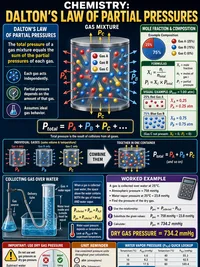
The collected gas is saturated with water vapor. By Dalton's law the dry-gas pressure is the total pressure minus the water vapor pressure at 25.0 °C. Use the dry-gas pressure in the ideal gas law to find the true moles collected.

Data Table

(0 rows)
#TrialGasTemp (°C)P total (mmHg)P water (mmHg)P dry gas (mmHg)Volume (mL)MolesMass (g)
0 / 500
0 / 500
0 / 500

Reference Guide

Collecting a Gas over Water

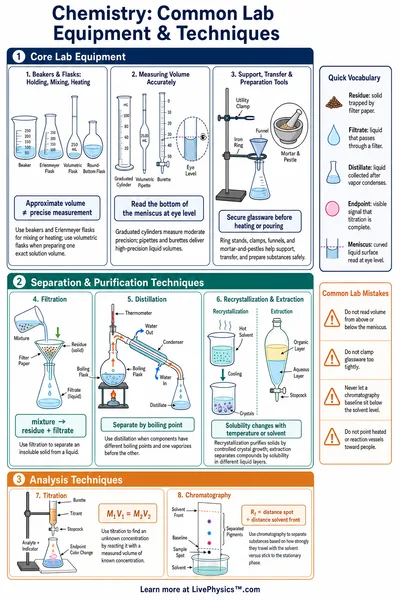
A gas produced by a reaction is bubbled into an inverted graduated cylinder or eudiometer that is full of water and standing in a water trough. As the gas rises it pushes the water down, and the volume it occupies can be read directly on the cylinder scale. This works well for gases that do not dissolve much in water, such as hydrogen, oxygen, and nitrogen.

Carbon dioxide is somewhat soluble, so collecting it over water underestimates the amount slightly. The trapped gas is never pure. It is always saturated with water vapor that has evaporated from the surface below it.

Dalton's Law of Partial Pressures

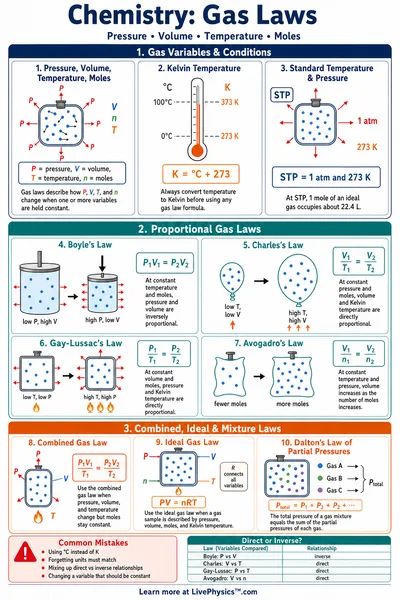
In a mixture of gases that do not react, each gas exerts the same pressure it would exert if it occupied the container alone. The total pressure is the sum of these partial pressures.

For gas collected over water the mixture is the dry gas plus water vapor, so the total pressure equals the dry-gas partial pressure plus the water vapor pressure. Rearranging gives the dry-gas pressure as the total minus the water vapor pressure.

The Water Vapor Correction

Water vapor pressure depends only on temperature, and it rises steeply as the water warms. At 20 °C it is about 17.5 mmHg, at 25 °C about 23.8 mmHg, and at 30 °C about 31.8 mmHg. These values come from a standard reference table, and the lab interpolates between them.

Subtracting the water vapor pressure at the measured temperature from the total pressure isolates the dry-gas pressure. Skipping this step overstates the moles of gas, and the error is largest when the water is warm.

The Leveling Step

Before reading the pressure, raise or lower the cylinder so the water level inside matches the water level in the trough outside. When the levels are equal there is no extra column of water pushing up or down, so the pressure of the trapped gas equals the atmospheric pressure in the room.

Without leveling you would need to add or subtract a water-column correction. Leveling lets you use the barometer reading directly as the total pressure of the gas mixture.

Finding Moles with the Ideal Gas Law

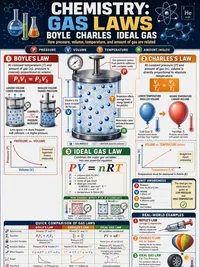
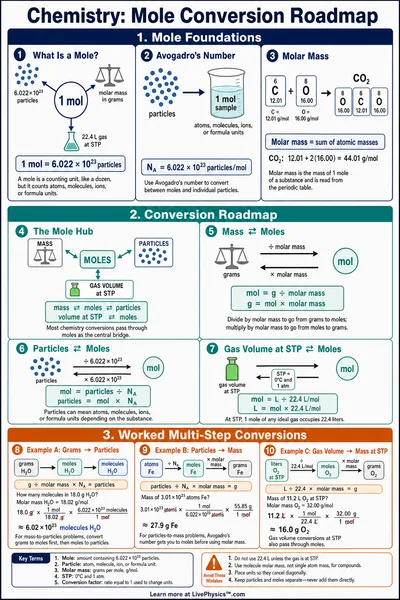
Once you have the dry-gas partial pressure, apply the ideal gas law n = PV / RT to find the moles collected. Convert the pressure from mmHg to atmospheres by dividing by 760, the volume from milliliters to liters by dividing by 1000, and the temperature from Celsius to Kelvin by adding 273.15. Use R = 0.082057 L·atm·mol⁻¹·K⁻¹.

Multiplying the moles by the molar mass of the gas gives the mass collected. Because the moles depend only on pressure, volume, and temperature, switching gases at the same conditions keeps the moles the same while the mass changes with molar mass.

Related Content