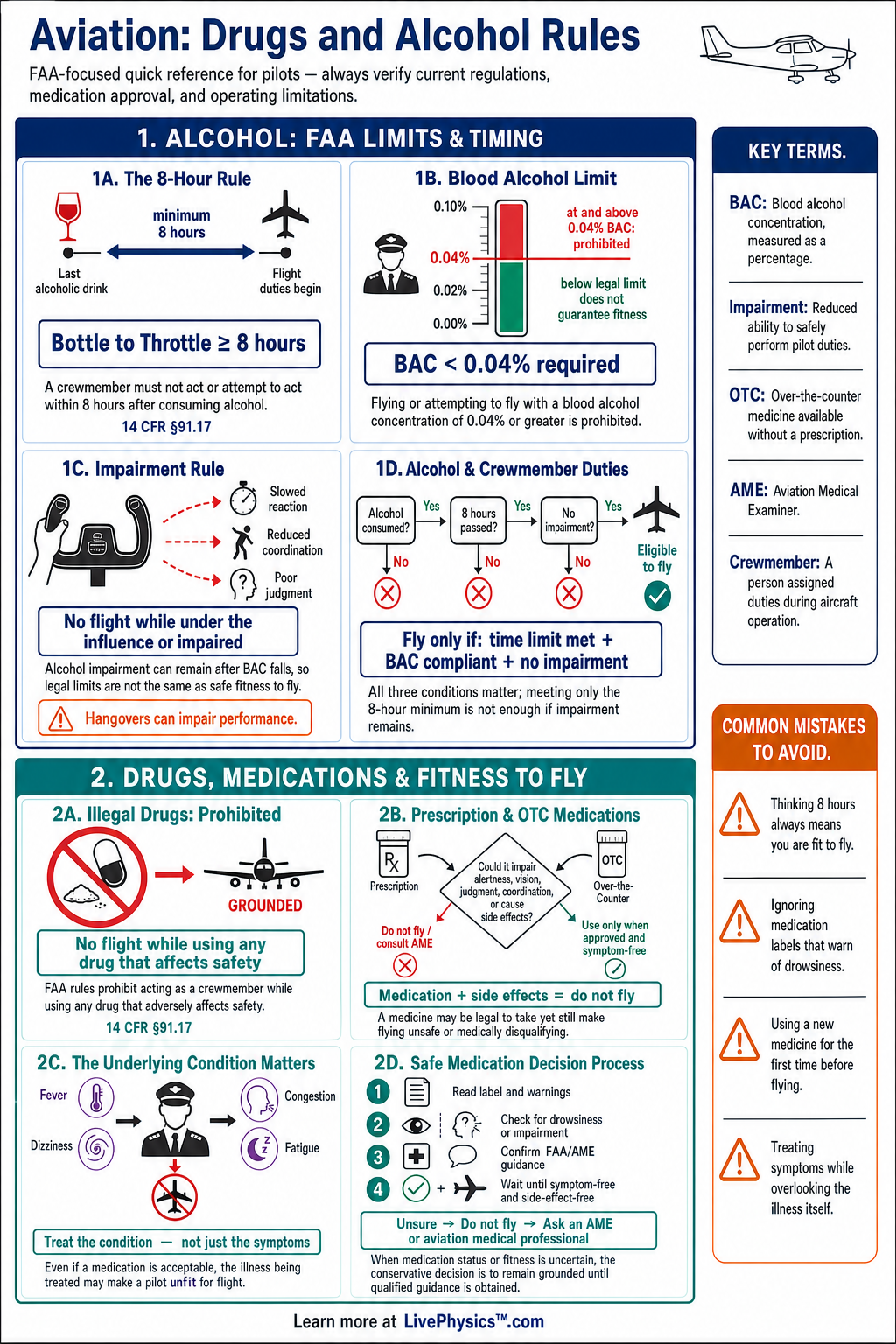
This cheat sheet summarizes key U.S. FAA rules on drugs, alcohol, medications, and fitness to fly. Student pilots need these rules because a legal flight can quickly become unsafe or unlawful when alcohol, impairing drugs, or medication side effects are involved. The rules apply to pilots, crewmembers, and other people performing safety-sensitive duties.
They are important for written tests, checkrides, and everyday aeronautical decision-making.
The central FAA regulation is 14 CFR 91.17, which sets alcohol limits and prohibits flying while under the influence of alcohol or drugs. The familiar bottle-to-throttle rule requires at least eight hours between drinking alcohol and acting as a crewmember, but eight hours alone does not guarantee legal fitness. A pilot must also consider blood alcohol concentration, impairment, illness, fatigue, and medication effects.
Under 14 CFR 61.53, pilots must not fly when a medical condition or medication makes them unable to meet medical certificate requirements or operate safely.
Key Facts
- Under 14 CFR 91.17, a person may not act as a crewmember within 8 hours after consuming alcohol.
- Under 14 CFR 91.17, a person may not act as a crewmember with a blood alcohol concentration of 0.04 percent or greater.
- A person may not act as a crewmember while under the influence of alcohol, regardless of whether 8 hours have passed.
- A person may not act as a crewmember while using a drug that affects the person’s faculties in any way contrary to safety.
- Under 14 CFR 61.53, a pilot must not fly when a medical condition makes the pilot unable to meet applicable medical standards or operate safely.
- Under 14 CFR 61.53, a pilot must not fly when medication or treatment for a medical condition makes safe operation impossible.
- The bottle-to-throttle rule is a minimum time limit, not proof that a pilot is free from alcohol impairment.
- A legal prescription or over-the-counter medicine can still ground a pilot if it causes impairment or if the underlying illness affects safe flight.
Vocabulary
- Bottle to throttle
- This is the FAA minimum rule requiring at least 8 hours between consuming alcohol and acting as a crewmember.
- Blood alcohol concentration
- Blood alcohol concentration is the amount of alcohol in a person’s blood, expressed as a percentage.
- Crewmember
- A crewmember is a person assigned to perform duties during flight time, including a pilot.
- Impairment
- Impairment is a reduction in abilities such as judgment, vision, coordination, attention, or reaction time.
- Aviation Medical Examiner
- An Aviation Medical Examiner is an FAA-authorized physician who evaluates pilots for medical certification.
- 14 CFR 61.53
- This FAA regulation requires pilots to avoid flying when a medical condition, medication, or treatment makes safe operation impossible.
Common Mistakes to Avoid
- Assuming that exactly 8 hours after drinking always makes flying legal is wrong because alcohol may still cause impairment or a blood alcohol concentration at or above 0.04 percent.
- Treating the 0.04 percent limit as permission to fly below that level is wrong because any alcohol-related impairment can prohibit crewmember duties.
- Taking an over-the-counter cold, allergy, or sleep medicine without checking its effects is unsafe because many products can cause drowsiness, dizziness, or slowed reactions.
- Focusing only on the medication and ignoring the illness is wrong because congestion, fever, pain, infection, or fatigue may independently make a pilot unfit to fly.
- Relying on personal feelings instead of qualified aviation medical guidance is risky because impairment and medication effects are not always obvious to the person experiencing them.
Practice Questions
- 1 A pilot finished drinking alcohol at 11:30 p.m. What is the earliest time the pilot may act as a crewmember under the 8-hour rule, assuming no other alcohol-related impairment exists?
- 2 A crewmember has a blood alcohol concentration of 0.04 percent and last consumed alcohol 10 hours ago. May the crewmember legally perform flight duties under 14 CFR 91.17?
- 3 A pilot takes a nonprescription cold medicine that causes drowsiness before a planned afternoon flight. State two FAA-related reasons the pilot should not fly.
- 4 A pilot waited more than 8 hours after drinking and feels alert, but is unsure whether alcohol or poor sleep still affects judgment. Explain the safest and most responsible decision using FAA fitness-to-fly principles.
Understanding Drugs and Alcohol Rules
FAA drug and alcohol rules are built around one main safety idea. A pilot must be physically and mentally able to perform every required task safely. Flying demands clear judgment, attention, coordination, memory, and quick reactions.
Alcohol, recreational drugs, and some legal medications can reduce these abilities before the person feels obviously impaired. A pilot is responsible for making a conservative decision before arriving at the aircraft.
Under 14 CFR 91.17, no person may act or attempt to act as a crewmember within eight hours after consuming alcohol. This is commonly called bottle to throttle. The same rule prohibits crewmember duties with a blood alcohol concentration of 0.04 percent or greater.
It also prohibits duties while under the influence of alcohol or any drug that affects a person’s faculties in a way contrary to safety. These are separate limits. Waiting eight hours does not make a flight legal if alcohol remains in the body or judgment is still affected.
The FAA does not use a simple list of medications that are automatically safe for every pilot and every flight. A medication can be legal to possess and still be unsuitable before flying. Sedation, dizziness, blurred vision, slowed reaction time, poor concentration, and changes in mood can create serious risk.
Over the counter cold medicines, sleep aids, pain medicines, and allergy treatments deserve the same careful review as prescription drugs. The illness being treated may also make the pilot unfit, even if the medication has no side effects.
14 CFR 61.53 requires a pilot to avoid acting as pilot in command or in any required crewmember role when a medical condition makes the person unable to meet the applicable medical standards. The rule also applies when the pilot is taking medication or receiving other treatment for a medical condition and cannot safely perform duties.
This responsibility applies even when a pilot does not need a medical certificate for a particular operation. A pilot should use FAA guidance, a qualified aviation medical examiner, and a treating clinician when deciding whether to return to flight.
These rules matter beyond checkride knowledge. A poor decision can lead to loss of control, incorrect navigation, missed radio calls, runway incursions, or bad weather decisions. Alcohol can disrupt sleep and worsen dehydration, so a person may be unsafe the next day despite feeling normal.
The best study habit is to learn the exact limits, then apply the broader fitness standard. When there is uncertainty about alcohol, drugs, illness, or medication, the safe aviation choice is not to fly until qualified guidance supports a return to duty.