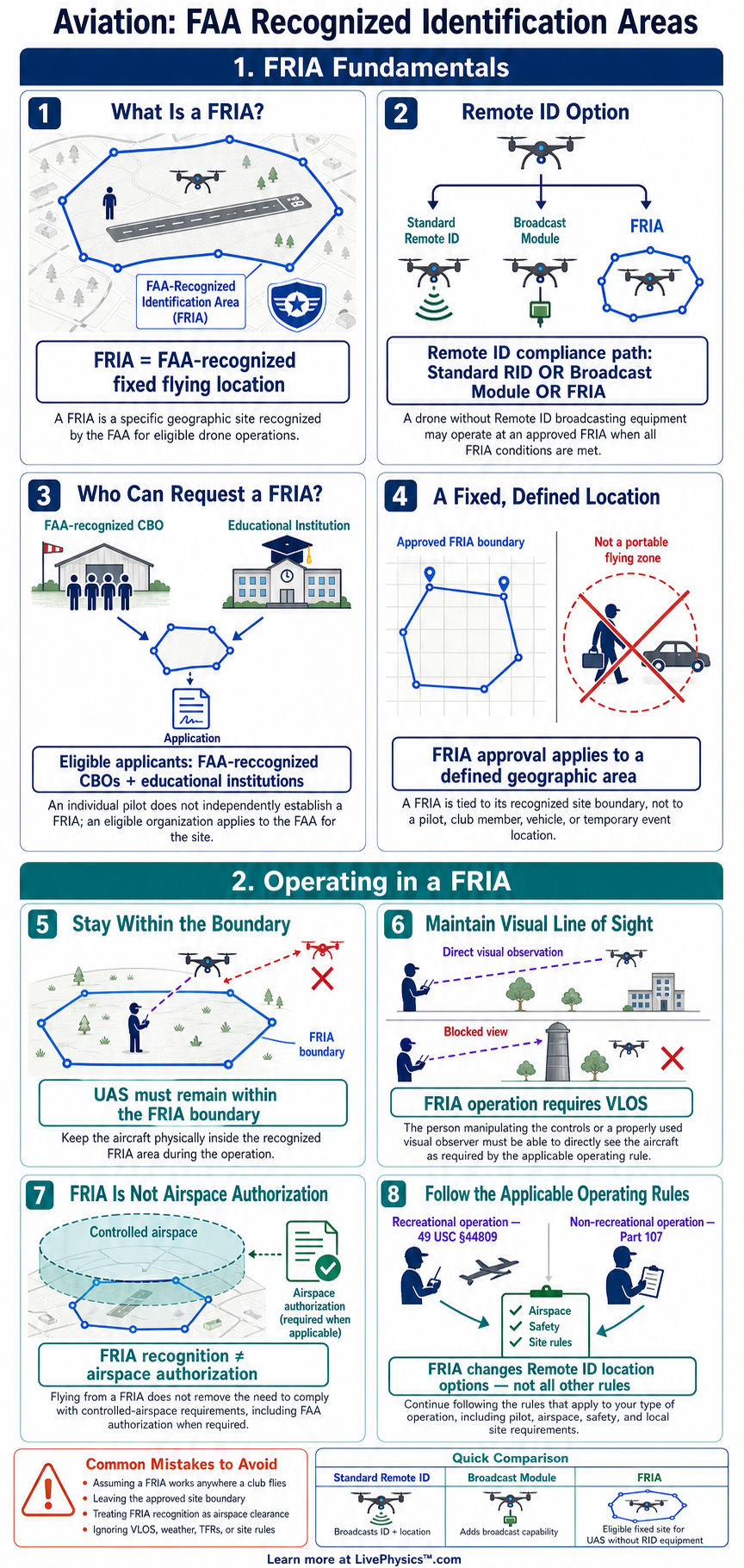
FAA Recognized Identification Areas, called FRIAs, are approved locations where certain unmanned aircraft may fly without broadcasting Remote ID. This cheat sheet helps drone pilots, aviation students, and educators understand what a FRIA does and does not allow. It separates the basic purpose of a FRIA from the rules that still apply while flying there.
Knowing these limits helps pilots plan legal and safe operations.
A FRIA is sponsored by an eligible community-based organization or educational institution and recognized by the FAA. The Remote ID exception applies only while the unmanned aircraft stays within the published FRIA boundaries. Pilots must still follow FAA airspace rules, registration rules, visual line of sight requirements, and other applicable operating limits.
A FRIA is not automatic permission to fly anywhere or at any time.
Key Facts
- A FAA Recognized Identification Area, or FRIA, is an FAA-recognized geographic area where unmanned aircraft may operate without Remote ID equipment while remaining within that area.
- The Remote ID exception applies only inside the published FRIA boundary, so a drone that leaves the boundary must meet normal Remote ID requirements.
- A FRIA may be requested by an eligible FAA-recognized community-based organization or educational institution.
- A FRIA does not remove the requirement to follow applicable FAA airspace rules, including obtaining authorization before operating in controlled airspace when required.
- Part 107 remote pilots operating in a FRIA must still follow Part 107 operating rules and any applicable FAA approvals.
- Recreational flyers operating in a FRIA must still follow the safety guidelines of an FAA-recognized community-based organization and complete the TRUST safety test.
- A FRIA is a Remote ID exception, not a waiver, pilot certificate, or blanket authorization to fly in restricted airspace.
Vocabulary
- FAA Recognized Identification Area
- A defined location recognized by the FAA where unmanned aircraft can operate without Remote ID broadcast equipment when they stay within its boundaries.
- Remote ID
- A system that provides identification and location information about an unmanned aircraft during flight.
- Community-Based Organization
- An FAA-recognized organization that supports recreational unmanned aircraft operations and safety guidelines.
- Controlled Airspace
- Airspace where air traffic control provides services and where drone operations may require FAA authorization.
- Part 107
- The FAA rules that govern many small unmanned aircraft operations conducted for business, research, or other non-recreational purposes.
- Visual Line of Sight
- The ability of a pilot or visual observer to see the unmanned aircraft directly well enough to control it safely.
Common Mistakes to Avoid
- Assuming a FRIA allows a drone to fly without Remote ID anywhere nearby is wrong because the exception ends at the published FRIA boundary.
- Treating FAA recognition of a FRIA as controlled-airspace permission is wrong because a pilot may still need separate FAA airspace authorization.
- Believing that all rules disappear inside a FRIA is wrong because registration, safe operation, visual line of sight, and pilot-specific rules still apply.
- Flying outside a FRIA to recover a drone without Remote ID is risky because the aircraft is no longer operating under the FRIA exception once it crosses the boundary.
- Assuming any club field or school property is a FRIA is wrong because the site must be formally recognized by the FAA and listed with defined boundaries.
Practice Questions
- 1 A published FRIA is 800 feet long and 500 feet wide. What is its area in square feet?
- 2 A drone begins 150 feet inside a FRIA boundary and flies 220 feet straight toward and beyond that boundary. How many feet does it travel outside the FRIA?
- 3 A Part 107 pilot wants to fly a drone without Remote ID equipment at a FRIA located in controlled airspace. What additional FAA planning step may be required before takeoff?
- 4 Explain why a FRIA should be viewed as a limited Remote ID exception rather than as unrestricted permission to operate a drone.
Understanding FAA Recognized Identification Areas
Remote ID helps identify unmanned aircraft during flight. Most drones that must be registered are generally required to comply with the FAA Remote ID rule when operating in the United States. A FRIA creates a limited location-based exception.
Within that recognized area, a drone without built-in Remote ID or an attached Remote ID broadcast module may be operated without transmitting Remote ID. This option is especially useful for model aircraft, student-built aircraft, and older drones that cannot easily be fitted with Remote ID equipment.
A pilot cannot simply label a local field as a FRIA. The FAA recognizes FRIAs after an eligible community-based organization or educational institution submits an application. The published location has specific geographic boundaries.
Pilots need to know those boundaries before flight and keep the aircraft inside them. Flying even slightly outside the FRIA means the Remote ID exception no longer applies. The operator must then use a drone that meets the normal Remote ID requirements unless another FAA exception applies.
A FRIA changes only the Remote ID requirement. It does not remove the rest of the rules for flying an unmanned aircraft. Recreational flyers must follow the safety guidelines of an FAA-recognized community-based organization and pass the recreational knowledge and safety test.
Part 107 remote pilots must follow the rules of their certificate, including operational limits and any needed airspace authorization. All pilots must avoid careless or reckless operations. They must also yield to and avoid creating hazards for crewed aircraft.
Airspace planning remains important at a FRIA. Some locations are in controlled airspace, near airports, or under temporary flight restrictions. A FRIA designation does not authorize entry into controlled airspace.
Pilots must obtain airspace authorization when it is required. They should check current FAA notices, local procedures, weather, and site conditions before every flight. A field may be suitable for model flying while still having important airspace limits overhead.
When studying FRIAs, focus on the difference between a place, an equipment exception, and an operating authorization. A FRIA is a defined place. Its main benefit is an exception from Remote ID broadcast requirements for flights that remain inside its boundary.
It is not a pilot license, a waiver, or an unrestricted flight zone. Good pilots verify the site, confirm the aircraft status, inspect the aircraft, and follow the rules that apply to their type of operation. These habits support safe integration of drones and crewed aviation.