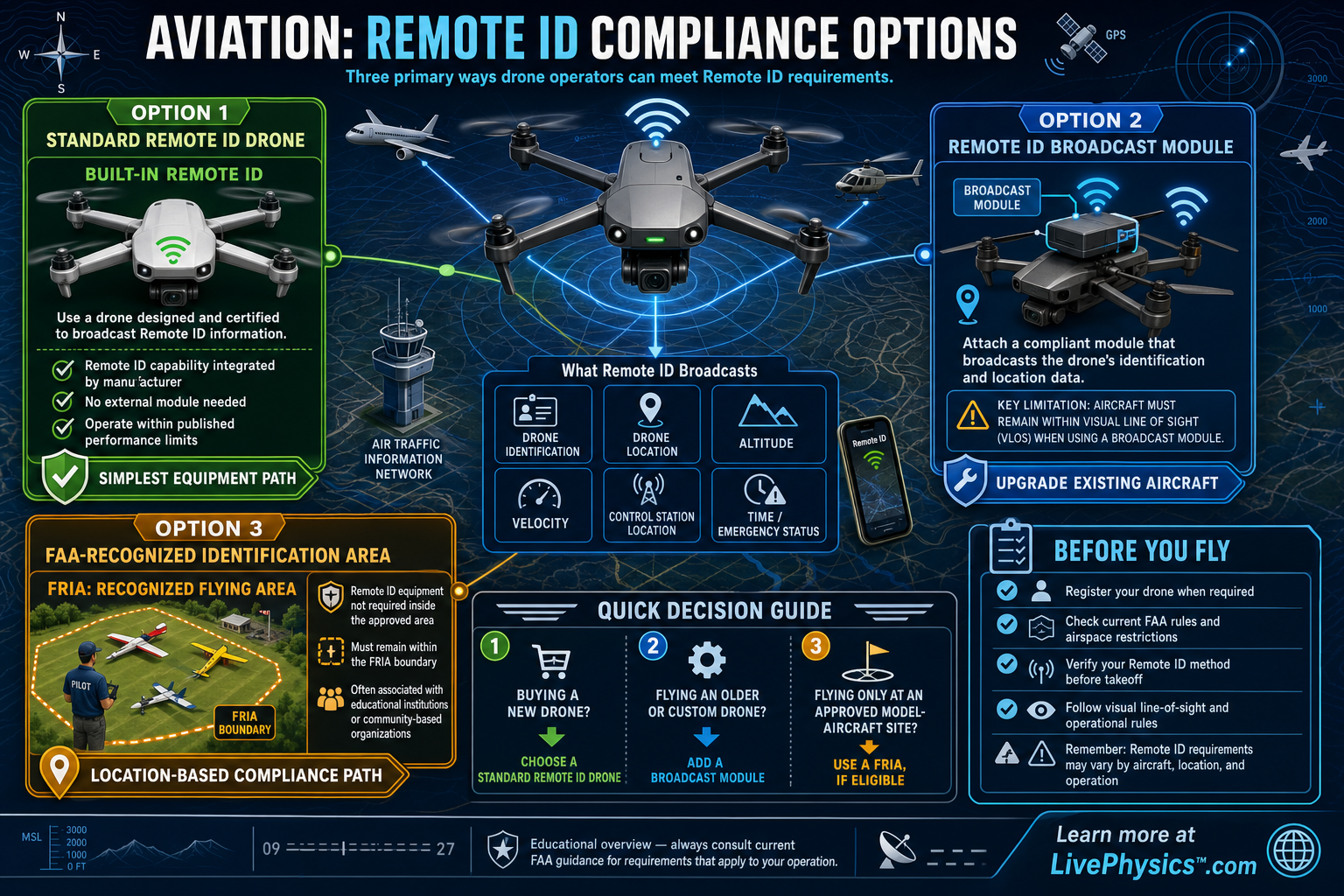
Remote ID is a digital identification system for drones operating in the United States. It gives certain people and systems basic information about a drone while it is flying. This supports safer shared airspace because pilots, public safety workers, and airspace managers can identify an unmanned aircraft when needed.
It does not replace normal flight rules, registration, or pilot responsibility.
A drone can meet Remote ID requirements through three main pathways. A Standard Remote ID drone has the capability built in by its manufacturer. An older drone may use a separate broadcast module attached to the aircraft.
A drone without Remote ID equipment may fly only within an FAA Recognized Identification Area, often called a FRIA, when the operation qualifies.
Understanding Aviation, Remote ID Compliance Options
Remote ID works like an electronic license plate for a drone in flight. The system broadcasts information directly from the aircraft using short range radio technology such as Bluetooth or Wi Fi. It is not a continuous connection to the internet.
A compatible receiver nearby can read the broadcast. The information is designed to help identify the drone operation without interfering with the pilot's control link.
A Remote ID message generally includes the drone's identification code, its position, altitude, velocity, and a time mark. It can include the control station location or the drone's takeoff location, depending on the type of system. The message helps a person distinguish one drone from another during an event.
It does not publicly reveal the pilot's name, home address, camera feed, or flight controls. Law enforcement can use the identification code to request registration information through proper channels.
The simplest compliance option is a Standard Remote ID drone. The aircraft is listed by the FAA as meeting Remote ID requirements and has the function installed at the factory. The pilot must keep the system operating during a flight when Remote ID is required.
A broadcast module is another option for a drone that was built before Remote ID became common. The module must be attached securely, charged, and configured correctly. Since a module reports the takeoff point as the control station location, the drone must remain within visual line of sight of the person operating it.
A FRIA is a defined location where drones may operate without broadcasting Remote ID. These areas are normally sponsored by community based organizations or educational institutions and recognized by the FAA. The boundary matters because the drone must stay inside it.
A FRIA is not a general exemption for flying anywhere without identification. Students should check the current FAA airspace information, registration rules, local restrictions, and the specific requirements for their type of operation before flying.
When learning this topic, separate Remote ID from other aviation rules. Registration identifies the aircraft in FAA records, while Remote ID broadcasts flight information locally. Airspace authorization determines whether a location may be used, while Remote ID does not grant permission to enter that airspace.
Focus on the three compliance pathways, the limits of each pathway, and the preflight checks needed for reliable broadcasting. A safe pilot confirms that the drone, module, battery, and planned flight area match the applicable rules.
Key Facts
- Remote ID broadcasts identification and flight information from a drone during flight.
- Three compliance pathways are a Standard Remote ID drone, a Remote ID broadcast module, or flight within an FAA Recognized Identification Area.
- A Standard Remote ID drone is listed by the FAA as meeting Remote ID requirements.
- A broadcast module lets an eligible older drone transmit Remote ID information.
- Remote ID data can include a drone identification code, position, altitude, velocity, and time mark.
- A broadcast module operation requires visual line of sight because it reports the control station location as the takeoff location.
Vocabulary
- Remote ID
- A system that broadcasts identification and location information from a drone while it is flying.
- Standard Remote ID drone
- A drone with Remote ID capability built in by the manufacturer and listed by the FAA.
- Broadcast module
- A device attached to a drone that transmits Remote ID information for an aircraft without built in capability.
- FRIA
- An FAA Recognized Identification Area where qualifying drones can fly without broadcasting Remote ID.
- Visual line of sight
- A flight condition in which the operator can see the drone directly well enough to control it safely.
Common Mistakes to Avoid
- Assuming Remote ID gives permission to fly in any airspace. Remote ID identifies a drone during flight, but it does not replace airspace authorization or local flight restrictions.
- Treating a broadcast module like a complete replacement for preflight checks. The module must be powered, attached securely, and configured so that it broadcasts correctly before takeoff.
- Flying outside a FRIA with a drone that has no Remote ID capability. The FRIA exception applies only within the recognized area's boundaries.
- Confusing Remote ID with public tracking of a pilot's private information. The broadcast is meant to identify the operation, while personal registration details are not simply displayed to every receiver.
Practice Questions
- 1 A pilot has an older drone with no built in Remote ID. They attach a compliant broadcast module and plan to fly 400 meters from the takeoff point. What additional flight condition must the pilot maintain when using the module?
- 2 A FRIA is a rectangular field 180 meters long and 120 meters wide. Calculate its area in square meters. Explain why knowing the boundary dimensions matters for a drone with no Remote ID equipment.
- 3 A drone broadcasts its Remote ID correctly, but its pilot wants to enter controlled airspace without authorization. Explain why the Remote ID broadcast does not make this flight compliant.