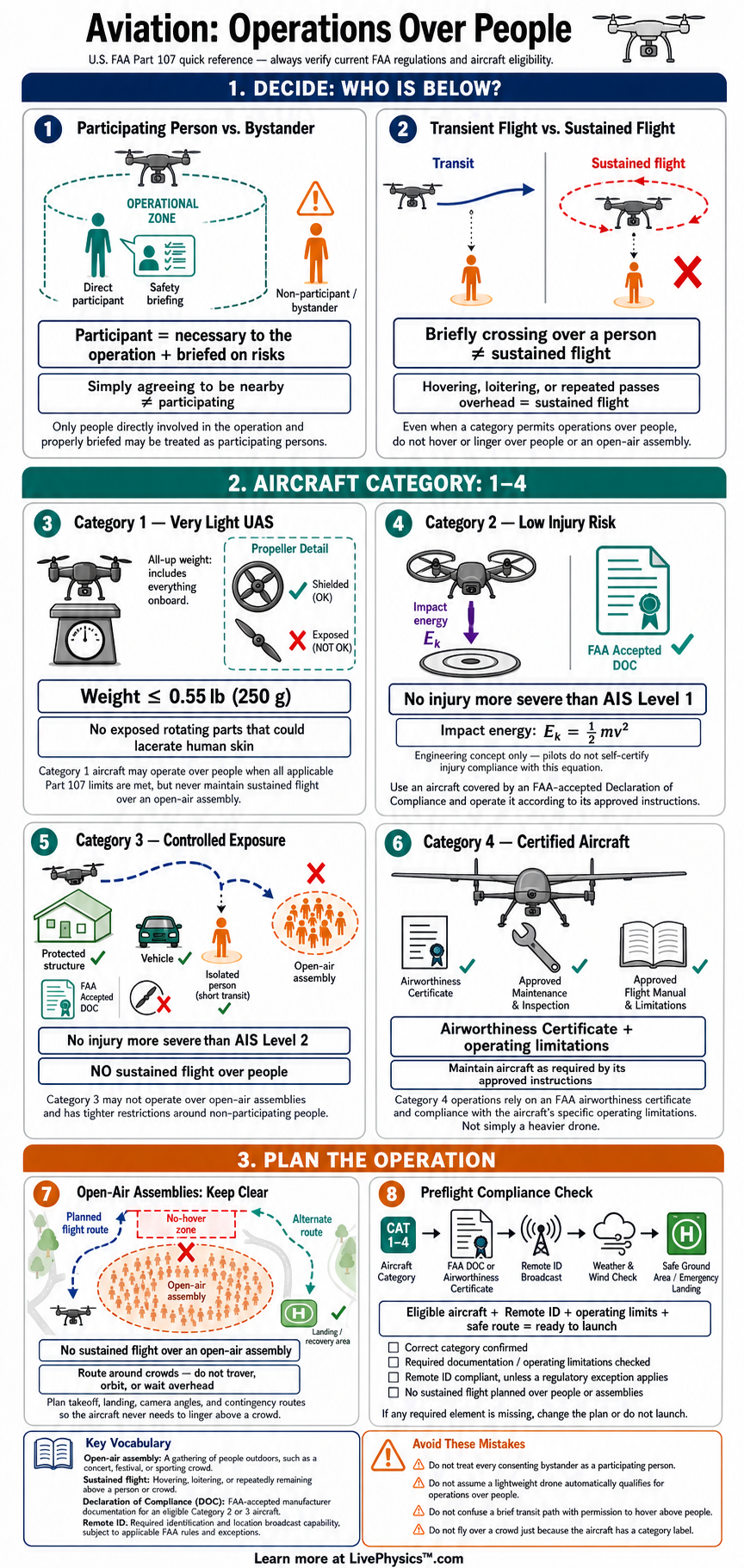
FAA Part 107 sets specific rules for flying small unmanned aircraft over people. These rules help reduce injury risk and protect people who are not part of a drone operation. This cheat sheet helps remote pilots quickly identify the operational category and its main limits.
It is designed for students preparing for safe, legal commercial drone operations.
Operations Over People are organized into four FAA categories. Each category has different requirements for aircraft weight, injury risk, aircraft design, and documentation. Categories 1 through 3 focus on weight and the risk of impact or laceration injuries.
Category 4 applies to aircraft with an FAA airworthiness certificate and approved operating limitations.
Key Facts
- Category 1 requires a total takeoff weight of 0.55 pounds or less, including the battery, payload, and all attached equipment.
- A Category 1 aircraft must have no exposed rotating parts that would lacerate human skin.
- Category 2 aircraft must be shown to cause no more than 11 foot-pounds of blunt force injury upon impact.
- Category 3 aircraft must be shown to cause no more than 25 foot-pounds of blunt force injury upon impact.
- Categories 2 and 3 require an FAA accepted Declaration of Compliance from the manufacturer before Operations Over People.
- Category 3 operations cannot occur over an open-air assembly of people and are limited to directly participating people or informed people in a restricted access site.
- Category 4 requires an FAA airworthiness certificate and operation according to its FAA approved operating limitations.
- A compliant Operations Over People flight must also meet applicable Remote ID requirements and all other Part 107 rules.
Vocabulary
- Operations Over People
- Part 107 operations in which a small unmanned aircraft flies over a person who is not directly participating in the flight.
- Open-air assembly
- A gathering of people outdoors where a drone flying above them could create a risk to multiple people.
- Declaration of Compliance
- A manufacturer filing accepted by the FAA that states an aircraft model meets the requirements for a specific Operations Over People category.
- Blunt force injury
- An injury caused by the impact force of an aircraft rather than by a cutting or piercing part.
- Airworthiness certificate
- An FAA certificate showing that an aircraft meets approved safety standards and may be operated under stated limitations.
- Remote ID
- A system that broadcasts identification and location information about a drone during flight.
Common Mistakes to Avoid
- Assuming a drone under 0.55 pounds always qualifies as Category 1 is wrong because the total takeoff weight includes batteries, payloads, guards, and every attached item.
- Using a personal impact-energy calculation to call a drone Category 2 or Category 3 is wrong because those categories require an FAA accepted manufacturer Declaration of Compliance.
- Flying repeatedly above a crowd because the aircraft is small is wrong because sustained flight over an open-air assembly is restricted.
- Treating Category 3 like Category 2 is wrong because Category 3 has stricter limits on flying over people and prohibits operations over open-air assemblies.
- Ignoring Remote ID because an aircraft meets an Operations Over People category is wrong because applicable Remote ID rules still apply to the flight.
Practice Questions
- 1 A drone weighs 225 grams, its battery weighs 20 grams, and its attached payload weighs 12 grams. What is its total takeoff weight, and does it meet the 250 gram Category 1 weight limit?
- 2 An aircraft weighs 0.44 pounds before a 0.13 pound payload is attached. What is the total takeoff weight, and can it qualify as Category 1 based on weight?
- 3 A manufacturer has an FAA accepted Category 2 Declaration of Compliance for a drone. May the pilot hover above an open-air concert crowd for several minutes under the Category 2 rule?
- 4 Explain why an aircraft with a low takeoff weight may still be ineligible for Operations Over People.
Understanding Operations Over People
Operations Over People rules apply when a small unmanned aircraft flies over a person who is not directly participating in the operation. A directly participating person is involved in tasks such as launching, observing, loading, or controlling the aircraft.
People inside a covered structure or stationary vehicle may also have protection from a falling aircraft. Remote pilots must still follow all other Part 107 rules, including visual line of sight, airspace authorization, and safe operating practices.
Category 1 is the simplest pathway. The aircraft must weigh 0.55 pounds or less at takeoff, including batteries, payloads, propeller guards, and all attached equipment. It also cannot have exposed rotating parts that could lacerate human skin.
Category 1 aircraft may not conduct sustained flight over an open-air assembly of people. Hovering above a crowd or repeatedly circling above the same people creates a greater risk than a brief flight path across an area.
Categories 2 and 3 require more proof before flight. The manufacturer must show that the aircraft meets FAA injury safety standards and must file an FAA accepted Declaration of Compliance. Category 2 aircraft must not cause a blunt force injury greater than 11 foot-pounds upon impact.
Category 3 aircraft must not cause a blunt force injury greater than 25 foot-pounds upon impact. Both categories must also avoid exposed rotating parts that can cause lacerations. A remote pilot cannot classify an ordinary drone by making a personal estimate of its impact energy.
Category 3 has stronger operating limits than Category 2. It cannot operate over open-air assemblies of people. Flights over people are generally limited to people directly participating in the operation or people within a restricted access site who have been informed about the drone operation.
Category 4 aircraft operate under an FAA issued airworthiness certificate. The remote pilot must follow the operating limitations, maintenance instructions, and other conditions tied to that certificate.
Remote ID is an important part of lawful Operations Over People. Pilots must meet applicable Remote ID requirements, such as using a compliant aircraft or operating within an approved FAA Recognized Identification Area when allowed.
Before every flight, pilots should verify the aircraft category, total takeoff weight, Declaration of Compliance status when needed, and the type of people below. FAA rules can change, so pilots should check current FAA guidance and the aircraft manufacturer documentation before relying on any reference sheet.