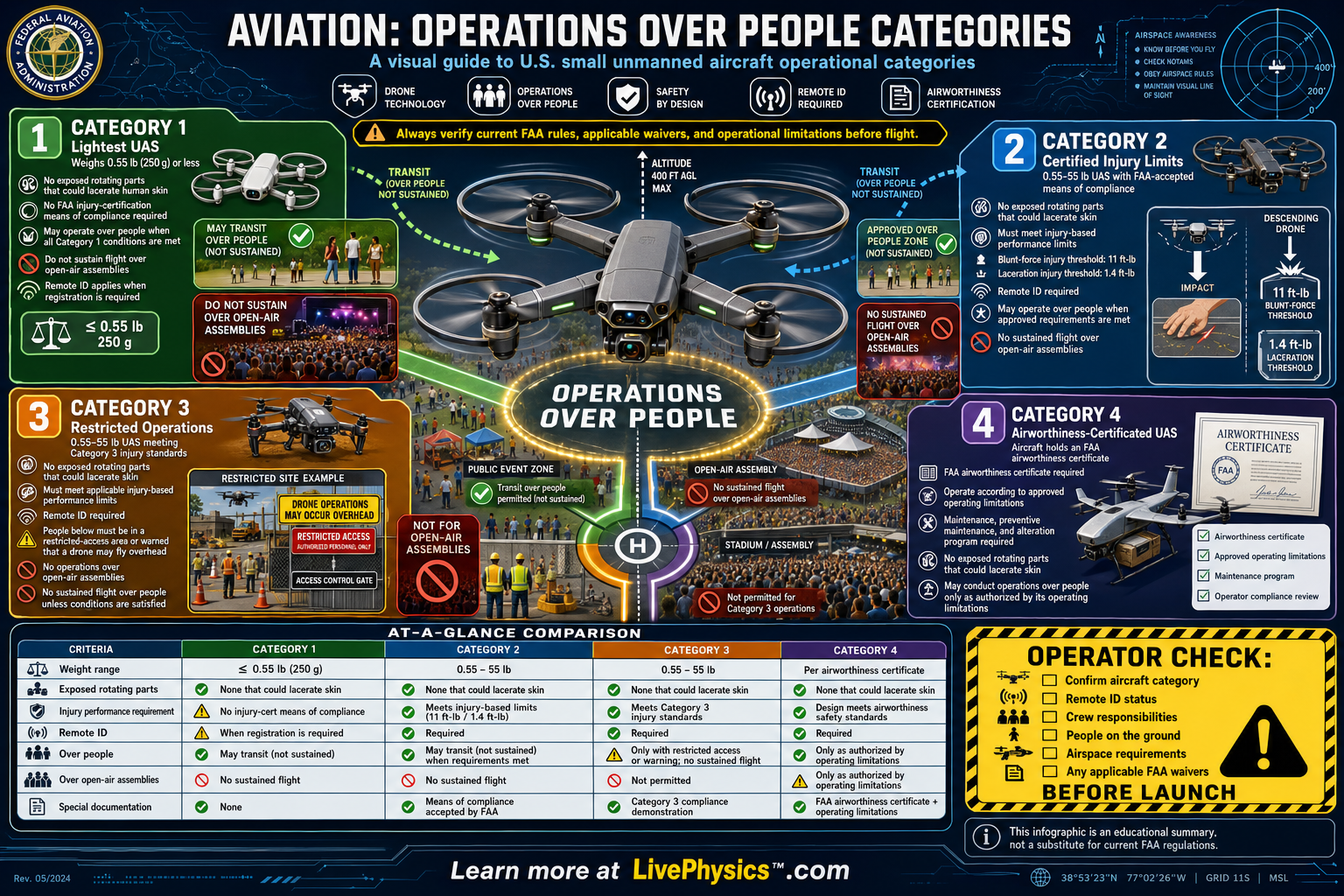
FAA operations over people categories help drone pilots judge when a small unmanned aircraft may fly above people who are not directly involved in the operation. The rules reduce the risk of injury from an aircraft impact, rotating propellers, or a loss of control. They matter in activities such as aerial photography, inspections, public events, and news gathering.
A pilot must meet the correct category requirements before treating a flight over people as permitted.
The four categories are based on the drone's weight, its potential injury risk, its design, and its certification status. Category 1 covers very light drones, while Categories 2 and 3 require approved declarations of compliance and impact testing. Category 4 applies to aircraft with an FAA airworthiness certificate and specific operating limitations.
These categories work alongside other Part 107 rules, including airspace authorization, visual line of sight, and Remote ID requirements.
Understanding Aviation, Operations Over People Categories
The phrase operations over people has a precise meaning in FAA rules. It concerns flight over human beings who are not directly participating in the operation. A person may be protected if they are inside a covered structure or a stationary covered vehicle that can provide reasonable protection.
A pilot should not assume that a sidewalk, a sports field, or a work area is clear just because the intended subject has agreed to be filmed. People nearby can still be nonparticipants.
Category 1 is intended for the smallest aircraft. The drone must weigh no more than 0.55 pounds, including everything attached or carried. That limit equals 250 grams.
It must not have exposed rotating parts that could cut human skin during an impact. Adding propeller guards can improve safety, yet the added mass counts toward the weight limit. If the equipped drone exceeds the limit, it no longer qualifies as Category 1.
Categories 2 and 3 use tested injury criteria instead of a simple weight limit. Both require that the aircraft have no exposed rotating parts likely to cause a skin laceration. Category 2 has a maximum injury severity of 11 foot pounds of kinetic energy on impact.
Category 3 allows up to 25 foot pounds. These values come from required testing and manufacturer documentation, not from a pilot making a quick estimate before launch. The operator must use a model that has an FAA accepted declaration of compliance and must follow its listed conditions.
Category 3 has important location limits because it permits more impact energy than Category 2. It cannot be flown over open-air assemblies, such as a concert crowd or a packed outdoor game. The operation must take place in a restricted area where people who are not participating are kept out.
It may transit over a nonparticipant only when that person is not in an open-air assembly and the transit is not sustained. Planning the flight path matters as much as selecting the drone.
Category 4 is for a small unmanned aircraft that holds an FAA airworthiness certificate. Its approved operating limitations define how it may be used over people. This category requires a higher level of aircraft approval, continuing maintenance, and operational control.
In every category, pilots still need to check weather, battery condition, airspace, visual line of sight, and emergency landing options. The category is one part of a full safety decision, not a replacement for careful judgment.
Key Facts
- Category 1 maximum takeoff weight is 0.55 lb, or 250 g, including payload and attachments.
- Category 1 aircraft must not have exposed rotating parts likely to cause skin lacerations.
- Category 2 maximum impact kinetic energy is 11 ft-lb.
- Category 3 maximum impact kinetic energy is 25 ft-lb.
- KE = 1/2 mv^2
- Category 4 requires an FAA airworthiness certificate and compliance with its operating limitations.
Vocabulary
- Nonparticipant
- A person who is not directly involved in the drone operation and has not been briefed as part of it.
- Open-air assembly
- A gathering of people outdoors where the people are not protected by a structure or covered vehicle.
- Declaration of compliance
- A manufacturer document accepted by the FAA that states a drone model meets a required operations over people category.
- Kinetic energy
- Energy an object has because of its mass and speed, which affects the severity of an impact.
- Airworthiness certificate
- An FAA certificate showing that an aircraft meets approved design and safety requirements for its authorized operation.
Common Mistakes to Avoid
- Treating a drone under 250 grams as automatically legal over any crowd. Category 1 has equipment conditions, and other Part 107 rules such as airspace and visual line of sight still apply.
- Ignoring the weight of propeller guards, cameras, lights, or payloads. Every attached item counts when determining whether a drone remains within the Category 1 weight limit.
- Using a Category 3 drone over a concert or festival crowd. Category 3 operations cannot occur over open-air assemblies.
- Estimating Category 2 or Category 3 impact energy from the drone's advertised weight and speed. These categories require an FAA accepted manufacturer declaration of compliance and required testing.
Practice Questions
- 1 A drone weighs 235 g with its battery. A 22 g propeller guard set is installed. Determine whether the equipped drone meets the 250 g Category 1 weight limit.
- 2 A drone has a mass of 0.80 kg and is moving at 5.0 m/s immediately before impact. Calculate its kinetic energy using KE = 1/2 mv^2. Express the result in joules.
- 3 A pilot wants to film a crowded outdoor music festival with a Category 3 aircraft. Explain why the category rules do not allow this plan and identify a safer planning step.