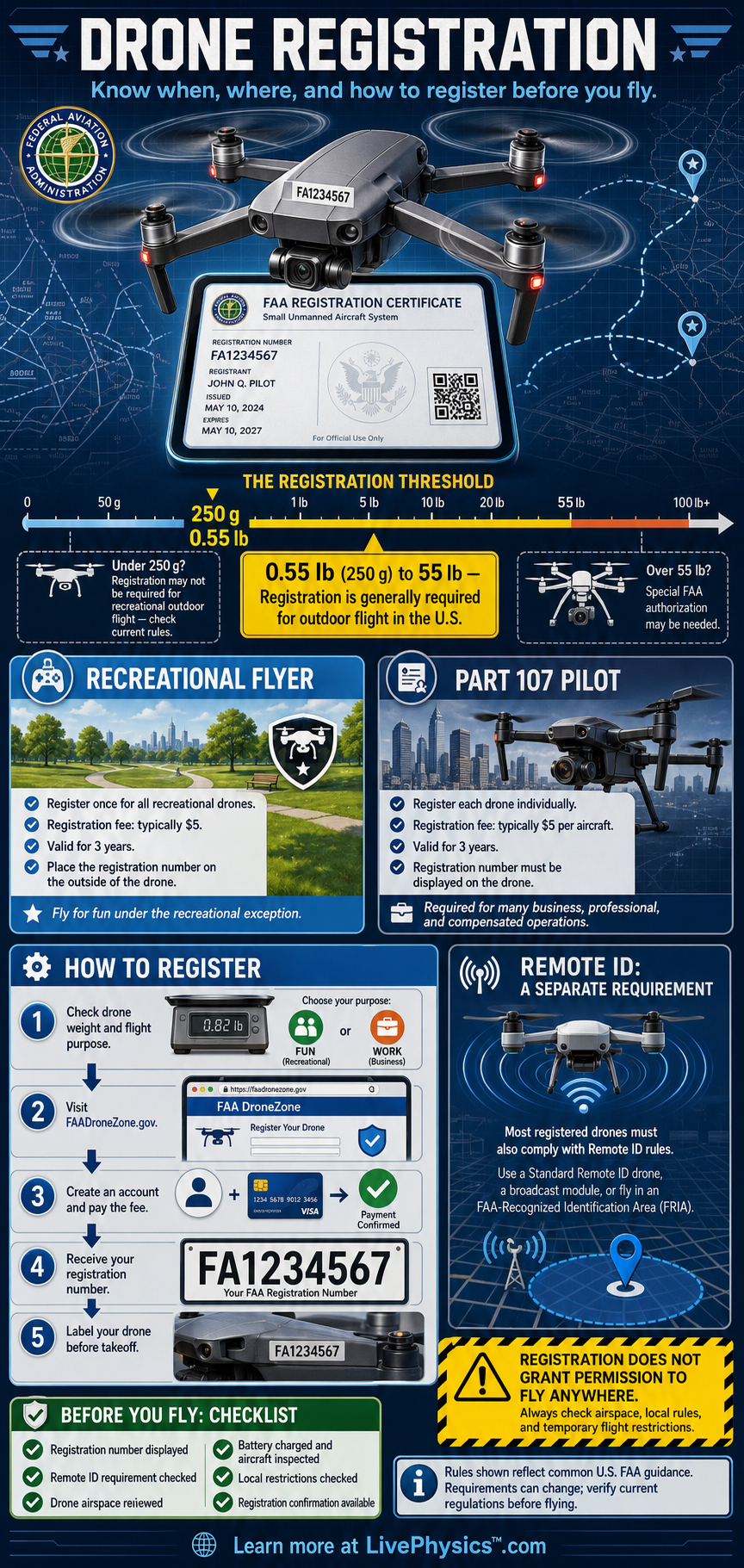
In the United States, drone registration helps the Federal Aviation Administration connect an aircraft with the person responsible for flying it. It is an important part of aviation safety because drones share airspace with aircraft, helicopters, and emergency responders. Many consumer drones must be registered before outdoor flight, even when they are small enough to fit in a backpack.
Knowing the rules prevents avoidable violations and supports safer flight decisions.
Registration depends mainly on a drone's takeoff weight and the purpose of the flight. Recreational flyers generally use one registration number for their qualifying drones, while Part 107 operators register each aircraft separately. The registration number must be placed where it can be seen on the outside of the drone.
Registration is only one requirement, so pilots must still follow airspace, altitude, Remote ID, and operating rules.
Understanding Aviation, Drone Registration
In the United States, drone registration is managed by the Federal Aviation Administration under Part 48. It links an aircraft to a responsible person and helps support safe use of shared airspace. A drone that weighs at least 0.55 pounds, or 250 grams, must usually be registered before outdoor flight.
Weight includes batteries, cameras, guards, and other attached items carried during takeoff. The rule helps create accountability when an aircraft is lost, damaged, or involved in an unsafe operation. Registration does not mean the FAA has inspected or approved a particular drone model.
Flight purpose changes how registration works. A person flying only for recreation can use one registration number on all qualifying drones they own. Each qualifying drone still needs that number displayed on its exterior.
A person flying under Part 107 for work, business, photography services, research, or another nonrecreational purpose must register each aircraft separately. This rule applies even when the aircraft weighs less than 250 grams.
The FAA system records aircraft details and contact information, then issues a certificate and registration number. Registration is generally valid for three years, though pilots should check current FAA guidance before relying on a certificate.
The registration number must be displayed on the outside of the drone where it can be seen without tools. It should be readable, secure, and protected from normal wear. Placing the number inside a battery compartment is not acceptable when tools are needed to open that compartment.
A small label, engraved marking, or durable plate can work if the number remains visible. The registration certificate should be available during flight as a paper copy or electronic copy. Students should treat this like carrying proof of registration for a vehicle, even though the aviation rules are different.
Registration does not grant permission to fly anywhere. Pilots must still follow rules about controlled airspace, maximum altitude, visual line of sight, flights near people, and operations near airports. A flight near an airport may require airspace authorization even when the drone is properly registered.
Local parks, schools, and private property can have additional restrictions. Checking a map before flight is useful, but a map does not replace the responsibility to understand the rule that applies. Safe pilots plan the flight location, height, route, and emergency landing area before takeoff.
Students should keep registration separate from Remote ID, since the ideas are related but not identical. Remote ID broadcasts identification and location information while a drone operates, subject to FAA requirements and exceptions. Registration identifies the owner or operator in the FAA system.
A drone may need registration plus a Remote ID compliance method. Before flying, confirm the takeoff weight, intended purpose, registration status, label placement, and current FAA rules. Official FAA guidance is the best source because regulations and approved methods can change.
Key Facts
- FAA registration is generally required at 0.55 lb or 250 g and above for outdoor flight.
- 0.55 lb is approximately 250 g.
- Recreational flyers may use one registration number for multiple qualifying drones they own.
- Part 107 operators must register each drone separately, including drones under 250 g.
- The registration number must be visible on the outside of the drone without using tools.
- FAA drone registration is generally valid for 3 years.
Vocabulary
- FAA
- The Federal Aviation Administration is the United States agency that regulates civil aviation, including drone operations.
- Part 48
- Part 48 is the FAA rule section that establishes the registration system for small unmanned aircraft.
- Part 107
- Part 107 is the FAA rule set for many nonrecreational small drone operations.
- Remote ID
- Remote ID is a system that broadcasts certain identification and location information from a drone during flight.
- Takeoff weight
- Takeoff weight is the total weight of a drone with its battery and all attached items when it leaves the ground.
Common Mistakes to Avoid
- Using the manufacturer listed drone weight is wrong because registration is based on takeoff weight, which includes the battery and attached equipment. Weigh the drone in the configuration you will actually fly.
- Using one recreational registration number for business drones is wrong because Part 107 requires each aircraft to be registered separately. Determine the purpose of the operation before registering.
- Hiding the registration number inside a tool-accessed battery compartment is wrong because the number must be visible on the outside without tools. Place a durable label or marking on an exterior surface.
- Treating registration as permission to fly anywhere is wrong because airspace and operating restrictions still apply. Check airspace authorization needs and local restrictions before each flight.
Practice Questions
- 1 A drone has a takeoff weight of 268 g with its battery and camera attached. State whether it generally meets the FAA weight threshold for registration during outdoor recreational flight.
- 2 A Part 107 photographer owns four drones, each weighing 180 g at takeoff. Determine how many separate FAA registrations the photographer needs.
- 3 A recreational pilot registers a qualifying drone and puts the registration number inside a compartment that opens only with a screwdriver. Explain why this setup does not meet the labeling rule and describe a better placement.