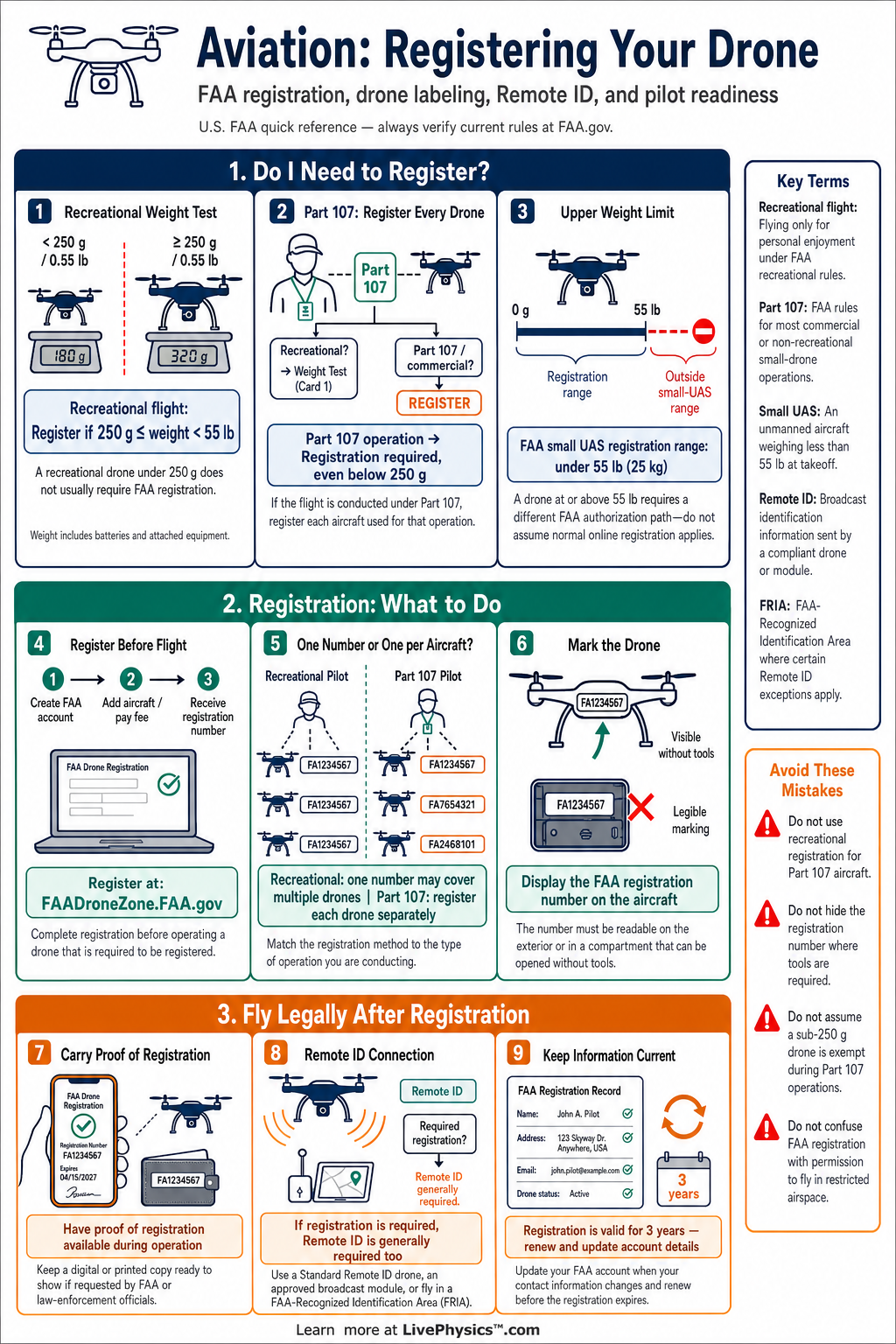
Drone registration is a legal step that connects an aircraft to its owner in the United States. This cheat sheet helps learners identify when FAA registration is required and which registration path applies. It also summarizes key limits, fees, labels, and records to keep before flying.
Knowing these rules supports safe, lawful aviation activity.
The main registration threshold is 0.55 pounds, or 250 grams. Recreational flyers and Part 107 operators follow different registration procedures, even when they use the same drone model. Remote ID requirements also affect many drones that must be registered.
Registration does not replace pilot knowledge, airspace checks, or other operating rules.
Key Facts
- Register a drone with the FAA when it weighs at least 0.55 pounds, or 250 grams, at takeoff and weighs less than 55 pounds.
- Takeoff weight includes the drone, battery, camera, propeller guards, and any other attached equipment.
- A recreational flyer may use one FAA registration number for multiple eligible recreational drones.
- A Part 107 operator must register each drone separately, including drones that weigh less than 0.55 pounds.
- FAA drone registration costs 5 dollars and is valid for three years.
- Place the FAA registration number on the outside of the drone or in a tool free compartment.
- Recreational pilots must complete TRUST and carry proof of completion when flying.
- Many registered drones must meet Remote ID requirements through built in Remote ID, a broadcast module, or flight in a FAA recognized identification area.
Vocabulary
- FAA DroneZone
- The FAA online system used to register drones and manage registration information.
- Recreational flyer
- A person who flies a drone only for personal enjoyment under the recreational exception.
- Part 107
- The FAA rule that governs many small drone operations conducted for work or other non recreational purposes.
- Remote ID
- A system that broadcasts identification and location information from a drone during flight.
- Takeoff weight
- The total weight of a drone and all equipment attached to it when it begins flight.
- FRIA
- A FAA recognized identification area where drones without Remote ID may operate under specific conditions.
Common Mistakes to Avoid
- Using the drone's box weight instead of takeoff weight is wrong because attached batteries, cameras, and accessories count toward the 0.55 pound threshold.
- Putting one recreational registration number on a Part 107 fleet is wrong because each drone used under Part 107 needs separate registration.
- Hiding the registration number in a compartment that requires a tool is wrong because the number must be externally visible or accessible without tools.
- Assuming registration gives permission to fly anywhere is wrong because pilots must still follow airspace, altitude, safety, and local operating restrictions.
- Treating Remote ID as the same as registration is wrong because registration identifies the owner in FAA records while Remote ID broadcasts information during flight.
Practice Questions
- 1 A recreational drone weighs 230 grams, and its attached camera weighs 35 grams at takeoff. Does it meet the FAA weight threshold for registration?
- 2 A Part 107 photographer owns three drones that each weigh 240 grams at takeoff. How many separate FAA registrations are needed for those drones?
- 3 A recreational registration expires three years after it is issued. If it was issued on June 1, 2025, when should the owner renew it?
- 4 Explain why a pilot should check both registration status and Remote ID compliance before flying a drone.
Understanding Registering Your Drone
FAA drone registration is managed through the FAA DroneZone website. A drone generally must be registered when it weighs at least 0.55 pounds, including anything attached at takeoff, and weighs less than 55 pounds.
This means a lightweight drone may cross the threshold after a camera, battery, propeller guards, or other equipment is installed. The takeoff weight matters, not only the weight listed on the product box.
A person flying only for recreation can usually register multiple eligible drones under one recreational registration number. That number is associated with the person, not with one aircraft.
The pilot must place the number on the exterior of every drone covered by that registration. Recreational pilots must also pass The Recreational UAS Safety Test, often called TRUST, and carry proof of completion while flying.
A Part 107 operator uses a different system. Each drone used under Part 107 needs its own separate registration. This applies even if the drone weighs less than 0.55 pounds, because non recreational operations have a lower registration threshold.
Examples include many flights for business, work, inspections, photography services, or other purposes beyond recreation. The operator should confirm the purpose of each flight and follow the correct rule set.
Registration normally costs 5 dollars per aircraft or recreational registration and lasts for three years. The registrant must provide accurate contact information and keep it current. The registration certificate should be available during operations.
A registration number must be visible on the outside of the aircraft or placed in a compartment that can be opened without tools. A number hidden behind a battery door that needs a tool does not meet the labeling rule.
Remote ID is another major requirement for many registered drones. A standard Remote ID drone broadcasts identification and location information during flight. A drone without built in Remote ID may use an approved broadcast module, or it may fly only in a FAA recognized identification area.
Registration and Remote ID work together, but they are not the same task. Learners should check current FAA guidance before each new type of operation because aviation rules and approved equipment can change.