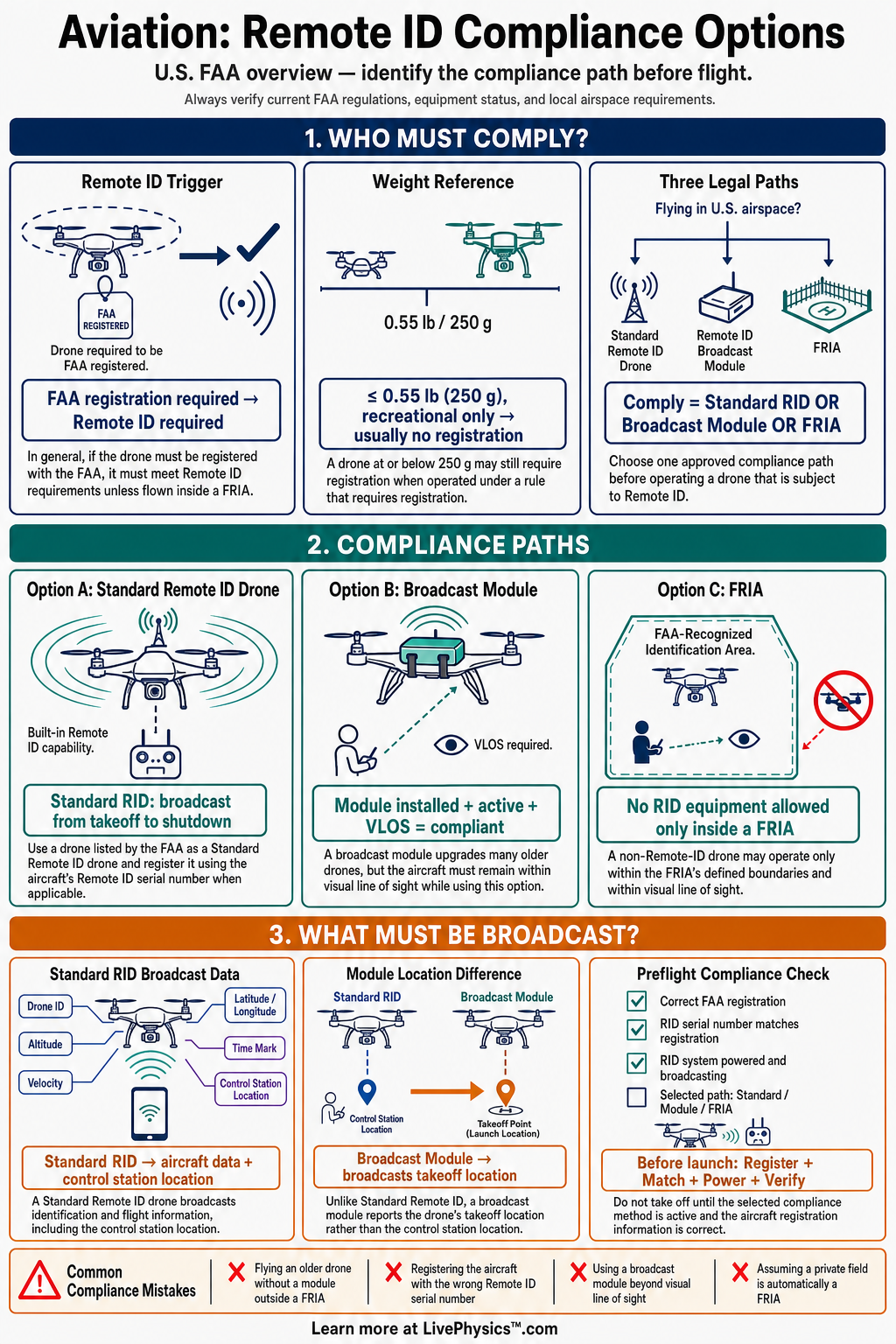
FAA Remote ID helps identify drones in flight and supports safer use of the national airspace. This cheat sheet explains the three FAA compliance options available to most U.S. drone operators. It is useful for recreational flyers, Part 107 remote pilots, and students preparing for UAS operations.
Knowing the correct option prevents illegal flights and equipment mistakes.
The three compliance paths are flying a Standard Remote ID drone, attaching a Remote ID broadcast module, or operating only within an FAA-Recognized Identification Area. Standard Remote ID is built into the aircraft, while a module adds the required broadcast capability to an eligible drone. Both methods send identification and flight information by radio signal.
A FRIA provides a location-based option with tighter operating limits.
Key Facts
- A drone required to be registered with the FAA must comply with Remote ID unless it is flown only within an FAA-Recognized Identification Area.
- A Standard Remote ID drone has FAA-compliant Remote ID broadcast capability built into the aircraft.
- A Remote ID broadcast module is an add-on device that must be listed in an FAA Declaration of Compliance.
- A drone using a Remote ID broadcast module must be operated within visual line of sight of the person controlling it.
- Standard Remote ID broadcasts the drone identifier, drone location, altitude, velocity, time information, emergency status, and control station location.
- A Remote ID broadcast module broadcasts the drone identifier, drone location, altitude, velocity, time information, emergency status, and takeoff location.
- A FRIA allows Remote ID-free flight only when the drone remains within the FAA-approved area and within visual line of sight.
- Remote ID compliance does not replace FAA registration, airspace rules, Part 107 requirements, or safe operating practices.
Vocabulary
- Remote ID
- Remote ID is an FAA system that broadcasts identification and location information from a drone during flight.
- Standard Remote ID Drone
- A Standard Remote ID drone is an aircraft with FAA-compliant Remote ID capability built into it by the manufacturer.
- Broadcast Module
- A broadcast module is a separate approved device that adds Remote ID broadcasts to an eligible drone.
- FRIA
- An FAA-Recognized Identification Area is an approved site where drones may fly without Remote ID equipment under specific limits.
- Declaration of Compliance
- A Declaration of Compliance is an FAA listing that states a drone or Remote ID module meets the applicable requirements.
- Visual Line of Sight
- Visual line of sight means the operator can see the drone directly well enough to control it safely and observe its flight path.
Common Mistakes to Avoid
- Assuming every small drone is exempt from Remote ID is wrong because a drone that must be registered generally must also meet Remote ID requirements unless it flies only in a FRIA.
- Buying any tracking device and calling it a Remote ID module is wrong because the module must be listed in an FAA Declaration of Compliance.
- Flying beyond visual line of sight with a broadcast module is wrong because module-equipped drones have a visual line of sight operating limit.
- Treating a FRIA as permission to fly anywhere without Remote ID is wrong because the exemption applies only inside the boundaries of that specific FAA-approved area.
- Ignoring the Remote ID label, serial number, or software status is risky because compliance depends on using the approved equipment correctly and keeping it operational.
Practice Questions
- 1 A registered drone does not have built-in Remote ID. Name two FAA compliance options that could allow it to fly legally.
- 2 A pilot attaches an approved Remote ID broadcast module to an older drone. State the visual line of sight limit that applies to this flight.
- 3 A student club operates at an approved FRIA. If the drone stays inside the site and remains in visual line of sight, explain whether it needs a Remote ID broadcast module for that flight.
- 4 Explain why a pilot might choose a Standard Remote ID drone instead of using a broadcast module, even when both options can meet Remote ID requirements.
Understanding Remote ID Compliance Options
Remote ID is often compared to a digital license plate for a drone. It allows certain people, including the FAA and law enforcement, to receive identifying and location information from a drone during flight. The system improves accountability when many aircraft use the same airspace.
It also helps support safe integration of drones with helicopters, airplanes, and emergency response aircraft. Remote ID does not replace registration, pilot certification, airspace authorization, or visual line of sight rules.
A Standard Remote ID drone has Remote ID capability built into its design. The FAA lists approved models in a Declaration of Compliance database, and the aircraft should have a Remote ID label. When operating normally, the drone broadcasts its identifier, position, altitude, velocity, time information, and an emergency status indication.
It also broadcasts the location of the control station. Operators should check that Remote ID is functioning before takeoff and should keep the drone software updated according to the manufacturer instructions.
A Remote ID broadcast module is an add-on device for a drone that does not have Standard Remote ID. The module must be listed in an FAA Declaration of Compliance and must be attached according to its instructions. A drone using a broadcast module must remain within visual line of sight of the person operating the controls.
The module broadcasts the drone position and the takeoff location rather than the current control station location. This option can extend the useful life of older aircraft, but it does not make every drone suitable for every type of operation.
The third option is to fly without Remote ID equipment inside an FAA-Recognized Identification Area, commonly called a FRIA. FRIAs are approved locations sponsored by educational institutions, community-based organizations, or other eligible groups. The operator must keep the drone within visual line of sight and within the boundaries of the approved area.
A FRIA is not a general exemption that follows the pilot to other fields or parks. Before flying, operators should confirm the site location and rules using FAA information and the sponsor guidance.
Students should first decide whether their drone must be registered, then confirm which Remote ID path applies. Most drones that are required to be registered must comply with Remote ID unless they operate only in a FRIA. Check the aircraft serial number, the FAA compliance listing, module battery condition, and the planned flight location.
Good records help when registering a drone, adding a module identification number, or showing that equipment meets FAA requirements. The best compliance choice depends on the drone model, the type of flying, and where the operation will occur.