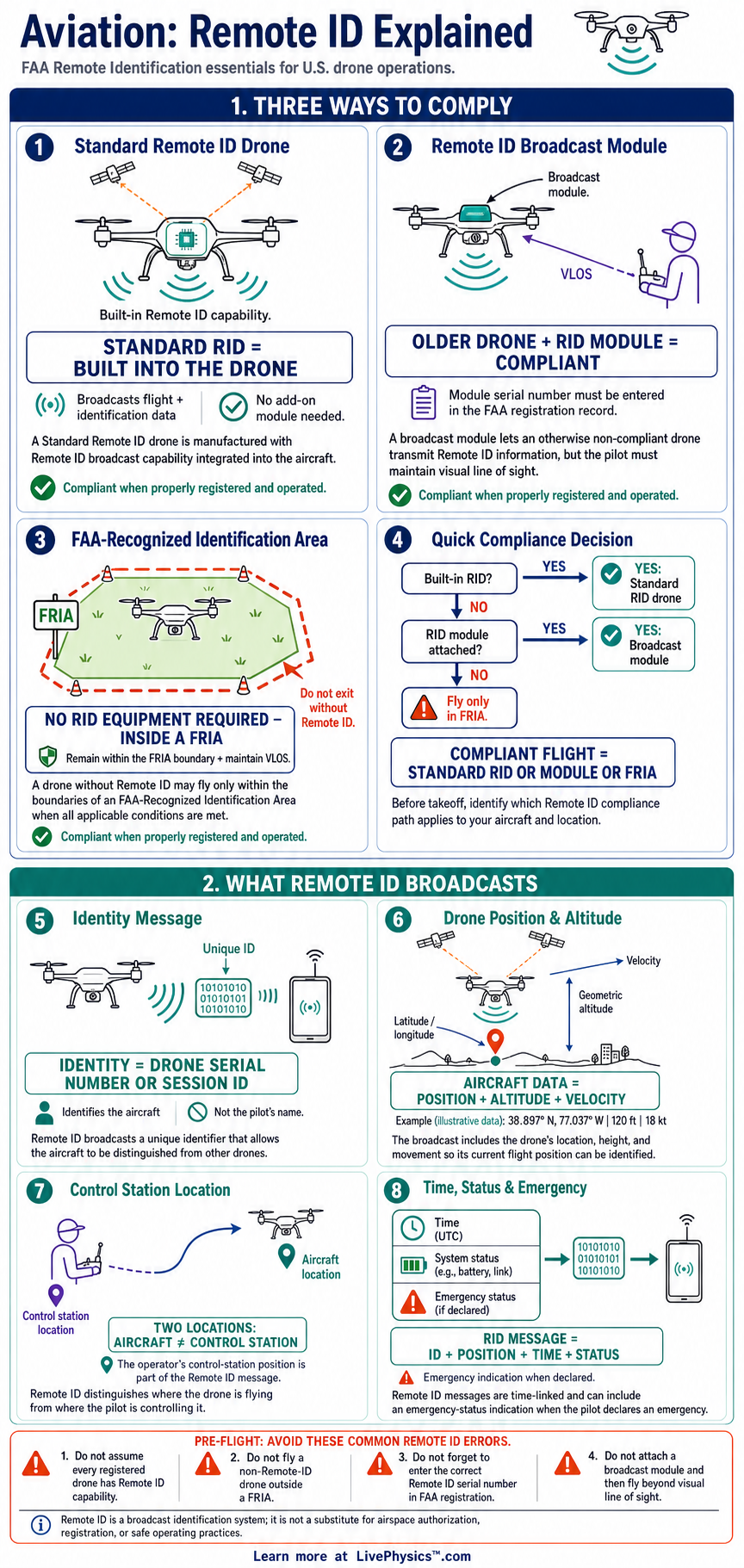
Remote ID is the system that allows certain unmanned aircraft to broadcast identification and location information while flying. It is an important FAA safety requirement for most drone operations in the United States. This cheat sheet helps pilots understand what Remote ID sends, when it is required, and how to choose a compliant setup.
It also supports practical preflight decisions for recreational and Part 107 operations.
The two main compliance paths are a Standard Remote ID drone and a Remote ID broadcast module. A Standard Remote ID drone transmits required information from the aircraft, while a module can be attached to an older aircraft. Pilots must also understand FAA-Recognized Identification Areas, called FRIAs, where some non-Remote-ID flights may occur.
The broadcast includes the drone identity, position, altitude, velocity, control station location, and an emergency status indication.
Key Facts
- Remote ID generally requires an unmanned aircraft to broadcast identification and location information during flight.
- A Standard Remote ID drone broadcasts Remote ID information through equipment built into the aircraft.
- A Remote ID broadcast module can make an eligible older drone compliant, but the aircraft must remain within visual line of sight of the control station.
- Remote ID broadcasts drone latitude, longitude, geometric altitude, velocity, time mark, identity information, and control station location.
- Drone geometric altitude equals the drone height measured from the reference ellipsoid, not necessarily its height above the launch site.
- A drone without Remote ID may operate in an FAA-Recognized Identification Area when it follows the FRIA and visual line of sight rules.
- Remote ID compliance does not replace FAA registration, airspace authorization, or the operating rules that apply to the flight.
- The Remote ID module serial number or the Standard Remote ID drone serial number must be properly linked to the aircraft registration when required.
Vocabulary
- Remote ID
- Remote ID is a system that broadcasts identifying and location information from an unmanned aircraft during flight.
- Standard Remote ID drone
- A Standard Remote ID drone is an aircraft with built-in equipment that meets the FAA Remote ID rule.
- Remote ID broadcast module
- A Remote ID broadcast module is an add-on device that broadcasts required Remote ID information for a drone.
- FRIA
- An FAA-Recognized Identification Area is an approved site where eligible drones may operate without Remote ID.
- Control station
- The control station is the location from which the pilot controls or monitors the unmanned aircraft.
- Geometric altitude
- Geometric altitude is an altitude measured from a global mathematical reference surface called an ellipsoid.
Common Mistakes to Avoid
- Assuming Remote ID replaces airspace approval is wrong because pilots still need authorization before entering controlled airspace when authorization is required.
- Flying an older drone with an attached broadcast module beyond visual line of sight is wrong because module-based compliance requires visual line of sight operations.
- Treating a FRIA as permission to ignore all drone rules is wrong because registration, safety limits, and local site requirements can still apply.
- Failing to connect the correct drone or module serial number to the registration is wrong because the broadcast identity must match the FAA registration record when required.
- Confusing geometric altitude with height above ground is wrong because Remote ID altitude uses a reference ellipsoid rather than the local terrain.
Practice Questions
- 1 A drone has a Remote ID module attached. The pilot plans to fly 1,200 feet away while keeping direct visual line of sight. Is the module compliance path suitable for this flight, and what other basic requirement must be checked?
- 2 A Remote ID message reports a drone latitude of 38.8977 degrees north, longitude of 77.0365 degrees west, and geometric altitude of 145 meters. List the three reported position-related data values.
- 3 A pilot owns a drone with no built-in Remote ID and no broadcast module. Name one location where the pilot may be able to fly it legally and state the important visibility condition.
- 4 Explain why Remote ID improves accountability without replacing the pilot's responsibility to follow airspace, registration, and operational rules.
Understanding Remote ID Explained
Remote ID works like a digital license plate combined with a basic location report for a drone. It uses radio signals that can be received by nearby compatible devices. The transmitted message helps the FAA, law enforcement, and other authorized parties identify aircraft that may be operating unsafely.
It does not mean that every person nearby can immediately learn the pilot's personal identity. The broadcast provides information that can be connected to registration records by authorized officials when needed.
A Standard Remote ID drone is built to meet the Remote ID rule. The manufacturer declares that the model complies, and the drone broadcasts its message during flight. Before flying, the pilot should confirm that Remote ID is active and that the aircraft registration number is correctly associated with the drone.
A Remote ID broadcast module is another option for an aircraft that is not Standard Remote ID compliant. The module must be attached and operating during the flight, and its serial number must be added to the drone registration record.
The message contains several important data fields. It includes a unique session identifier or a serial number, depending on the system. It also includes the drone latitude, longitude, geometric altitude, velocity, and time mark.
Geometric altitude is measured relative to a mathematical reference surface rather than local ground level. The message reports the control station location, which is usually the pilot's location or the launch point. It can also report an emergency status when the aircraft is in an urgent situation.
A broadcast module has a key operating limit. The unmanned aircraft must remain within visual line of sight of the person manipulating the flight controls. This rule prevents a pilot from using a module to conduct long-distance flights beyond the area where the aircraft can be seen directly.
Standard Remote ID drones can be used for operations that otherwise meet the applicable FAA rules, including some operations beyond visual line of sight when separately authorized. Remote ID compliance does not replace airspace authorization, visual observer requirements, registration, or Part 107 certification.
FRIAs provide a limited location-based exception. These sites are sponsored by community-based organizations or educational institutions and recognized by the FAA. A drone without Remote ID may fly inside a FRIA if it remains within visual line of sight and meets all other flight rules.
Pilots should study the status of their aircraft, module, registration, and planned location before each operation. A simple preflight check reduces the chance of an avoidable regulatory violation and improves safety for everyone using the airspace.