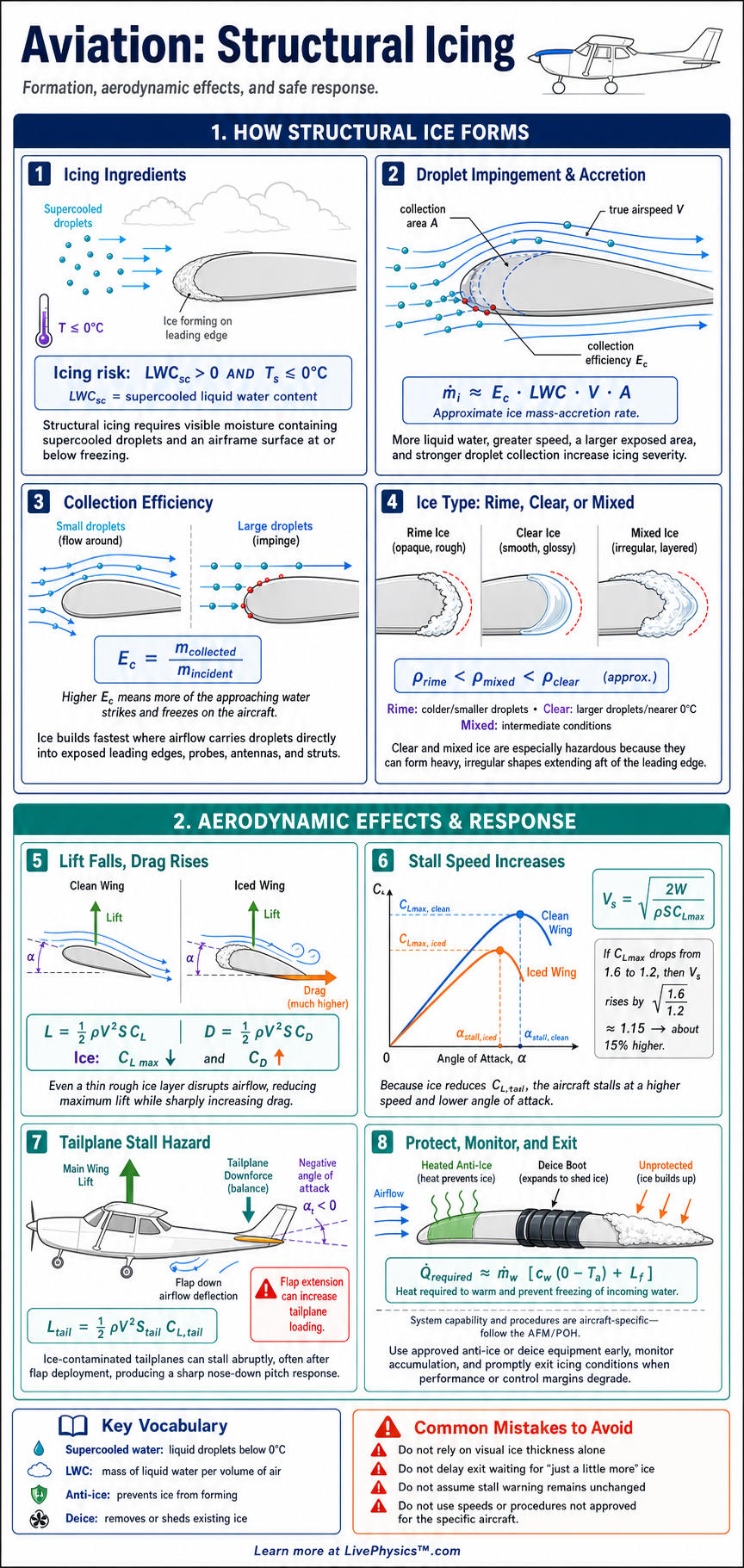
Structural icing occurs when supercooled water droplets freeze onto an aircraft’s exposed surfaces. It is a serious flight hazard because even a thin layer of ice can change airflow and reduce aircraft performance. Pilots need a clear reference because icing decisions often involve weather knowledge, aircraft limitations, and immediate action.
This cheat sheet organizes the essential facts for safe study and practical review.
The main ideas include the conditions needed for ice to form, the common types of structural ice, and their effects on lift, drag, stall speed, and control. It also covers the role of temperature, visible moisture, droplet size, and aircraft surface shape. Prevention starts before departure with weather planning and a clean airframe.
In flight, early recognition and prompt use of approved procedures are critical.
Key Facts
- Structural icing requires visible moisture and an aircraft surface temperature at or below zero degrees Celsius.
- Supercooled water droplets are liquid droplets below freezing that freeze when they strike an aircraft surface.
- Rime ice is rough and opaque, while clear ice is smoother, denser, and often formed by larger droplets.
- Ice reduces lift and increases drag by disrupting airflow over the wing and tail surfaces.
- Ice increases stall speed and decreases the critical angle of attack, so an aircraft can stall at a higher indicated airspeed.
- The clean aircraft concept states that critical aircraft surfaces must be free of snow, frost, slush, and ice before takeoff unless approved procedures state otherwise.
- Anti-ice prevents or delays ice formation, while deice removes or sheds ice that has already formed.
- The safest response to continuing ice accumulation is usually to exit the icing conditions using approved aircraft procedures.
Vocabulary
- Structural icing
- Structural icing is ice that forms on an aircraft’s external surfaces and affects its aerodynamic performance or systems.
- Supercooled water
- Supercooled water is liquid water that remains unfrozen at a temperature below zero degrees Celsius.
- Rime ice
- Rime ice is rough, white, opaque ice formed mainly when small supercooled droplets freeze quickly on impact.
- Clear ice
- Clear ice is dense, glossy ice that forms when larger droplets spread across a surface before freezing.
- Anti-ice
- Anti-ice is a system or treatment used to prevent ice from forming or adhering to an aircraft surface.
- Deice
- Deice means to remove accumulated ice from an aircraft surface using an approved system or procedure.
Common Mistakes to Avoid
- Waiting until ice looks thick before acting is unsafe because even a thin rough layer can greatly reduce lift and raise stall speed.
- Assuming icing occurs only below zero degrees Celsius outside air temperature is wrong because aircraft surface temperature and supercooled droplets determine whether ice forms.
- Treating rime ice as harmless is incorrect because its rough texture strongly disrupts airflow over leading edges.
- Using non-approved speed, flap, or autopilot actions during icing is dangerous because each aircraft has specific limitations and recovery procedures.
- Departing with frost on the wings is unsafe because frost can destroy smooth airflow and reduce lift during takeoff.
Practice Questions
- 1 An aircraft enters cloud at minus 8 degrees Celsius and accumulates rough white ice. Identify the likely ice type and describe its main aerodynamic effect.
- 2 A clean aircraft stalls at 55 knots. If icing raises stall speed by 15 percent, calculate the new stall speed.
- 3 An aircraft encounters visible moisture at plus 3 degrees Celsius, then descends into air at minus 4 degrees Celsius. State when structural icing becomes more likely and explain why.
- 4 Explain why leaving icing conditions is often safer than relying only on onboard deice equipment.
Understanding Structural Icing
Structural icing forms when an aircraft flies through visible moisture while the surface temperature is at or below freezing. Visible moisture includes cloud, fog, rain, drizzle, wet snow, and freezing precipitation. Many icing encounters occur between zero and minus twenty degrees Celsius, but icing can occur outside this range under certain conditions.
Supercooled droplets remain liquid below freezing until they strike a surface. On impact, they freeze and attach to the aircraft.
The shape and texture of the ice depend on droplet size, temperature, and the rate at which heat leaves the surface. Rime ice usually forms from small droplets in colder cloud. It looks rough, milky, and opaque.
Clear ice often forms from larger droplets or freezing rain. It can be smooth, heavy, and difficult to see because water spreads before freezing. Mixed ice combines features of both and can build into irregular shapes.
Ice changes an airfoil long before it looks severe. A rough leading edge disrupts smooth airflow and reduces the wing’s ability to produce lift. Drag increases, so the aircraft needs more power to maintain speed.
The stall angle of attack decreases and stall speed increases. Ice can also affect propellers, antennas, windshields, sensors, vents, landing gear, and control surfaces. Tailplane icing is especially dangerous because it can cause a sudden loss of pitch control, often during flap extension.
Pilots manage icing first through avoidance. Preflight planning includes checking forecasts, reports, freezing levels, cloud tops, precipitation type, and alternate routes. No aircraft should depart with frost, snow, or ice on critical surfaces unless its approved procedures specifically allow it.
During flight, pilots monitor outside air temperature, visible moisture, ice accumulation points, airspeed, engine instruments, and handling changes. They activate anti-ice or deice equipment according to the aircraft flight manual, not after waiting for a large buildup.
If ice continues to accumulate, leaving the icing conditions is often the safest response. A pilot may climb, descend, turn toward warmer air, or request a route change when performance permits. Speed changes, flap use, and autopilot use must follow the aircraft’s approved icing procedures.
The key study habit is to connect weather conditions with aircraft limitations and early action. Structural icing is not only a weather topic. It is an aerodynamic, operational, and decision-making hazard.