Understanding Phase Changes & Phase Diagram Lab
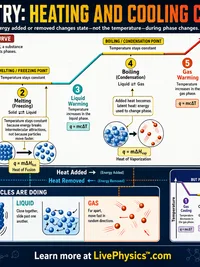
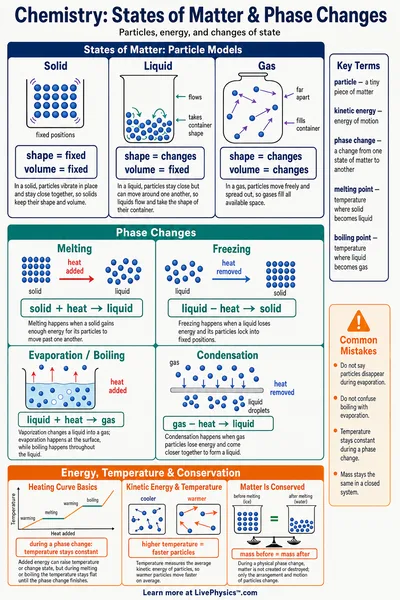
A phase change is not simply a substance getting hotter or colder. At the particle level, added energy can increase motion, or it can pull particles farther apart by weakening attractions between them. During a melting or boiling plateau, the energy is mainly changing the arrangement of particles, so the temperature stays steady even though heat continues to enter the sample.
The size of a plateau depends on the amount of substance and on how much energy its particles need to change phase. This hidden energy is called latent heat, and it explains why a large block of ice can absorb heat for a long time before all of it becomes liquid water. Cooling reverses the energy flow, but the same idea applies when particles form stronger attractions as a liquid freezes or a gas condenses.
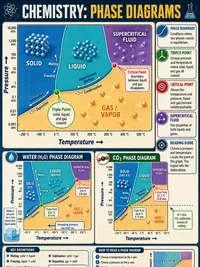
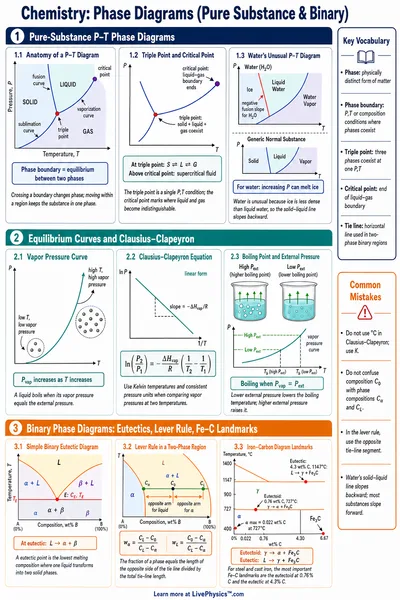
A pressure and temperature diagram shows which phase is most stable under a particular set of conditions. Each boundary line represents conditions where two phases can exist together in balance, such as liquid water and water vapor. The triple point is the one condition where solid, liquid, and gas all coexist, while above the critical point there is no clear boundary between liquid and gas.
Pressure changes boiling behavior because boiling begins when a liquid's vapor pressure matches the pressure outside it. At high altitude, lower outside pressure lets water boil at a lower temperature, so food may cook more slowly even though the water is bubbling. A pressure cooker raises the outside pressure, which raises the boiling temperature and allows hotter water and steam to transfer energy to food.
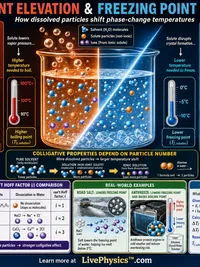
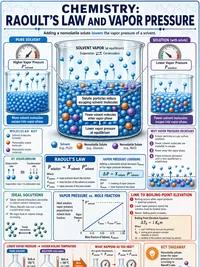
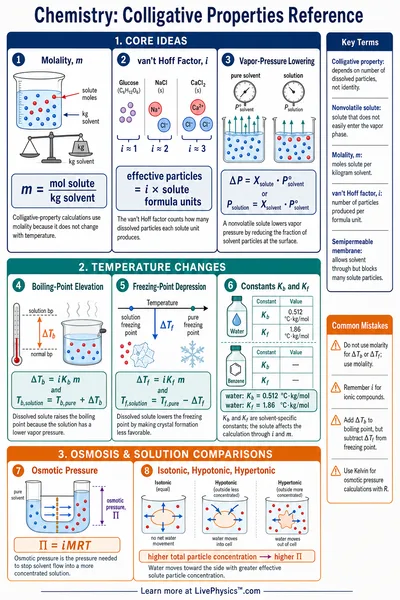
Dissolved particles affect phase changes because they disturb the ability of solvent particles to escape into a gas or organize into a solid crystal. More dissolved particles usually lower the freezing point and raise the boiling point, which is why salt can help melt ice on roads and antifreeze protects engine coolant in winter. When studying these effects, focus on the number of dissolved particles rather than only the mass of solute, since a compound that separates into ions can produce a larger change than a substance that stays as whole molecules.