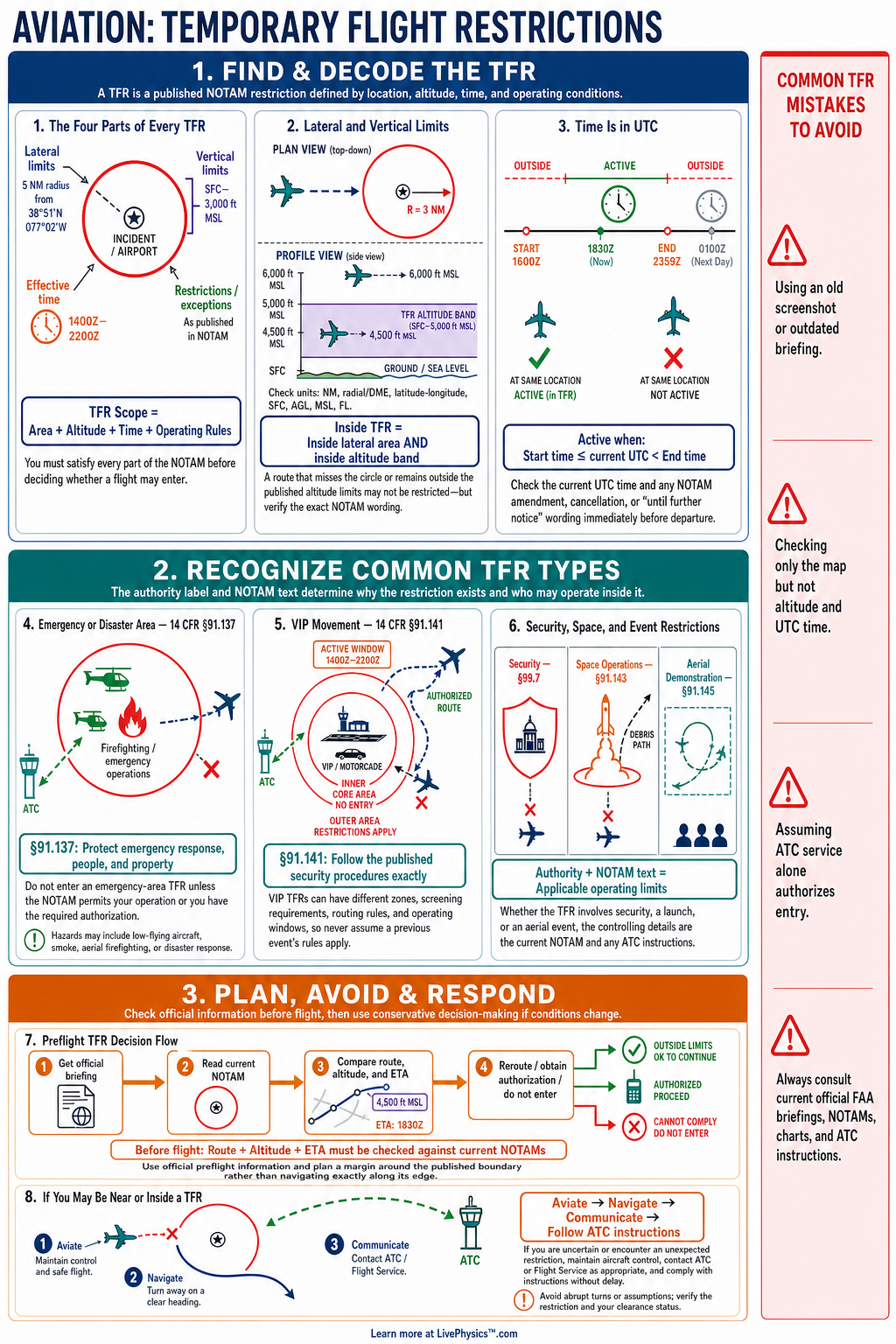
A TFR is published through a NOTAM and defines a location, time period, altitude range, and operating rules. Some TFRs prohibit most aircraft, while others permit flights that meet stated conditions or have approval. Pilots should check official FAA NOTAM information during preflight planning and remain alert for changes before departure.
Key Facts
- A Temporary Flight Restriction is a short-term airspace restriction published by the FAA in a NOTAM.
- A TFR NOTAM states the location, effective time, altitude limits, controlling authority, and any allowed operations.
- Pilots must convert NOTAM times in UTC to local time correctly before deciding whether a TFR is active.
- A restriction described as surface to 5,000 feet MSL includes all airspace from the ground up to 5,000 feet mean sea level.
- A sporting event TFR commonly restricts flight within 3 nautical miles of the venue from the surface to 3,000 feet AGL during the published period.
- A filed flight plan or VFR flight following does not equal authorization to enter a TFR.
- Pilots must follow every condition in the NOTAM, including assigned routes, transponder requirements, radio contact, and ATC clearance when required.
Vocabulary
- Temporary Flight Restriction
- A Temporary Flight Restriction is a short-term limit on aircraft operations within a defined area of airspace.
- NOTAM
- A NOTAM is an official notice that provides time-sensitive information important to flight operations.
- FDC NOTAM
- An FDC NOTAM is a Flight Data Center notice that often announces regulatory airspace changes such as TFRs.
- UTC
- UTC is the worldwide time standard used in aviation notices and flight planning.
- AGL
- AGL means above ground level and measures altitude from the surface directly below an aircraft.
- Authorization
- Authorization is explicit permission from the responsible agency or ATC to conduct an operation that would otherwise be restricted.
Common Mistakes to Avoid
- Assuming a TFR is inactive because local time is different from the NOTAM time is wrong because NOTAMs normally use UTC. Convert the published start and end times accurately.
- Reading only the TFR graphic is wrong because graphics may not show every exception, altitude rule, or communication requirement. Read the complete text NOTAM.
- Believing that an IFR clearance automatically permits entry is wrong because the TFR NOTAM may require separate authorization or may prohibit the operation. Follow the specific entry rules.
- Checking NOTAMs only the night before departure is risky because TFRs can appear or change shortly before a flight. Check again during final preflight planning.
- Treating the radius as a rough estimate is wrong because crossing even slightly inside the published boundary can be a violation. Plan a clear buffer around the restricted area.
Practice Questions
- 1 A TFR extends from the surface to 4,000 feet MSL. Your planned altitude is 3,500 feet MSL inside its lateral boundary. Is your flight within the restricted altitude range?
- 2 A sporting event TFR has a radius of 3 nautical miles centered on a stadium. An aircraft is 4.2 nautical miles from the stadium center. How far outside the TFR boundary is it?
- 3 A NOTAM is active from 1800 UTC to 2300 UTC. If local time is UTC minus 5 hours, what local times mark the start and end of the TFR?
- 4 A pilot receives VFR flight following while approaching a TFR but has not read the NOTAM or received specific entry approval. Explain why the pilot should not assume entry is permitted.
Understanding Temporary Flight Restrictions
A Temporary Flight Restriction is an area where normal flight rules are changed for a limited time. The Federal Aviation Administration issues these restrictions through NOTAMs. A NOTAM gives the exact area, effective dates and times, altitude limits, and any permitted operations.
TFRs can begin or end at unusual times, so pilots must read the complete notice rather than relying on a map symbol alone. An electronic flight bag can help display a restriction, but the official NOTAM remains the source for its legal details.
The location is often described using a center point, a radius, and sometimes multiple rings. For example, an inner ring may have stricter rules than an outer ring. Altitudes may be listed from the surface to a stated altitude, or between two altitudes.
Pilots must compare those limits with their planned route and cruising altitude. A route that passes above or below a TFR may be legal only when the NOTAM clearly allows that altitude. Terrain, altimeter settings, and climb or descent paths also matter near the boundary.
Different regulations support different kinds of TFRs. Disaster and hazard restrictions can protect firefighting aircraft, rescue crews, and people on the ground. Presidential movement restrictions protect national security and usually have detailed access procedures.
Space operation restrictions protect launches, reentries, and recovery activity. Airshows, major sporting events, and security events may also create restricted airspace. Each NOTAM states who may enter, such as law enforcement, military aircraft, emergency aircraft, scheduled airlines, or aircraft that receive specific authorization.
Careful preflight planning reduces the chance of an airspace violation. Pilots should obtain a complete standard briefing, review graphical and text NOTAMs, inspect the planned route, and check alternate airports. They should also check again shortly before takeoff because TFRs can be issued, extended, canceled, or changed quickly.
If a flight may operate near a restriction, pilots should contact the appropriate ATC facility or controlling agency using the instructions in the NOTAM. Filing a flight plan, receiving flight following, or seeing no warning on one app does not automatically grant entry permission.
Violating a TFR can create serious safety and legal consequences. A pilot may interfere with emergency operations, trigger an interception, face enforcement action, or lose certificate privileges. The best study habit is to practice reading real NOTAM language slowly.
Identify the center point, radius, altitude floor, altitude ceiling, time in UTC, rule authority, and exceptions. Then decide whether the planned flight stays outside the area or meets every listed condition for entry.