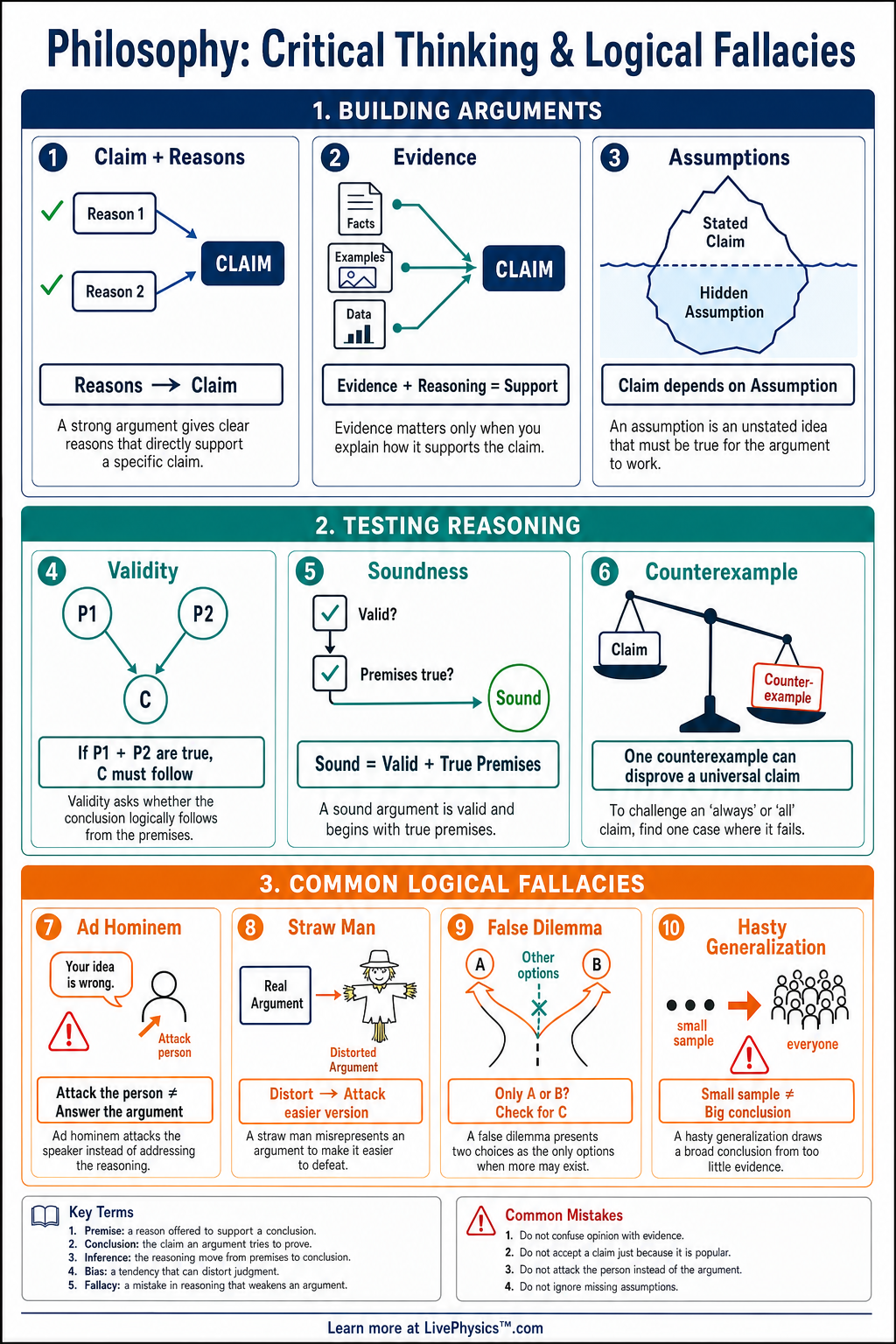
Critical thinking helps students judge whether claims are supported by good reasons. This cheat sheet covers the structure of arguments, the difference between truth and validity, and the most common logical fallacies. Students need these tools to read philosophy, evaluate debates, write stronger essays, and avoid weak reasoning.
It is useful for class discussions, written arguments, and analyzing real-world claims.
The core idea is that an argument contains premises that are meant to support a conclusion. A valid argument has a structure where true premises would make the conclusion impossible to deny, while a sound argument is both valid and based on true premises. Truth tables test how logical statements behave under different truth values.
Fallacies are common reasoning errors, such as attacking a person, using a false dilemma, or assuming that correlation proves causation.
Key Facts
- An argument is a set of premises offered as support for a conclusion.
- A valid argument has this form, if all premises are true, then the conclusion cannot be false.
- A sound argument has this formula, sound = valid structure + true premises.
- Modus ponens has this valid form: P -> Q; P; therefore Q.
- Modus tollens has this valid form: P -> Q; not Q; therefore not P.
- A conditional statement P -> Q is false only when P is true and Q is false.
- De Morgan's laws state, not (P and Q) = not P or not Q, and not (P or Q) = not P and not Q.
- Correlation does not prove causation because two events can be related without one directly causing the other.
Vocabulary
- Argument
- A group of statements in which some statements give reasons for accepting another statement.
- Premise
- A statement that gives evidence or support for a conclusion.
- Conclusion
- The claim that an argument is trying to prove or support.
- Validity
- A property of an argument whose conclusion must be true if all its premises are true.
- Soundness
- A property of an argument that is valid and has all true premises.
- Logical fallacy
- A mistake in reasoning that makes an argument weaker or misleading.
Common Mistakes to Avoid
- Confusing truth with validity, A valid argument can still have false premises, so validity is about structure, not whether every statement is factually true.
- Attacking the person instead of the claim is ad hominem reasoning because a person's character does not automatically show that their argument is false.
- Treating two options as the only options is a false dilemma when other reasonable choices or explanations exist.
- Assuming that an event caused another event just because it came first is post hoc reasoning because timing alone does not prove causation.
- Using popularity as proof is an appeal to popularity because a belief can be widely accepted and still be false or poorly supported.
Practice Questions
- 1 In the argument 'All mammals are warm-blooded; all whales are mammals; therefore all whales are warm-blooded,' how many premises are there, and what is the conclusion?
- 2 For the conditional P -> Q, list the truth value of the statement in each case: P true and Q true, P true and Q false, P false and Q true, P false and Q false.
- 3 Identify the fallacy: 'This policy must be good because millions of people support it.' Explain why the reasoning is weak.
- 4 A speaker gives accurate facts but uses them to support a conclusion that does not follow. Is the main problem truth, validity, or soundness? Explain your reasoning.
Understanding Critical Thinking & Logical Fallacies
A strong reasoner first separates the claim being made from the evidence offered for it. Many arguments contain hidden premises. For example, a school rule might say that phones should be banned because they distract students.
The unstated premise is that a rule should ban anything that distracts students. Once hidden premises are visible, they can be tested. Perhaps some phones are used for learning, or perhaps less strict rules could reduce distraction.
Finding an unstated premise does not automatically defeat an argument. It shows exactly where discussion should focus.
Deductive reasoning aims for certainty when its starting points are accepted. Its conclusion follows by the form of the argument. Inductive reasoning works differently.
It uses observations to make a likely conclusion. A survey of students may suggest that later school start times improve sleep, but it cannot guarantee the same result for every student or every school. Good inductive arguments need enough evidence, a fair sample, reliable measurements, and conclusions that do not go beyond the data.
Students should notice words such as likely, usually, and probably. These words often signal an inductive claim rather than a deductive proof.
Conditional statements can be confusing because ordinary conversation often adds meanings that formal logic does not include. The statement if it rains, the field is wet does not say that rain is the only way for a field to become wet. A sprinkler could produce the same result.
This explains why seeing a wet field does not prove that it rained. It is a common error called affirming the consequent. A truth table helps because it checks every possible pairing of truth values rather than relying on what seems natural in a sentence.
When working through one, read the conditional carefully and keep each row separate. Do not assume that a reversed statement has the same logical force.
Fallacies often work because they appeal to quick feelings or familiar patterns. An appeal to popularity treats widespread belief as proof. A straw man changes an opponent's actual view into a weaker version that is easier to reject.
A false dilemma pretends that only two choices exist when other options are available. In news posts, advertisements, and online arguments, pause before sharing a claim. Identify the exact conclusion.
Ask what evidence would support it, what evidence would weaken it, and whether another explanation fits the facts. In essays, state sources accurately and respond to the strongest version of an opposing view.
Careful reasoning is not about winning every disagreement. It is about making claims that can stand up to fair checking.