Argument Writing Lab
Pick a debate topic, gather evidence, and write a structured argument with a fair counterclaim and rebuttal. Score your draft on a 20 point rubric and run multiple trials to see what makes an argument stronger.
Guided experiments
Pick a guided experiment to follow step by step, or explore on your own.
Controls
Current topic. Social media for under-13s
Build a claim, gather evidence with warrants, fairly state the counterclaim, then close with a rebuttal.
Choose a debate topic
Should social media be banned for users under 13?
Step 1. Build your claim
Topic. Should social media be banned for users under 13?
Template. Social media should be banned for users under 13 because ...
Step 3. Acknowledge the counterclaim
Pick the strongest opposing argument and state it fairly. Aim for 20 to 40 words.
Suggested counterclaims
Step 2. Choose evidence and write warrants
0 / 4 addedHeavy social media use in early adolescence is linked to higher rates of anxiety and lower self-reported life satisfaction.
American Psychological Association, 2023
Brain regions involved in emotion regulation are still developing through age 14, which makes younger users more vulnerable to harmful content.
U.S. Surgeon General Advisory, 2023
Most major platforms already require users to be at least 13, but enforcement is weak and self-reported ages are rarely checked.
Pew Research Center, 2022
Cyberbullying reports drop in school districts that delay phone and social media access until middle school.
Journal of Adolescent Health, 2023
Many tweens use social media to maintain long-distance friendships and family ties, especially in immigrant and military families.
Common Sense Media, 2023
Strict age bans have historically pushed underage users onto private messaging apps with weaker safety tools.
Berkman Klein Center, 2022
Young creators use social platforms to learn digital skills, share art, and build small businesses before age 13.
MIT Media Lab, 2022
Teaching media literacy alongside supervised access leads to better outcomes than total bans, according to several school pilots.
UNESCO Media and Information Literacy Report, 2023
Time spent on social media varies widely. Some heavy users report harm, while moderate users report neutral or positive effects.
Oxford Internet Institute, 2022
Parental controls and screen-time tools work well for some families but are bypassed by tech-savvy preteens in others.
Family Online Safety Institute, 2023
Step 4. Write your rebuttal
Answer the counterclaim directly and then point back to your own claim. Aim for 2 to 3 sentences and at least 30 words. Reference a word from the counterclaim to show you read it carefully.
Step 5. Essay preview
Pro stanceShould social media be banned for users under 13?
Introduction
Your claim will appear here.
Body
Add evidence cards in step 2 to see body paragraphs here.
Counterclaim and rebuttal
Counterclaim. Acknowledge the strongest opposing view in step 3.
Rebuttal. Answer the counterclaim in step 4.
Conclusion
For these reasons, your claim will close the essay here.
Rubric score
5 / 20Claim Clarity
Is the claim stated in 1 to 3 sentences and does it use a clear stance verb such as should, must, or is?
Evidence and Warrants
How many evidence cards are used and is each one paired with a warrant that connects it to the claim?
Counterclaim Acknowledgment
Does the writer name the strongest opposing view fairly and in enough detail to be taken seriously?
Rebuttal Strength
Does the rebuttal answer the counterclaim directly and reinforce the original claim?
Overall Structure
Are all four sections complete and arranged in a logical order from claim to evidence to counterclaim to rebuttal?
Record this score to track your progress across trials.
Data Table
(0 rows)| # | Trial | Topic | Stance | Claim Words | # Evidence | Rubric /20 |
|---|
Reference Guide
Building a Strong Claim
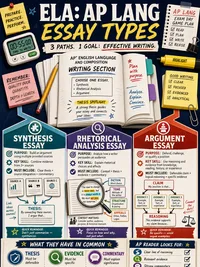
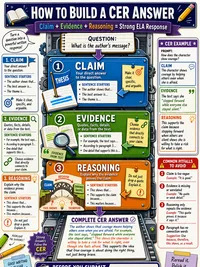
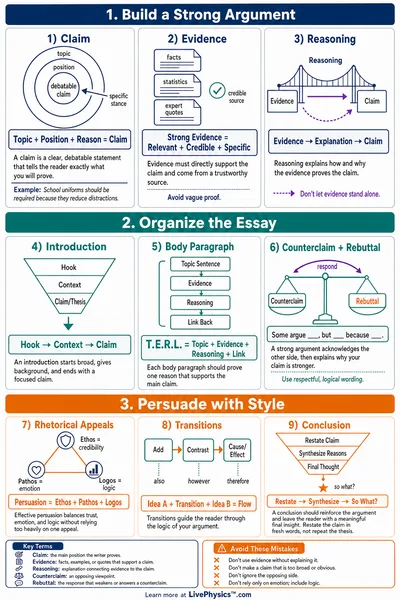
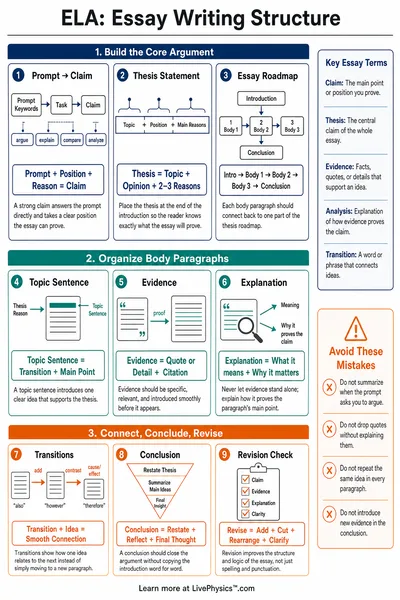
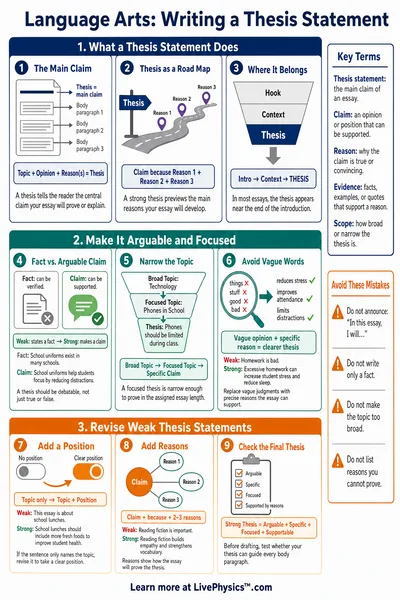
A claim is the sentence that states your position. It tells the reader exactly where you stand and signals that the rest of the essay will defend that stand.
Stance verbs. Strong claims use words like should, must, ought to, is, are, or must not. These words show the reader you are taking a position rather than describing the topic.
Length. One to three sentences is usually best. Long claims feel like body paragraphs and lose focus.
Specificity. A vague claim like "social media is bad" gives the reader nothing to evaluate. A focused claim names a group, a behavior, or a policy.
Evidence and Warrants Explained
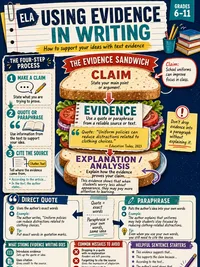
Evidence is a fact, study, expert quote, or example that supports your claim. Strong evidence comes from a clearly named source. The argument lab labels every card with a publisher and year so readers can trust the citation.
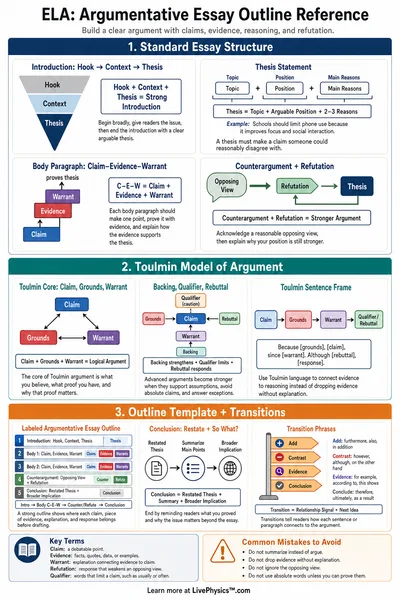
A warrant is one or two sentences that explain why the evidence supports your claim. Without a warrant the reader is left guessing about the connection.
Sentence stems. Try "This shows that...", "This connects to my claim because...", or "If this is true, then...". These stems force you to make the link explicit.
Two strong pieces of evidence with clear warrants usually beat five vague quotes with no explanation.
Counterclaim and Rebuttal Structure
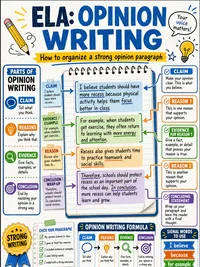
A counterclaim is the strongest opposing argument stated fairly. Acknowledging the other side shows the reader you have considered the full picture.
Useful starters include "Some argue that...", "Others believe...", or "Critics of this view say...". Keep the counterclaim long enough to feel real, not just a sentence to dismiss.
The rebuttal answers the counterclaim directly. Reference a word or phrase from the counterclaim to show you read it, then explain why your claim still holds up.
Try this pattern. "While it is true that..., the stronger reason for my claim is..."
Logical Fallacies to Avoid
Straw man. Rewriting the opposing view as weaker or sillier than it really is. Quote the strongest version of the counterclaim instead.
Ad hominem. Attacking the person who holds a view rather than the view itself.
Slippery slope. Claiming one change will inevitably lead to extreme outcomes without showing the steps.
Hasty generalization. Drawing a broad conclusion from one or two examples.
False dilemma. Treating the issue as only two options when more exist.
Appeal to emotion only. Using fear or pity in place of evidence rather than alongside it.