Argument & Evidence Organizer
Build a complete evidence-based argument step by step. Enter your claim, add supporting evidence with reasoning, address the counterclaim, and write your rebuttal. Preview and copy your finished argument when ready.
Choose a starter topic or write your own
State your main position or argument in one sentence.
Evidence
Add up to 4 pieces of supporting evidence with explanations.
What would someone who disagrees with you say?
Why is your argument still stronger despite the counterclaim?
Argument Structure Guide
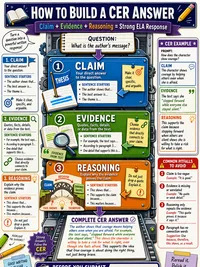
The Claim
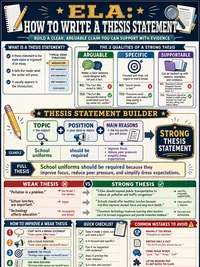
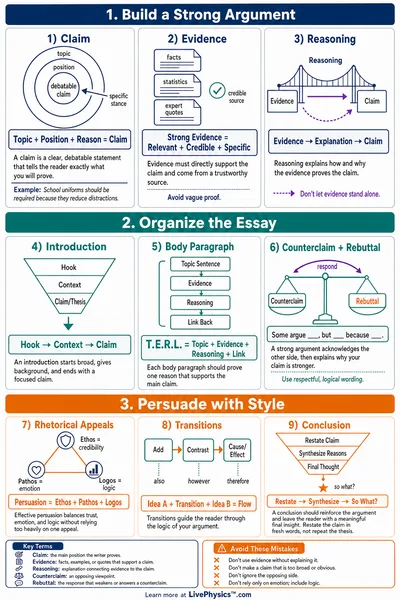
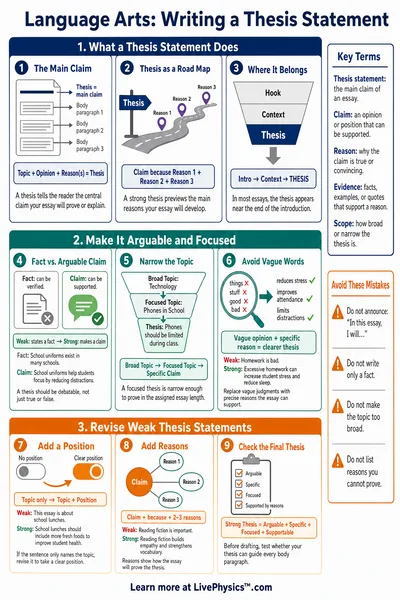
A claim is your main position or thesis - the central argument you want your reader to accept. A strong claim is specific, debatable, and supportable with evidence.
- Debatable. A good claim takes a clear side on an issue that reasonable people could disagree about.
- Specific. Avoid vague claims like "uniforms are good." State exactly what you believe and why it matters.
- Provable. You should be able to back it up with facts, statistics, or expert opinion.
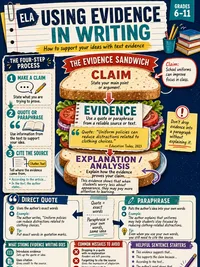
Evidence and Warrant
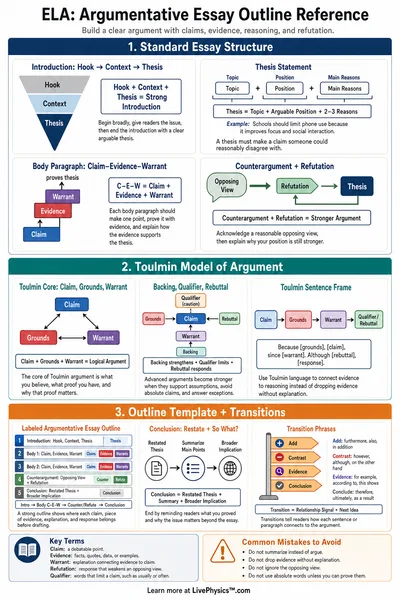
Evidence alone is not enough - you must explain how it connects to your claim. That explanation is called a warrant (or reasoning).
- Evidence can be statistics, research findings, expert quotes, historical events, or specific examples.
- Warrant explains the logical link, "This evidence shows that..." or "This supports my claim because..."
- Strong arguments use 2-4 pieces of evidence so each point gets clear explanation.
Counterclaim
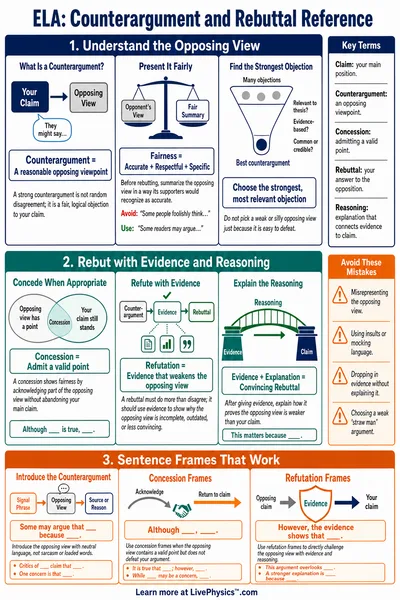
A counterclaim is the strongest opposing view to your argument. Including one makes your writing more credible - it shows you have considered multiple perspectives.
- Present the opposing view fairly and accurately, without dismissing it.
- Use phrases like "Some argue that..." or "Critics point out that..." to signal the shift in perspective.
- Choose a counterclaim you can effectively address in your rebuttal.
Rebuttal
The rebuttal explains why your argument is still stronger despite the counterclaim. It is not enough to simply repeat your original points - you must directly address the opposing view.
- Acknowledge any valid point in the counterclaim before explaining why it does not outweigh your evidence.
- Phrases like "While this concern has merit, the data shows..." help structure an effective rebuttal.
- End the rebuttal by reinforcing your core claim so the reader leaves with a clear takeaway.