Sign in to save

Bookmark this page so you can find it later.

Sign in to save

Bookmark this page so you can find it later.

Biology middle-school May 21, 2026

Why Do Twins Look Alike?

How shared genes shape family resemblance
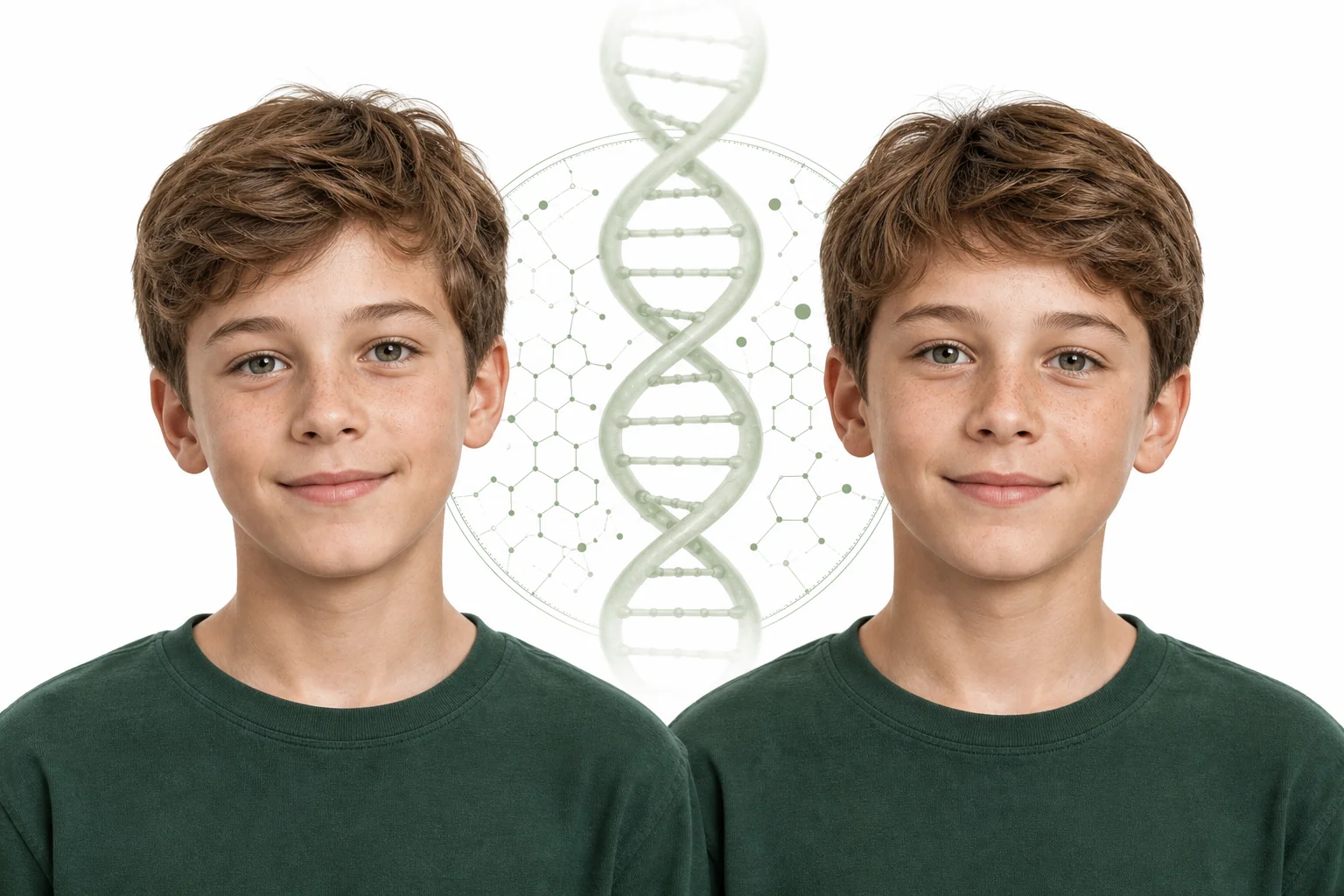
Two pairs of twins shown with a simplified DNA strand and family tree to compare identical and fraternal twin inheritance.

Identical twins look very alike because they started as one fertilized egg that split into two babies. They have almost the same genetic instructions, so many body traits develop in similar ways. Fraternal twins look alike about as much as other siblings because they came from two different eggs and two different sperm.

Big Idea. NGSS MS-LS3-2 explains how offspring inherit traits from parents, which helps students compare identical and fraternal twins.

Twins make inheritance easier to see. Some twins seem to match in face shape, eye color, hair texture, and height. Other twins share a birthday but look no more alike than other brothers and sisters. The difference starts before birth, when eggs and sperm join. In identical twins, one fertilized egg begins making cells and then separates into two embryos. Those two embryos carry almost the same DNA. In fraternal twins, two eggs are fertilized by two different sperm cells. Each baby gets a different mix of DNA from the same parents. That makes fraternal twins genetic siblings who happen to grow in the uterus at the same time. Biology also has a second part. Nutrition, health, and life experiences can affect how traits develop. Twins are a clear way to study how inherited instructions and the environment work together.

Two ways twins begin
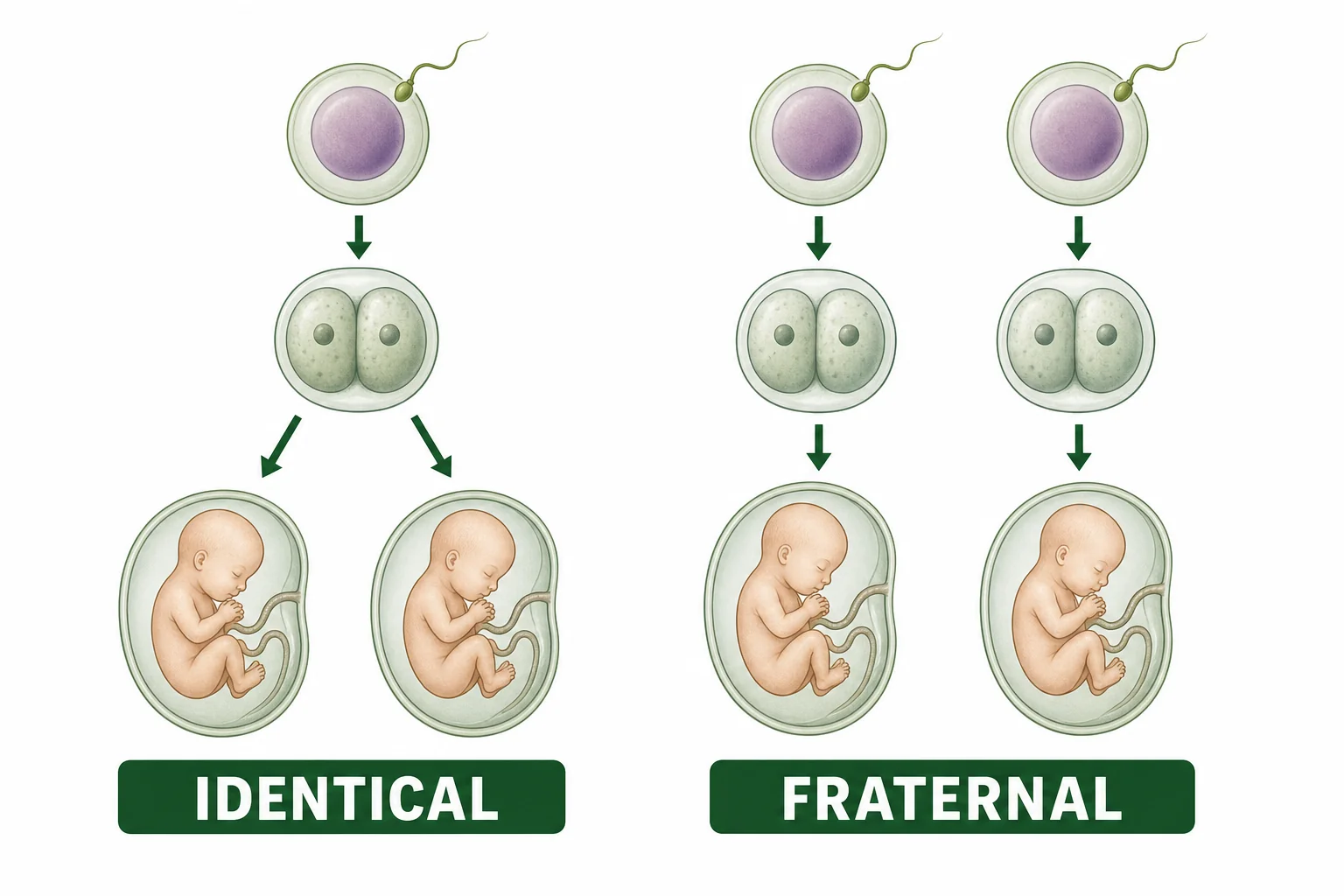
Diagram comparing identical twins from one fertilized egg that splits and fraternal twins from two separate fertilized eggs.
Identical twins share one starting cell. Fraternal twins start from two.
All twins begin with eggs and sperm, but the starting pattern is not always the same. Identical twins begin when one egg is fertilized by one sperm. The early ball of cells then splits into two groups. Each group can grow into a baby. Because both groups came from the same first cell, the two babies start with nearly the same DNA. Fraternal twins begin in a different way. The parent releases two eggs during the same cycle. Each egg is fertilized by a different sperm cell. The two babies grow at the same time, but they did not come from the same fertilized egg. Their DNA is mixed in the same way as any two siblings with the same parents. This is why identical twins usually look more alike than fraternal twins.

The first split tells a big part of the twin story.

DNA is the instruction set
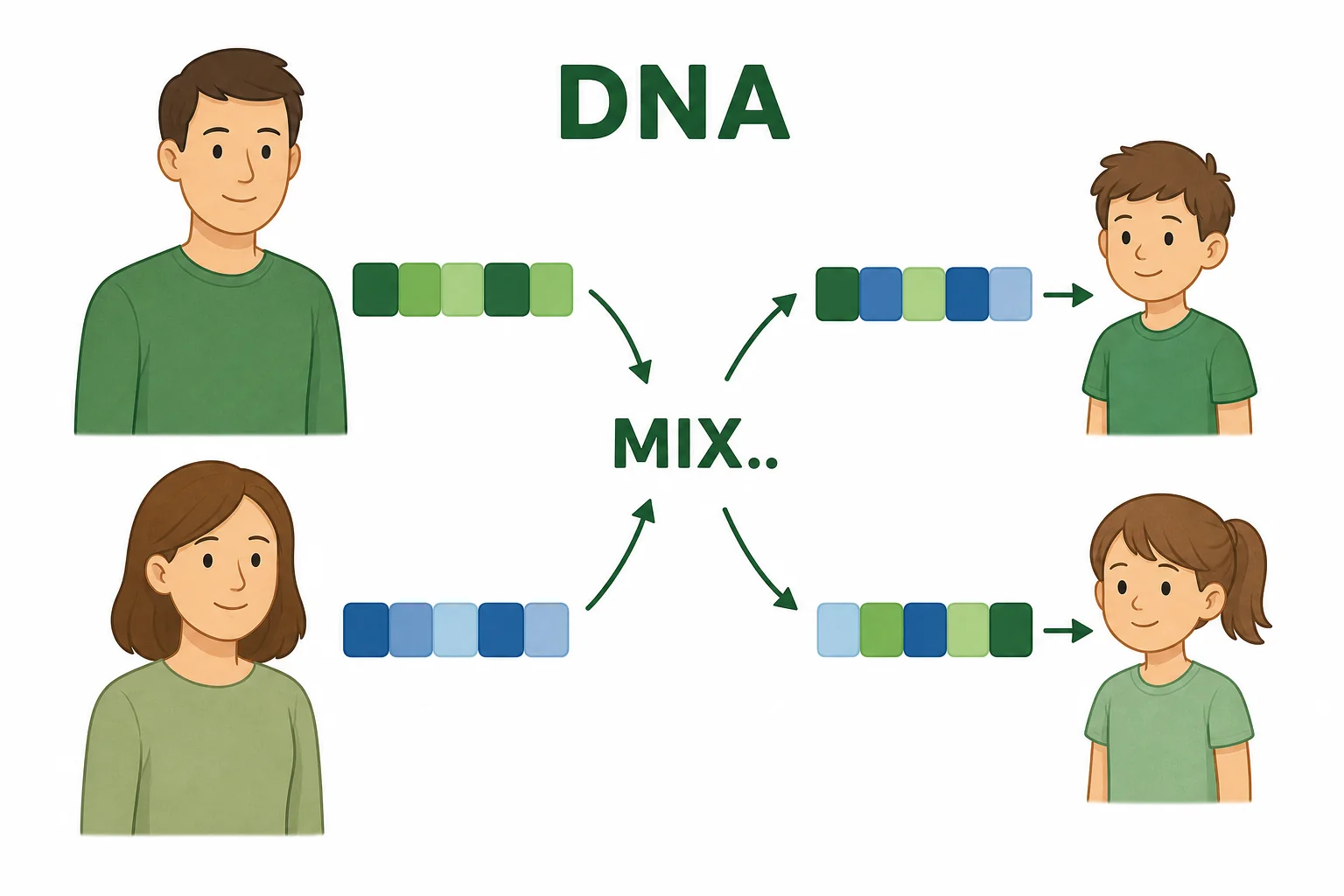
Simplified DNA strands and parent-to-child inheritance arrows showing shared and different gene versions in twins.
DNA is copied from parents in different combinations.
DNA is a long molecule inside cells. It carries instructions that help build and run the body. These instructions affect many traits, such as blood type, eye color range, hair color range, and some parts of face shape. A person gets half of their DNA from the egg and half from the sperm. Identical twins come from the same egg and sperm pair, so their DNA starts almost the same. Fraternal twins get different egg and sperm pairs, so each twin receives a different mix of the parents' DNA. That mix can still produce shared family traits. Two siblings may both have brown eyes or similar smiles because they inherited some of the same versions of genes. They do not need to have the exact same DNA to look related.

Identical twins start with nearly matching instructions.

Same genes, not exact copies
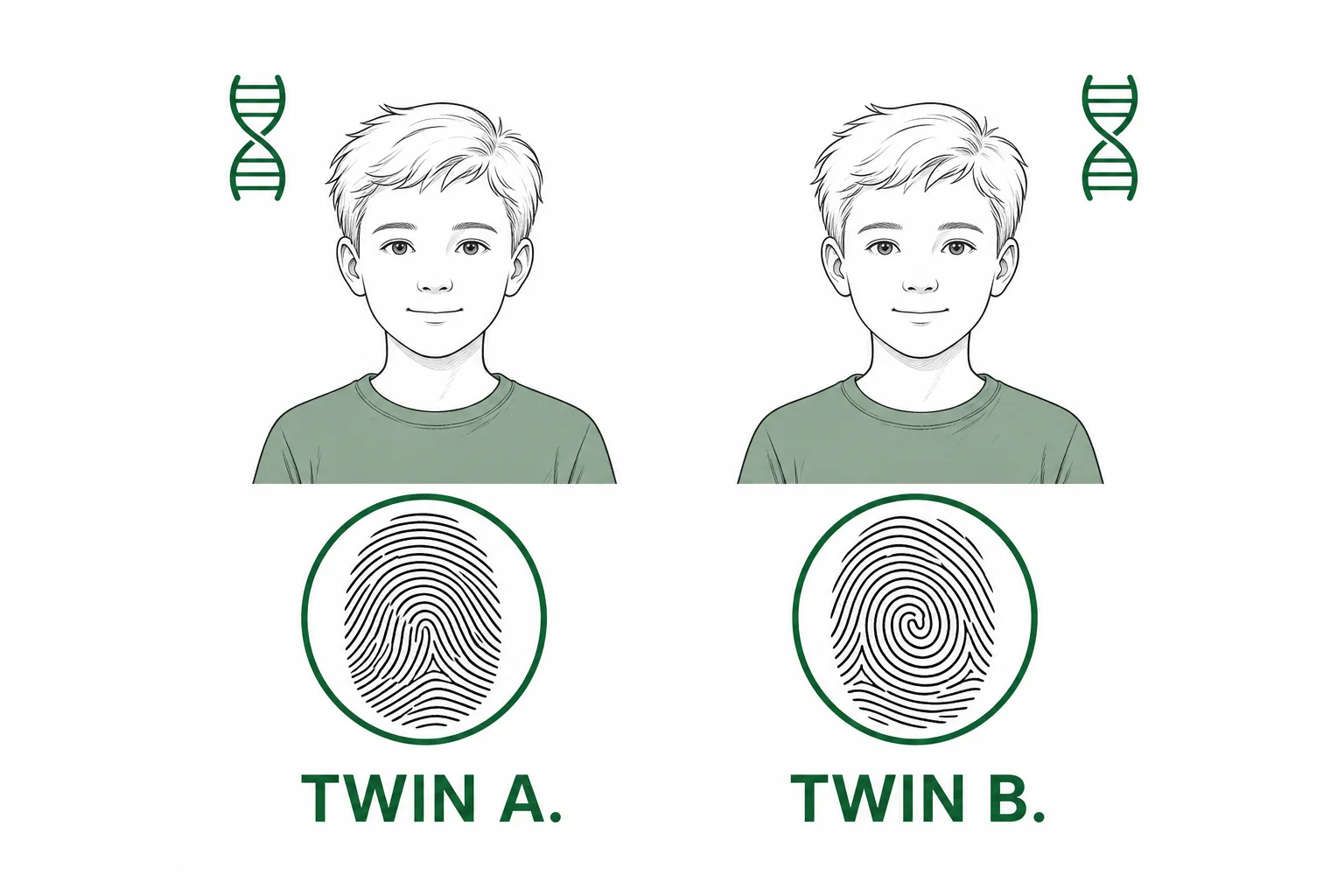
Two identical twin profiles with similar DNA symbols and enlarged fingerprints that have different ridge patterns.
Similar DNA can still lead to small differences.
Identical twins are often called genetic matches, but they are not perfect copies in every possible way. DNA can gain small changes as cells divide. These changes are usually tiny and may not affect appearance. Also, cells can use the same DNA instructions at different levels. One gene may be more active in one tissue than another. This can lead to small differences over time. Fingerprints are a good example. Identical twins have very similar genes, but they do not have the same fingerprints. Fingerprints form as skin grows before birth. Pressure, blood flow, and position in the uterus all play a role. The result is a pattern that is influenced by genes and shaped by development. This helps explain why identical twins can be very similar but still be separate individuals.

Matching DNA does not make two people exactly the same.

Fraternal twins are siblings
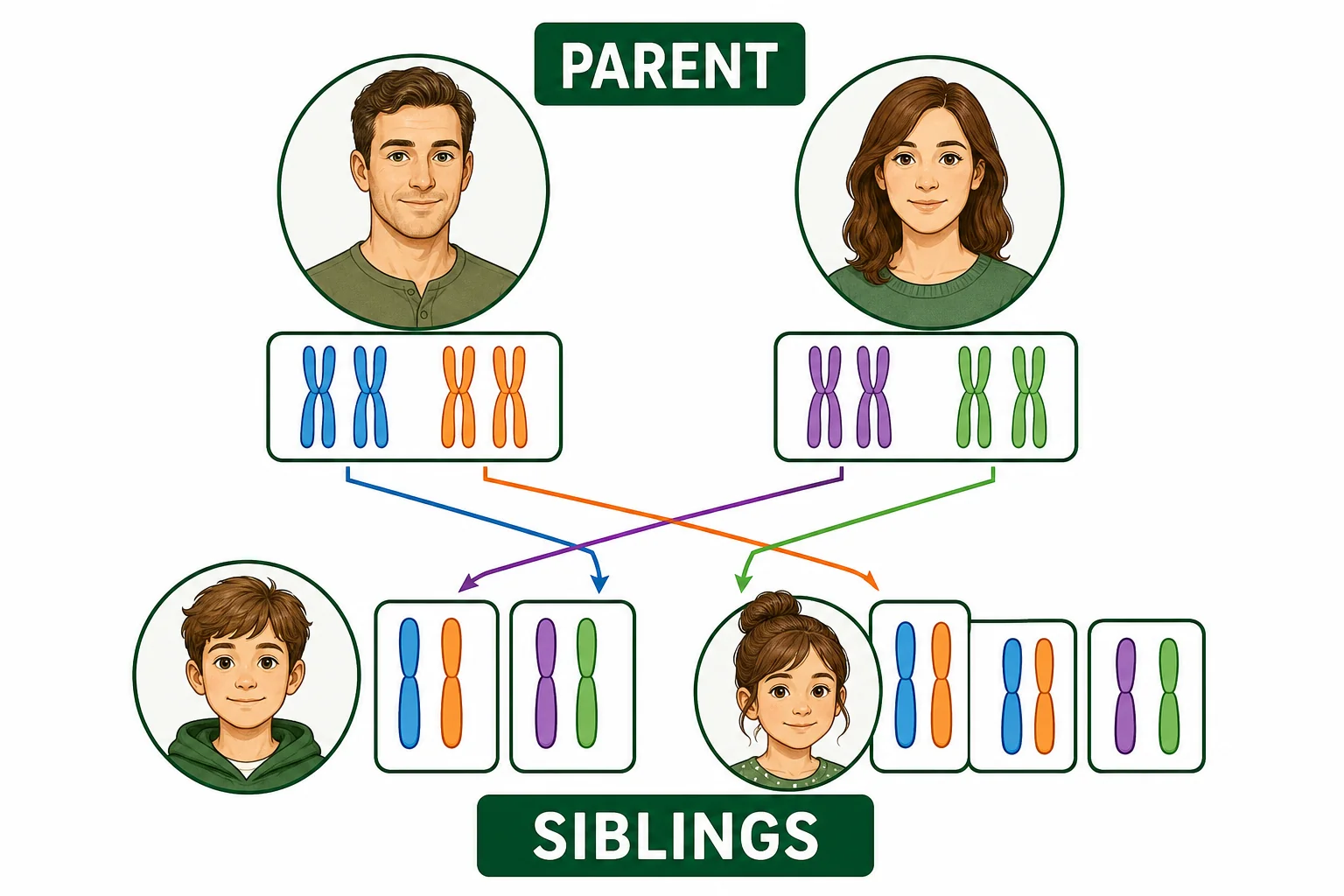
Family inheritance diagram showing two parents and fraternal twins receiving different combinations of chromosome colors.
Fraternal twins receive different DNA mixes from the same parents.
Fraternal twins can look alike, but their resemblance has a different cause. They are siblings who share a birthday. Like other siblings, they inherit about half of their DNA from each parent. The exact half is not the same for each child. During egg and sperm formation, chromosomes are shuffled. This gives each egg and sperm a different set of genetic instructions. When two eggs are fertilized, two different combinations form. The twins may both inherit the same hair color version from a parent, or they may inherit different versions. They may be the same sex or different sexes. They may look very similar, somewhat similar, or quite different. Their shared family background matters, but they do not have the near match seen in identical twins.

Fraternal twins are as genetically related as other siblings.

Environment also matters
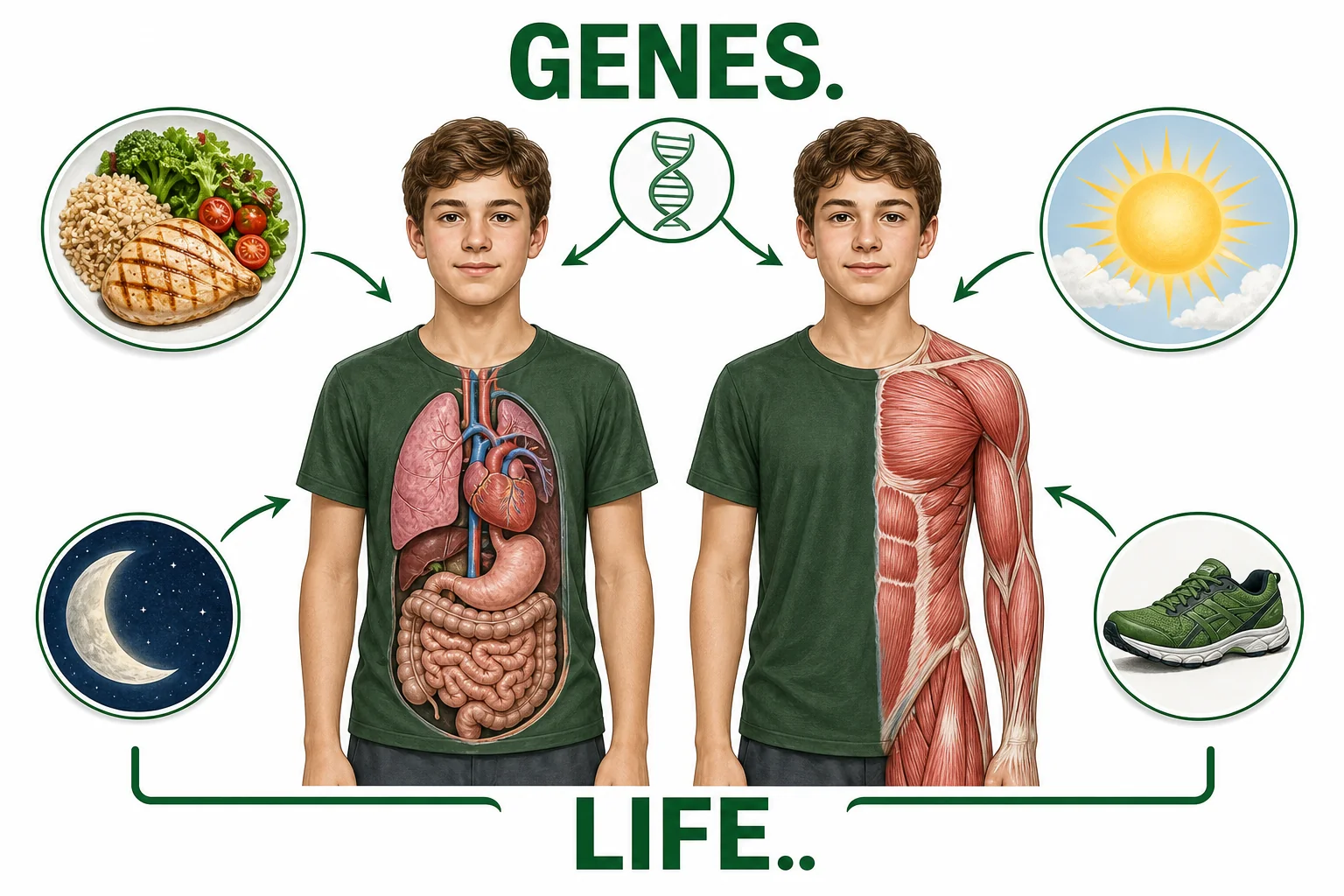
Identical twins shown in different daily environments with icons for food, sleep, sunlight, and exercise affecting development.
Life experiences can shape how inherited traits develop.
Genes are important, but they are not the only influence on how a person looks and grows. Environment includes nutrition, sleep, illness, exercise, sunlight, and many other parts of life. Even before birth, twins may not experience exactly the same conditions. One twin may get slightly more nutrients through the placenta. One may have a different position in the uterus. After birth, choices and experiences can add more differences. A twin who spends more time outdoors may have darker skin from sun exposure. A twin who plays a sport may build different muscles. Height, weight, and health can also change with diet and activity. Scientists study twins because they help compare inherited traits with life experiences. Twins show that traits develop through both biology and environment.

Traits are shaped by inherited instructions and real life.

Vocabulary

DNA
A molecule in cells that carries instructions for inherited traits.
Gene
A section of DNA that helps control a trait or body process.
Identical twins
Twins that develop after one fertilized egg splits into two embryos.
Fraternal twins
Twins that develop from two different eggs fertilized by two different sperm cells.
Trait
A feature of an organism, such as eye color, height, or blood type.
Environment
The conditions and experiences that affect development, such as nutrition, sunlight, and activity.

In the Classroom

Twin start models

20 minutes | Grades 6-8

Students use counters or paper circles to model one fertilized egg splitting and two separate fertilized eggs forming. They compare which model should produce the most similar DNA.

Inherited trait cards

30 minutes | Grades 6-8

Students draw parent gene cards and create two offspring trait combinations. Then they decide whether the results are more like identical twins, fraternal twins, or non-twin siblings.

Genes and environment sort

25 minutes | Grades 6-8

Students sort trait examples into inherited, environmental, and both. The class discusses why many real traits fit best in the both category.

Key Takeaways

  • Identical twins usually look very alike because they come from one fertilized egg that splits.
  • Fraternal twins come from two eggs and two sperm, so they are genetic siblings with the same birthday.
  • DNA carries inherited instructions that affect many visible traits.
  • Identical twins can still have differences because development and life experiences matter.
  • Twin studies help scientists separate the effects of inheritance and environment.