Practice identifying genotypes, phenotypes, dominant alleles, recessive alleles, and simple inheritance patterns.
Read each problem carefully. Use letters to represent alleles when needed, and show your work in the space provided.
Using alleles and Punnett squares to predict inherited traits
Biology - Grade 6-8
- 1
In pea plants, the allele for purple flowers, P, is dominant over the allele for white flowers, p. What flower color would a plant with the genotype Pp have? Explain your answer.
- 2
A pea plant has the genotype pp for flower color, where P means purple flowers and p means white flowers. What is the plant's phenotype?
- 3
For a trait, B represents a dominant allele for brown eyes and b represents a recessive allele for blue eyes. List the possible genotypes for a person with brown eyes.
- 4
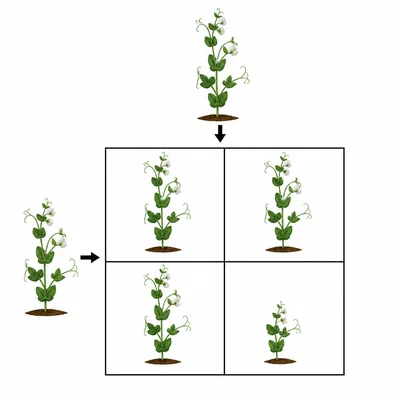
Use a Punnett square to predict the offspring from a cross between two heterozygous tall pea plants, Tt and Tt. Tall, T, is dominant over short, t. What are the possible genotypes and their ratios?
- 5
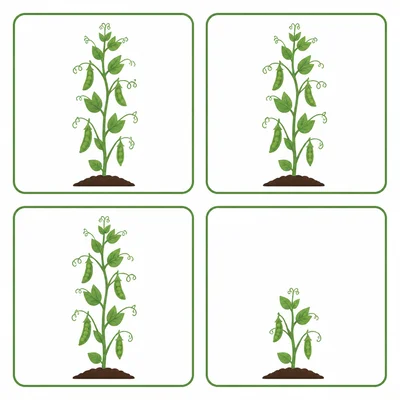
Using the Tt by Tt cross from the previous problem, what percent of the offspring are expected to be tall?
- 6
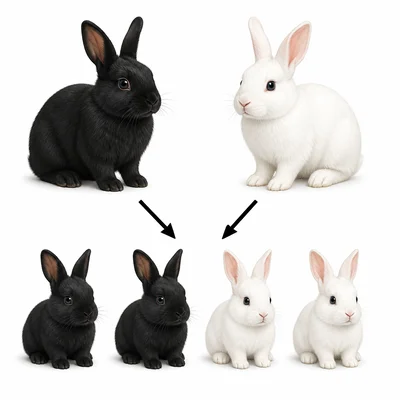
A rabbit's black fur allele, F, is dominant over its white fur allele, f. A rabbit with genotype Ff is crossed with a rabbit with genotype ff. Complete the cross and state the expected phenotypes of the offspring.
- 7
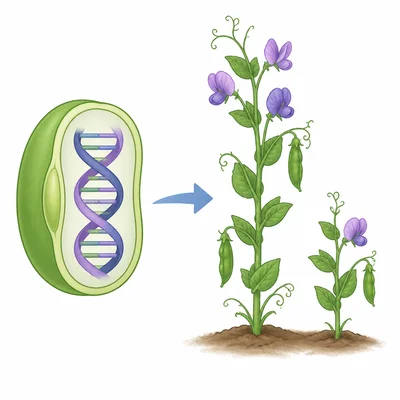
Explain the difference between genotype and phenotype using the example of pea plant height.
- 8
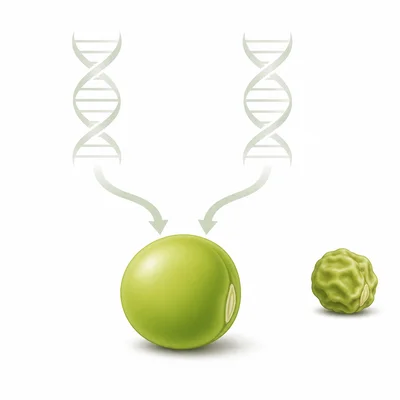
In a certain plant, smooth seeds, S, are dominant over wrinkled seeds, s. A student observes a plant with smooth seeds. Can the student know for sure whether the plant's genotype is SS or Ss just by looking? Explain.
- 9
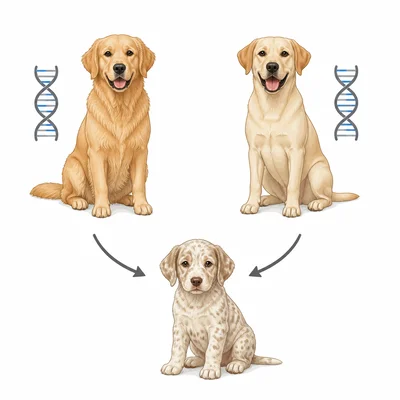
A dog has the genotype hh for a recessive coat pattern. What must be true about the dog's parents' alleles for this trait?
- 10
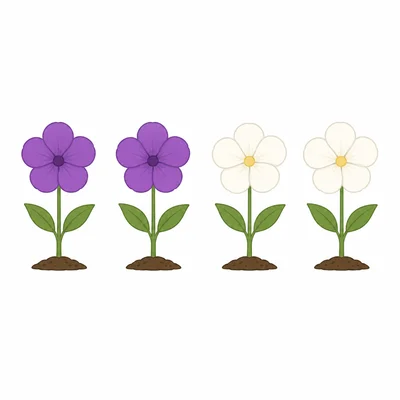
A chart shows four offspring from a cross: Aa, Aa, aa, and aa. If A is dominant and a is recessive, what percent of the offspring show the dominant phenotype and what percent show the recessive phenotype?
- 11
For a certain flower color trait, red, R, is dominant over white, r. Write the genotype of a plant that is homozygous dominant and the genotype of a plant that is homozygous recessive.
- 12
A flower with genotype Rr is described as heterozygous. What does heterozygous mean?
- 13
A student says, "A dominant trait is always more common in a population than a recessive trait." Is the student correct? Explain.
- 14
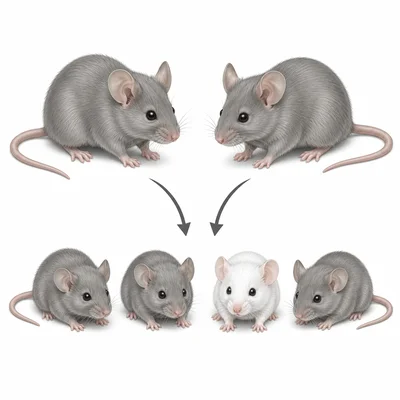
In mice, gray fur, G, is dominant over white fur, g. Two gray mice have some offspring with white fur. What are the most likely genotypes of the two gray parent mice?
- 15
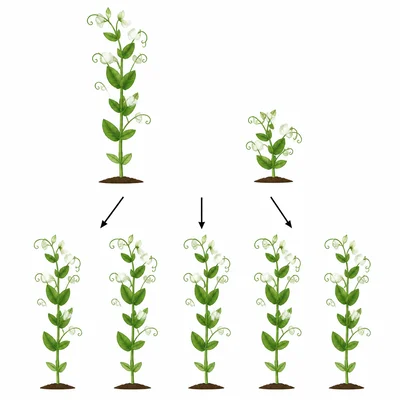
A plant breeder crosses a purebred tall pea plant, TT, with a purebred short pea plant, tt. Tall, T, is dominant over short, t. What genotype and phenotype are expected for all first-generation offspring?