DNA Replication Animator
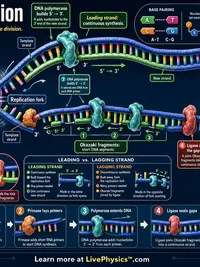
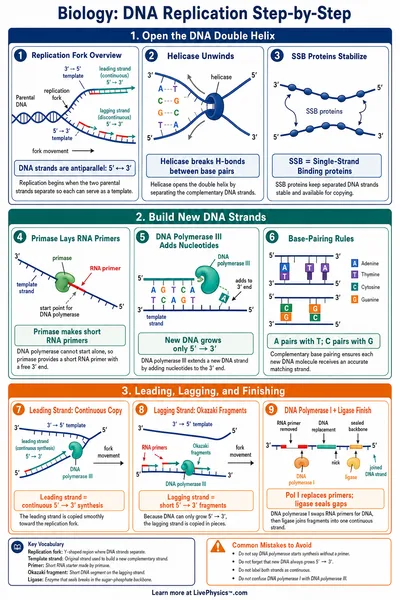
Animated visualization of DNA replication at the fork. Watch helicase unwind the helix, DNA polymerase build the leading strand continuously, primase lay RNA primers on the lagging strand, and ligase seal the Okazaki fragments.
DNA replication begins when replication machinery assembles at the origin of replication. The double helix is about to be unwound.
How DNA replication works
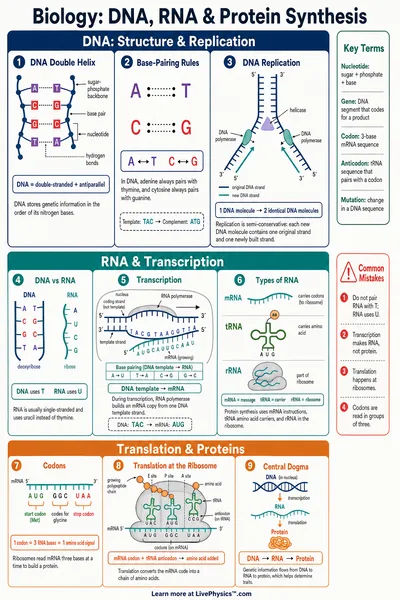
DNA replication is semiconservative. Each daughter helix contains one original parent strand and one newly synthesized strand. The two parent strands run in opposite directions, but DNA polymerase can only build a new strand in the 5 prime to 3 prime direction. This asymmetry is why the leading strand is built continuously while the lagging strand is built in short pieces called Okazaki fragments that ligase later joins together.
Curriculum alignment
Supports NGSS HS-LS1-1 (DNA structure and function), HS-LS3-1 (inheritance), AP Biology unit 6 (gene expression and regulation), and IB Biology topic 2.7 (DNA replication). The visualization makes the asymmetry between leading and lagging strand synthesis tangible and is a useful starting point before introducing the names of all the enzymes.
Key Concepts
Helicase
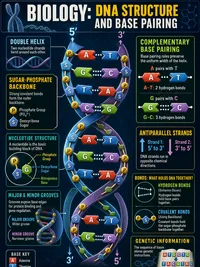
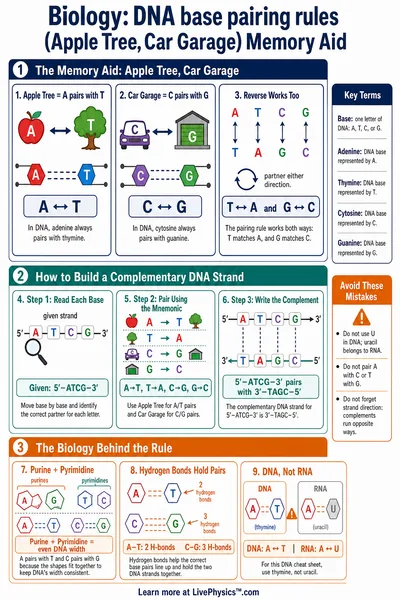
Helicase unwinds the double helix at the replication fork by breaking hydrogen bonds between complementary base pairs. It moves processively along the DNA, opening the two strands so that each can serve as a template for a new strand.
DNA Polymerase III
The main replicative polymerase. It reads a template strand in the 3 prime to 5 prime direction and synthesizes the complementary strand in the 5 prime to 3 prime direction, adding one nucleotide at a time. It requires a free 3 prime hydroxyl end provided by an RNA primer.
Ligase and Okazaki Fragments
The lagging strand is built in short Okazaki fragments, each starting with an RNA primer. DNA Polymerase I removes the primers and fills the gaps with DNA. DNA Ligase then seals the remaining nicks by forming phosphodiester bonds between adjacent fragments.