Sign in to save

Bookmark this page so you can find it later.

Sign in to save

Bookmark this page so you can find it later.

Math middle-school May 20, 2026

How Spirals Show Up Everywhere in Nature

A pattern made by growth and ratio
A nautilus shell, sunflower head, galaxy, and pine cone arranged to show spiral patterns in nature

A spiral is a curve that winds around a center while moving farther away. Nature makes spirals when growth, movement, or packing follows a steady rule. Math helps us compare these patterns with ratios, angles, and sequences.

Big Idea. Common Core 6.RP.A.3 asks students to use ratios and rates to describe real patterns, including spiral growth in nature.

Spirals are easy to spot once you know what to look for. A snail shell curls outward. A sunflower packs seeds in crossing arcs. A hurricane turns around a calm center. A galaxy forms long curved arms. These shapes are not copied from one master plan. They often appear because simple rules repeat as something grows, moves, or fits into space. Middle-school math gives us tools for describing those rules. Ratios compare one amount to another. A sequence lists numbers in order. A scale factor tells how a shape changes as it gets larger. The Fibonacci sequence is one famous example because its numbers can model some growth patterns. It does not explain every spiral, but it gives a useful starting point. In this explainer, spirals become a way to connect number patterns, proportional reasoning, and real objects in nature.

What makes a spiral
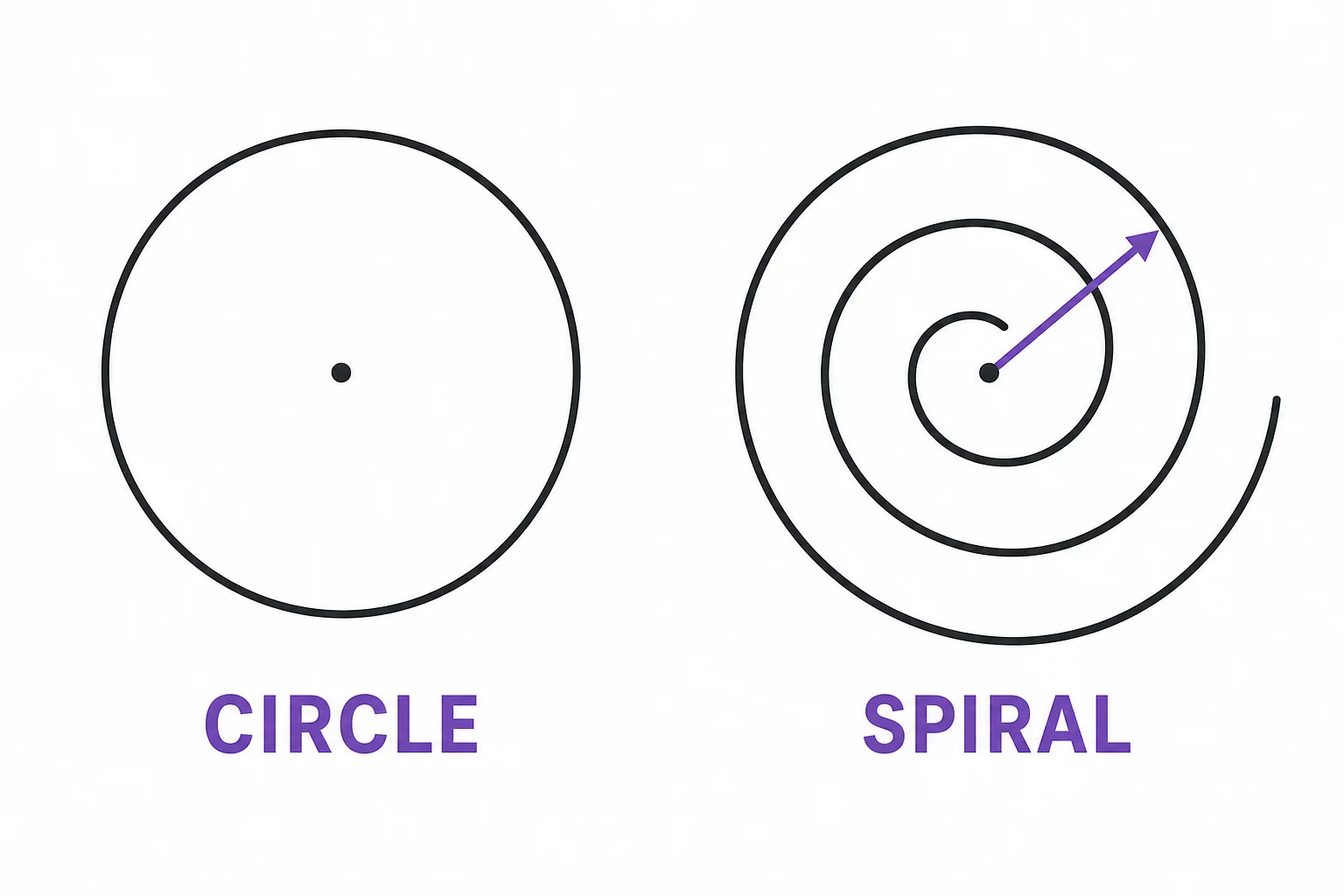
A diagram comparing a circle with a spiral and showing that the spiral moves farther from the center as it turns
A spiral turns and changes distance from the center
A spiral is not just a circle. A circle stays the same distance from its center. A spiral keeps turning while its distance from the center changes. That changing distance is the key idea. Some spirals spread out by adding the same amount each turn. Others spread out by multiplying by a similar factor. Those two rules make different curves. In middle-school math, this connects to ratios because you can compare one turn to the next. If each new turn is about the same number of times wider than the last, the shape follows a repeated growth rule. Natural spirals can be messy because living things grow in changing conditions. Even so, math lets us measure the pattern instead of only describing what it looks like.

A spiral turns like a circle, but its distance from the center changes.

Fibonacci numbers in plants
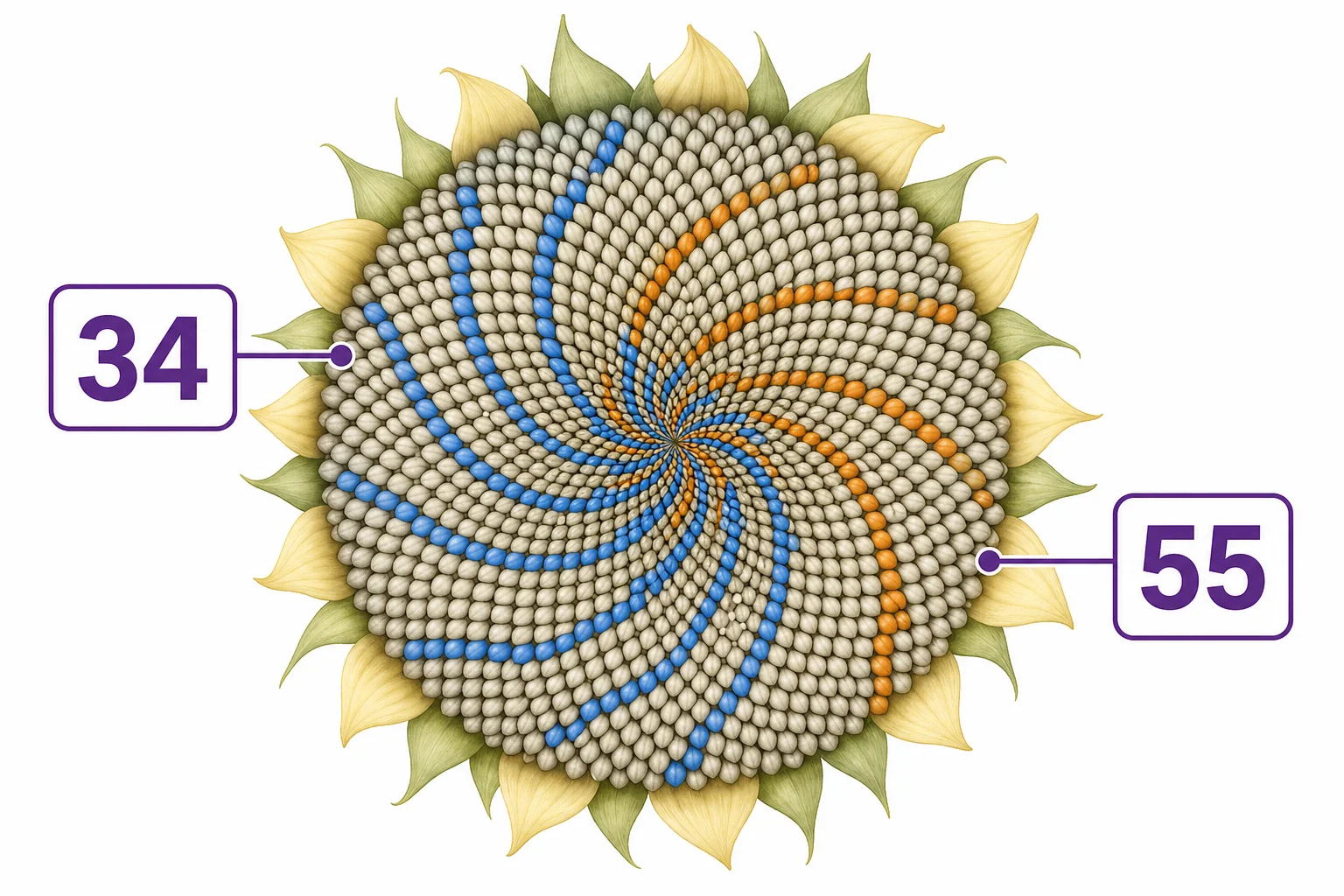
A sunflower head with two sets of curved seed spirals highlighted in different colors and labeled with Fibonacci counts
Sunflower seed arcs often have Fibonacci counts
The Fibonacci sequence begins 1, 1, 2, 3, 5, 8, 13, and continues by adding the two previous numbers. Many plants show counts that are near Fibonacci numbers. A pine cone may have 8 spirals going one way and 13 going the other. A sunflower may show 34 and 55, or another nearby pair. These numbers appear because new parts often grow near the center while older parts move outward. If each new seed or scale appears at a steady angle from the last one, the plant can pack many parts without leaving large gaps. This is not magic, and it is not exact every time. It is a useful model. The math pattern helps students count, compare, and test whether a real plant follows the model closely.

Fibonacci numbers can describe how repeated growth packs plant parts.

The golden ratio connection
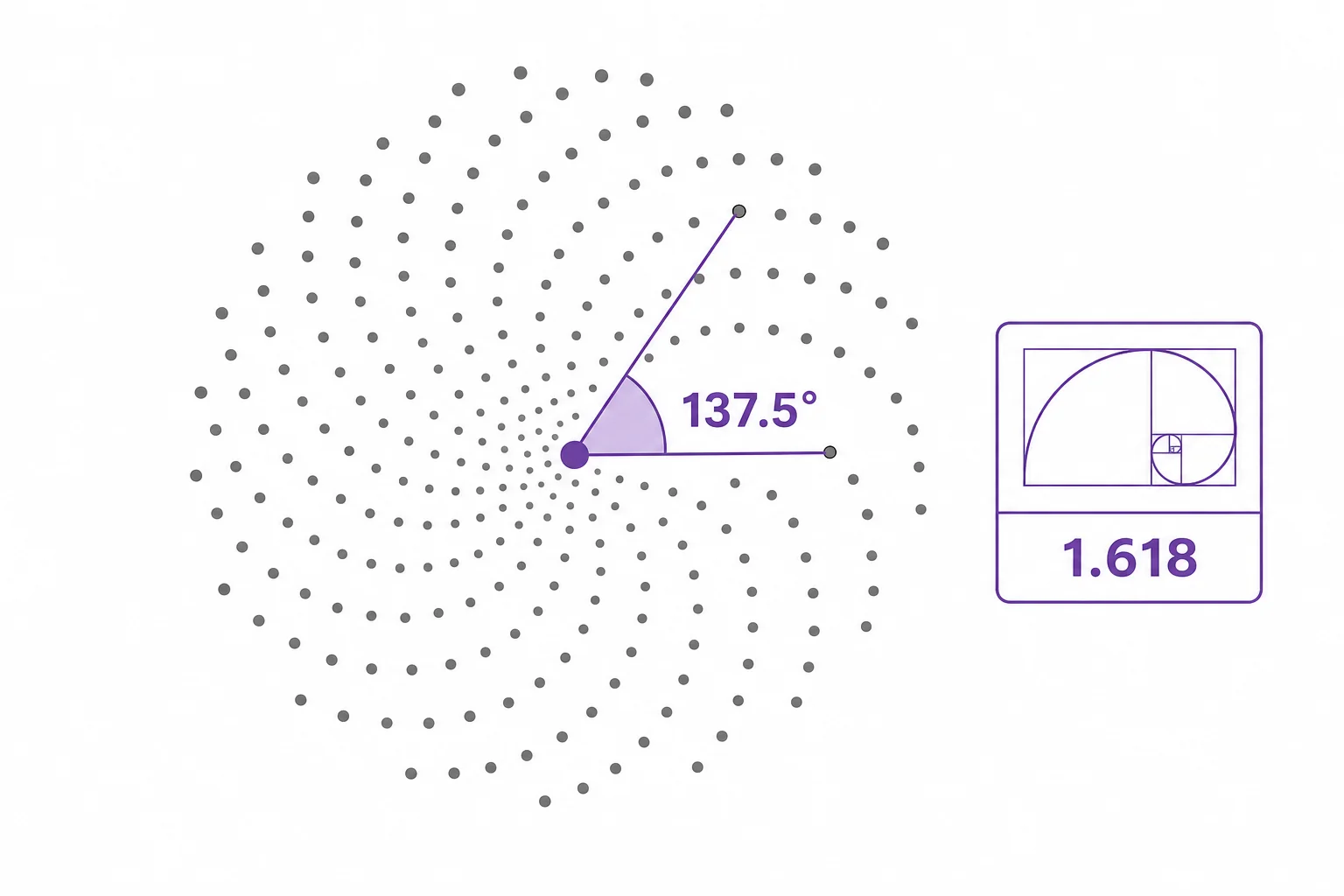
A simple diagram showing a center point and repeated seed positions separated by the golden angle
The golden angle helps spread new growth
The golden ratio is a number close to 1.618. It is often connected to Fibonacci numbers because ratios of nearby Fibonacci numbers get closer to this value as the numbers grow. For example, 13 divided by 8 is 1.625, and 21 divided by 13 is about 1.615. In plant growth, the more useful idea is often the golden angle, which is about 137.5 degrees. If each new seed appears about that angle from the one before it, seeds can spread out evenly. This makes good use of space. It also creates visible spiral families when we look at the final pattern. The golden ratio is sometimes overused in popular stories. In class, it is better to measure actual counts and ratios, then decide whether the model fits the data.

Ratios near the golden ratio can help model evenly spaced growth.

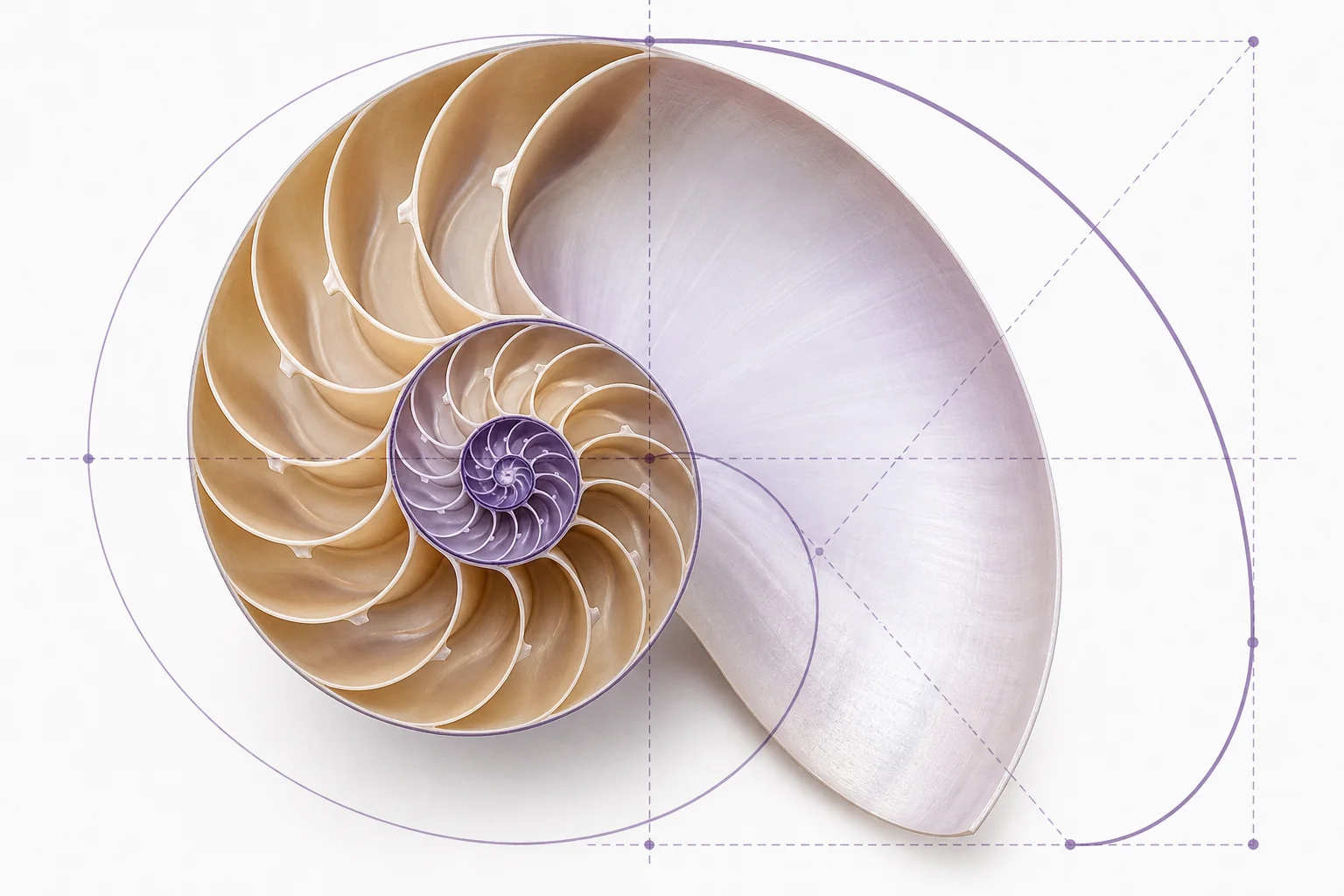
Shells and steady growth
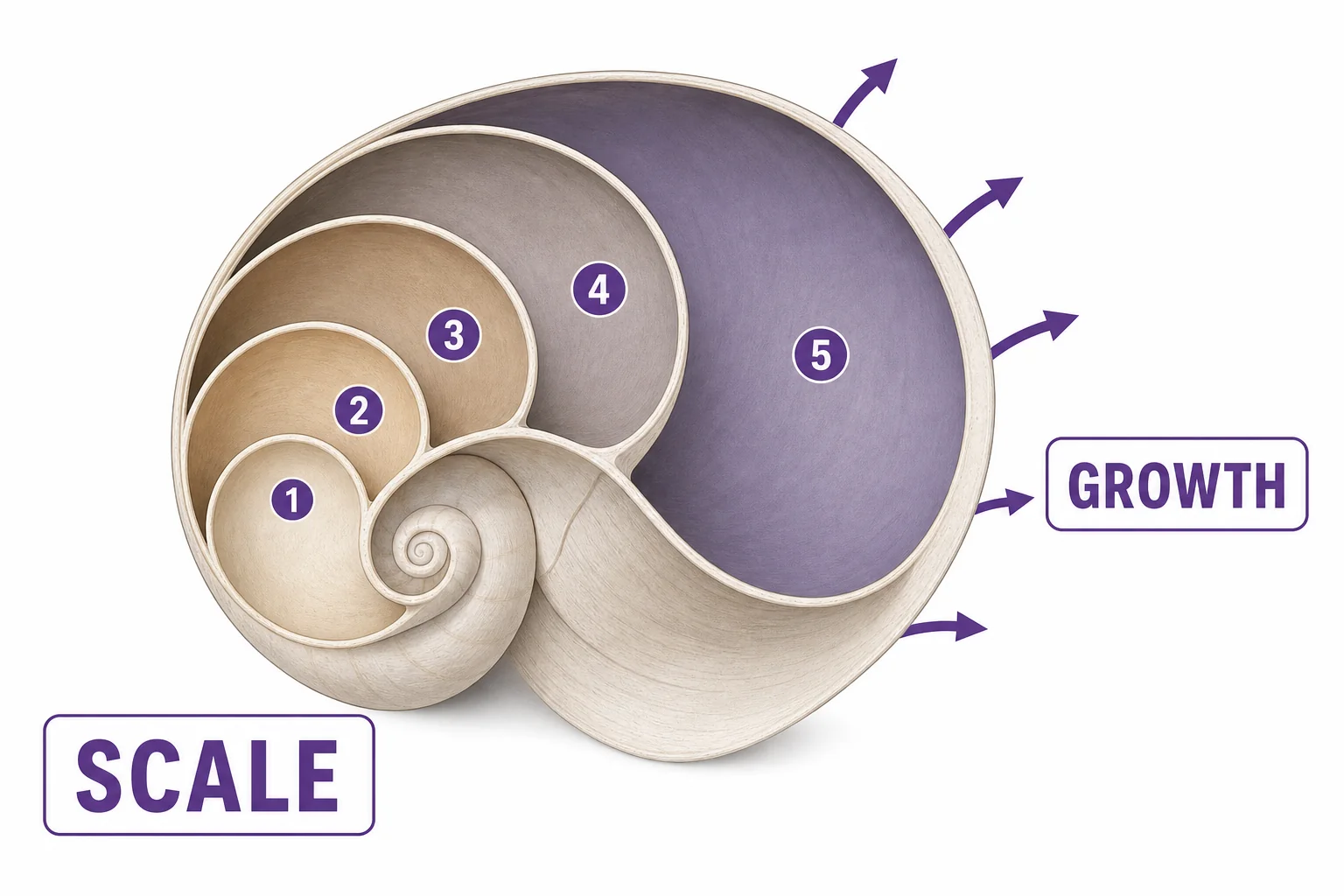
A cutaway shell spiral divided into growing sections that increase by a steady scale factor
A shell can keep its shape while growing outward
Many shells grow by adding new material at the open edge. The animal inside does not rebuild the whole shell each day. It adds to the outside, so the shell can get larger while keeping a similar shape. This can create a spiral. A simple way to model this is to imagine each new section as a scaled-up copy of the previous one. The ratio from one section to the next is the scale factor. If that factor stays fairly steady, the spiral keeps its overall form as it expands. This connects to proportional reasoning because students can compare widths, lengths, or distances from the center. Real shells vary because growth depends on species, food, and environment. The math model is still useful because it shows how repeated scaling can build a curved structure.

A steady scale factor can make a growing shape stay similar.

Spirals in motion and force
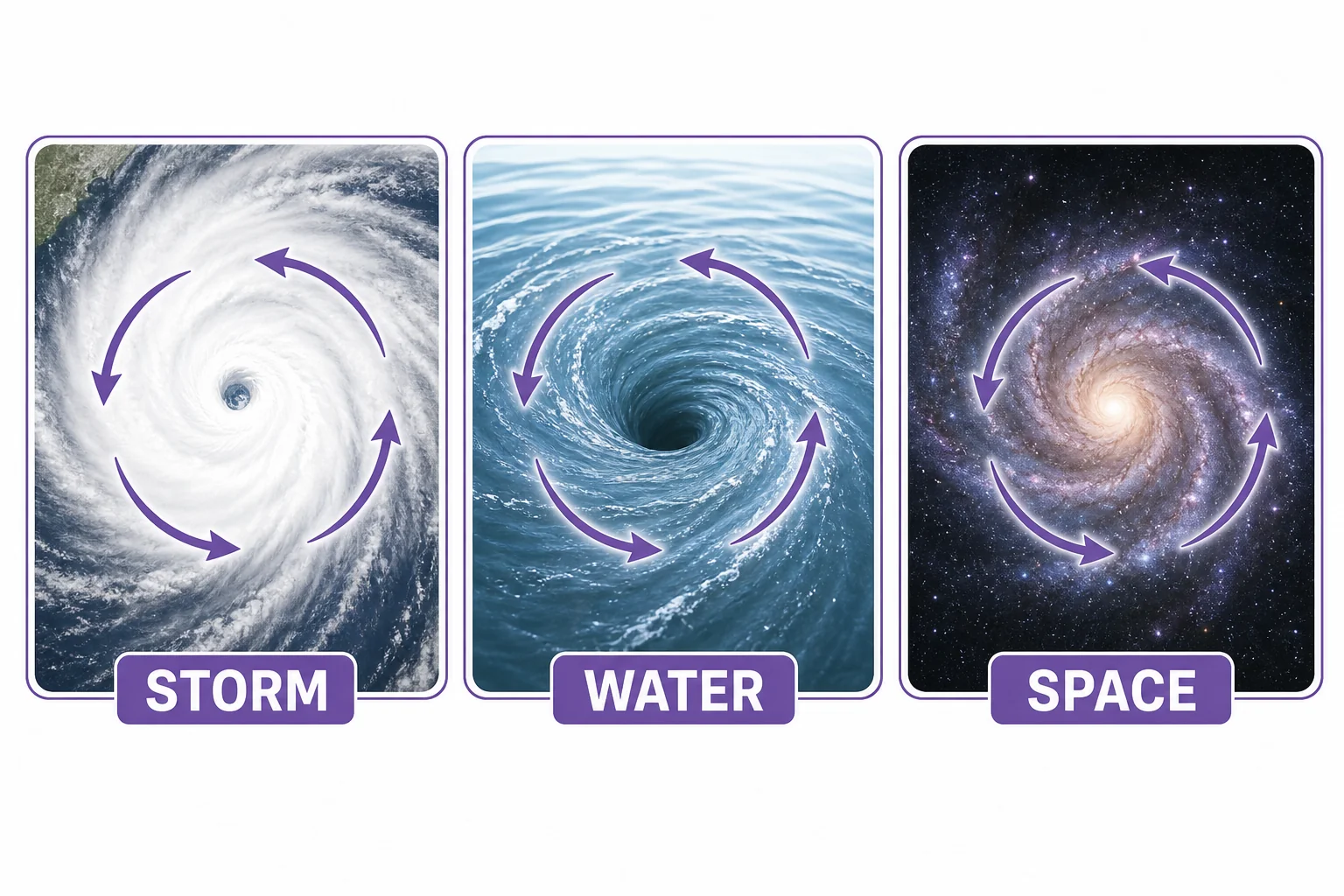
Three examples of motion spirals showing a hurricane, whirlpool, and spiral galaxy with arrows around their centers
Spirals can come from turning motion
Not every natural spiral is about growth. Some spirals form when moving material turns while also moving inward or outward. A hurricane has winds that rotate around a low-pressure center. A whirlpool forms when water drains while turning. A spiral galaxy has stars and gas arranged in curved arms because gravity and rotation shape their motion over long times. These spirals are different from sunflower or shell spirals, but they still involve change around a center. Math helps by tracking distance, angle, and rate. Students can compare how fast something turns with how fast it moves toward or away from the center. This is a bridge from ratios into later topics like functions and geometry. The same visual pattern can come from different causes, so measurement matters.

Similar spiral shapes can form from growth, packing, or motion.

Vocabulary

Spiral
A curve that turns around a center while moving closer to or farther from that center.
Ratio
A comparison of two quantities by division.
Fibonacci sequence
A number pattern where each new number is the sum of the two numbers before it.
Golden ratio
A number close to 1.618 that appears when some Fibonacci ratios get larger.
Scale factor
The number used to multiply a length or size to make a similar larger or smaller shape.

In the Classroom

Count the spirals

25 minutes | Grades 6-8

Give students photos of pine cones, pineapples, or sunflower heads. They trace spiral families in two directions, count them, and compare the counts with Fibonacci numbers.

Build a paper growth spiral

30 minutes | Grades 6-8

Students draw a small square or wedge, then copy it outward using a chosen scale factor. They measure each new section and write ratios between nearby sizes.

Test a golden angle model

35 minutes | Grades 7-8

Students place dots around a center by turning a fixed angle each time. They compare patterns made with 90 degrees, 120 degrees, and 137.5 degrees to see which spreads dots most evenly.

Key Takeaways

  • A spiral turns around a center while its distance from the center changes.
  • Fibonacci numbers can describe some plant spiral counts, but real examples are not always exact.
  • Ratios help compare one turn, seed row, or growth section with the next.
  • Shell spirals can form when new growth is added by a steady scale factor.
  • Similar spiral shapes can come from different causes, including growth, packing, rotation, and gravity.
Content generated with AI assistance and reviewed by the LivePhysics editorial team. See sources below for original references.