Understanding Geometric Transformations Visualizer
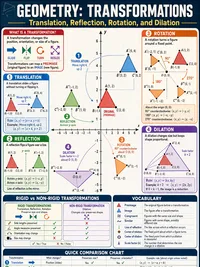
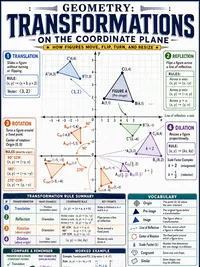
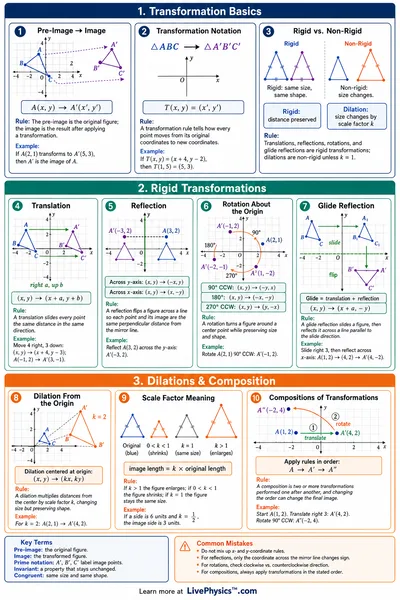
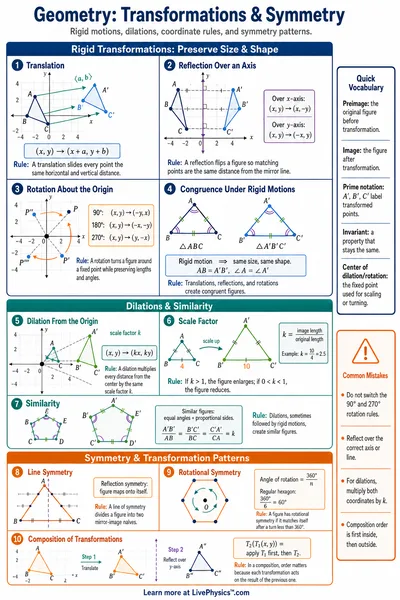
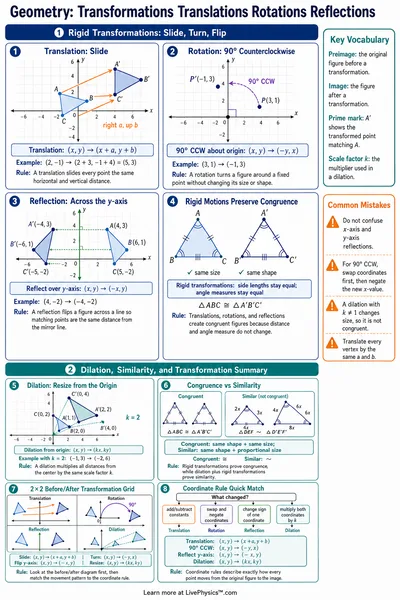
A transformation is a rule that sends every point of a figure to a new location. The result is called the image. The original figure and its image can look very different, yet certain properties may stay unchanged.
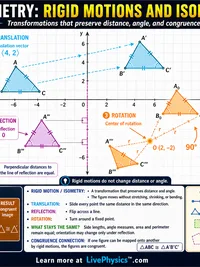
Lengths, angle sizes, parallel lines, and area are useful properties to track. Learning which properties survive helps students identify the transformation without relying only on appearance.
Translations are controlled by a horizontal change and a vertical change. Every vertex moves the same amount in the same direction, so the figure keeps its size and orientation. Rotations turn a figure around one fixed point, called the center of rotation.
A point near the center travels a short distance, while a point farther away travels a longer curved path. Its distance from the center stays constant throughout the turn.
Reflections flip a figure across a line called the line of reflection. Each point and its image lie on opposite sides of that line at equal perpendicular distances. This equal-distance rule is more reliable than judging whether a shape merely looks flipped.
A reflection reverses orientation. If a shape has vertices named in clockwise order before the reflection, their image is named in counterclockwise order afterward.
Dilations work differently because they change distances from a chosen center by one common scale factor. A positive factor larger than one enlarges the figure, while a positive factor between zero and one reduces it.
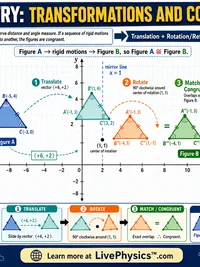
Compositions combine two or more transformations into a sequence. Order matters because turning a shape before shifting it usually gives a different final position than shifting it before turning it. Students can check each stage by marking the intermediate image rather than trying to predict everything at once.
In real life, transformations appear in map apps that pan and rotate views, photo editors that resize images, mirrors, tiling patterns, and computer graphics. When using a visualizer, focus on matching corresponding vertices, checking distances from a center or line, and noticing whether orientation changes. These checks build stronger reasoning than simply watching the image move.