Scale Drawing & Map Ratio Tool
Enter a map scale (like 1:50000) and a distance measured on the map to find the true real-world distance. Works in reverse too. Use the preset scales for common maps and drawings, or enter any custom ratio. Grades 5-9.
Scale 1 50000 - 1 cm = 500 m
Real-World Distance
2.5 km
Also 1.553 mi
Area Scale (bonus)
1 cm² on this map = 250000 m² in reality
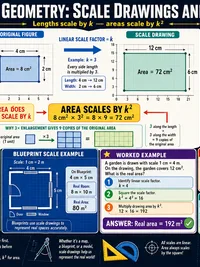
Area scales by the square of the linear scale factor (50,000² = 2,500,000,000)
Visual Ruler
Reference Guide
Reading Map Scales
What 1:50000 means
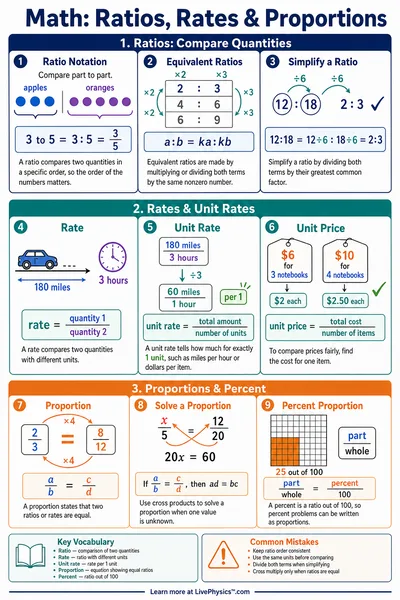
A scale of 1:50000 means every 1 unit on the map equals 50000 of the same units in the real world. Measure 1 cm on the map and the actual distance is 50000 cm, which is 500 m or 0.5 km.
The formula
Real distance = Map distance x Scale denominator
Map distance = Real distance / Scale denominator
Large vs small scale
A large denominator like 1:1000000 shows a wide area at low detail (small scale map). A small denominator like 1:1000 shows a tiny area at high detail (large scale map). The terms "large" and "small" refer to the fraction value, not the map size.
Ratio vs bar scale
A ratio scale (1:50000) works regardless of print size. A bar scale printed on the map adjusts automatically when the map is enlarged or reduced, making it more reliable for photocopied maps.
Scale Drawings in Real Life
Architecture and engineering
Architects use scales like 1:50 or 1:100 on floor plans. A room measuring 4 cm on a 1:50 plan is actually 200 cm (2 m) wide. Builders rely on this to cut materials to the right size.
Model cars and trains
HO scale trains use 1:87, meaning a real locomotive that is 20 m long is modeled at about 23 cm. Model cars at 1:18 are roughly the same size as a shoebox.
Topographic maps
Ordnance Survey maps in the UK use 1:25000 (4 cm = 1 km) and 1:50000 (2 cm = 1 km). US Geological Survey maps use 1:24000 and 1:100000. Hikers use these to estimate trail distances.
Scientific diagrams
Cell biology diagrams often use scales of 1:10000 or larger. A micrograph might show "scale bar = 10 micrometers" so you can measure the actual size of organelles in the image.
Scale Factor vs Area Scale
Linear scale factor
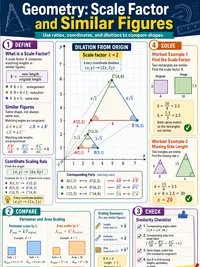
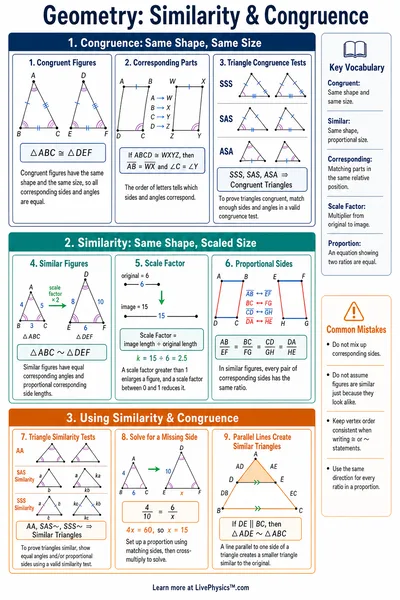
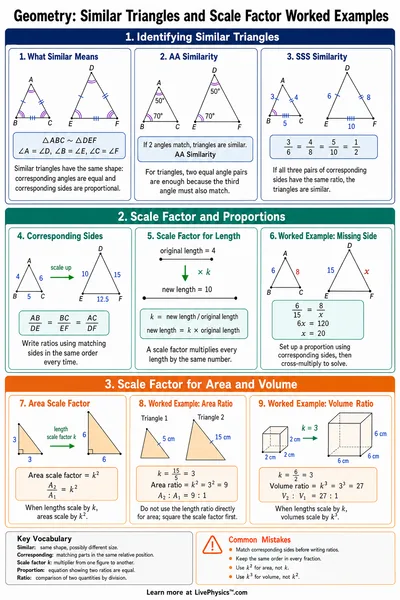
The scale denominator N is the linear scale factor. It tells you how many real units correspond to one map unit in a single dimension (length or width).
Area scales by N squared
Area scale = N²
At 1:50000, the area scale is 50000² = 2,500,000,000. So 1 cm² on the map equals 2.5 km² in reality.
Why the square?
Area is two-dimensional. Both the length and the width of a region scale up by N, so the product (area) scales up by N x N = N².
Volume scales by N cubed
For 3D models, volume scales by N³. A model car at 1:18 has a volume that is 18³ = 5832 times smaller than the real car.
Unit Conversion Tips
Metric ladder
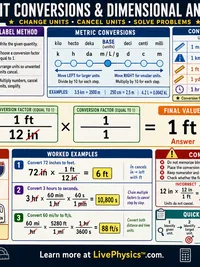
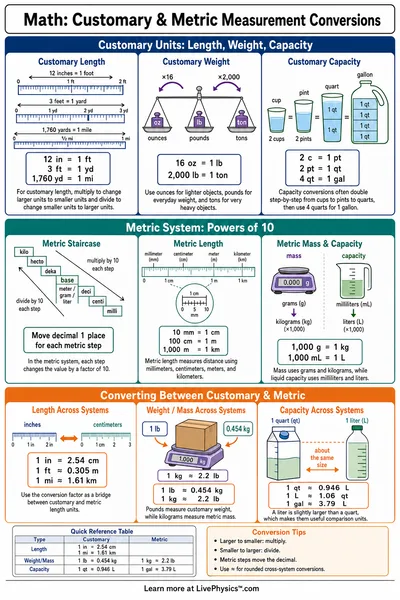
Move up the metric ladder, 10 mm = 1 cm, 100 cm = 1 m, 1000 m = 1 km. To convert, multiply going down and divide going up.
Quick metric check
If the raw real distance in cm is larger than 100000, convert to km by dividing by 100000. If between 100 and 100000, use meters. Below 100, use cm.
Imperial conversions
12 in = 1 ft, 3 ft = 1 yd, 5280 ft = 1 mi. When a map uses imperial units, the scale still works the same way - 1 in on a 1:12 scale model equals 12 in (1 ft) in real life.
Mixing systems
A scale ratio is unit-free. 1:50000 means 1 of any unit equals 50000 of the same unit. If you measure in inches on the map, the real distance is in inches too - then convert as needed.