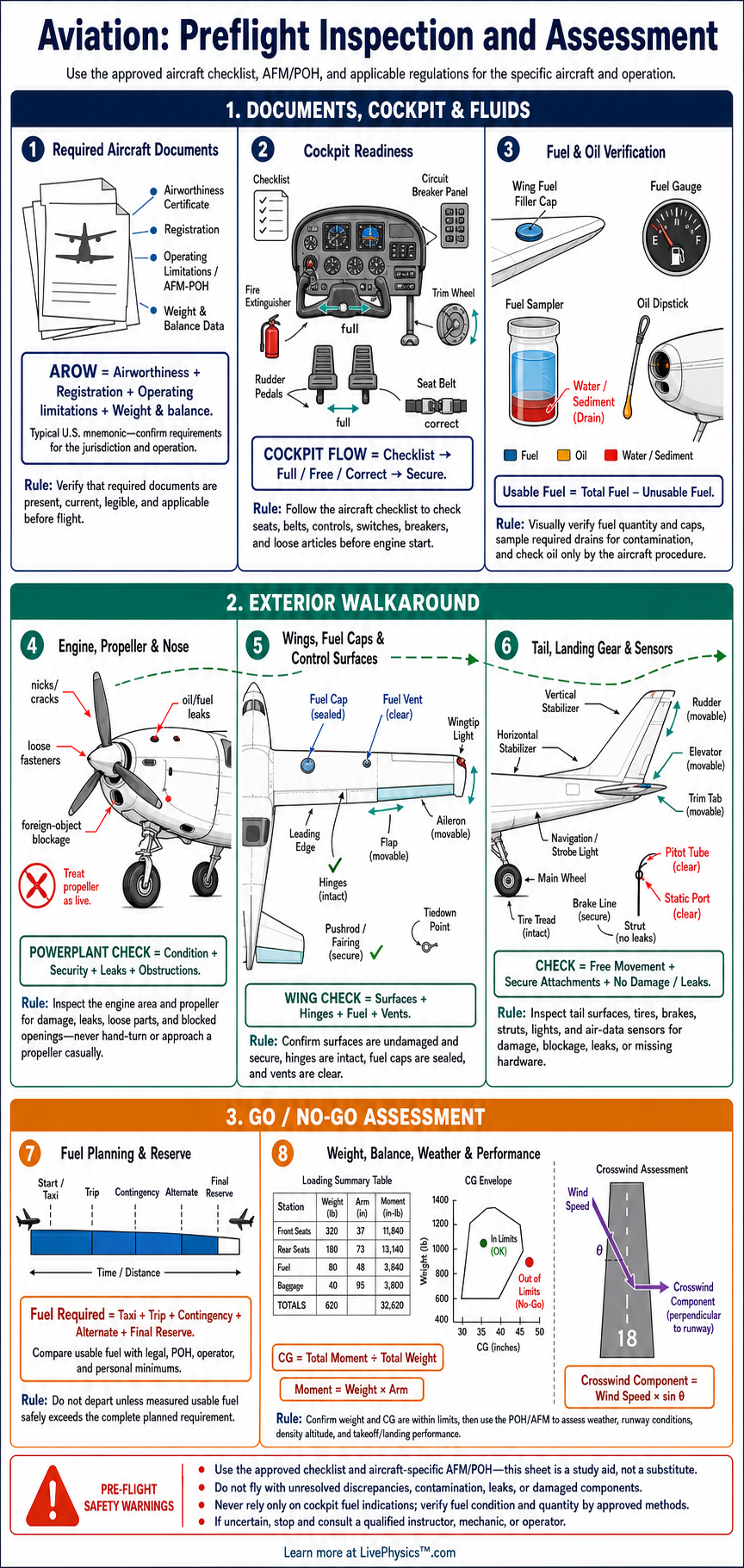
A preflight inspection and assessment helps pilots find problems before an aircraft leaves the ground. It combines a careful physical inspection with planning checks for weather, fuel, performance, weight, and pilot readiness. This cheat sheet gives learners a structured way to prepare for a safe flight.
It supports the aircraft-specific checklist and pilot operating handbook rather than replacing them.
A good preflight starts with documents, aircraft condition, and the planned flight. Pilots inspect the exterior, controls, landing gear, engine area, fuel system, and cockpit in a logical order. They also calculate aircraft weight, balance, fuel endurance, and takeoff and landing performance.
The final decision depends on whether the aircraft, environment, and pilot are all ready for the flight.
Key Facts
- Use the aircraft-specific approved checklist and pilot operating handbook for every preflight inspection.
- Total aircraft weight equals empty weight plus occupant weight plus baggage weight plus usable fuel weight.
- Moment equals weight times arm.
- Center of gravity equals total moment divided by total weight.
- Fuel endurance in hours equals usable fuel in gallons divided by planned fuel flow in gallons per hour.
- Required fuel must include planned flight fuel plus legal reserves and an appropriate safety margin.
- Density altitude increases as temperature increases, pressure decreases, or airport elevation increases.
- A takeoff or landing is acceptable only when calculated performance meets the handbook limits with suitable safety margin.
Vocabulary
- Airworthiness
- Airworthiness is the condition in which an aircraft meets its approved design and maintenance requirements for safe operation.
- Center of gravity
- Center of gravity is the point where an aircraft's total weight is considered to act.
- Moment
- Moment is the turning effect of a weight, found by multiplying the weight by its distance from a reference point.
- Density altitude
- Density altitude is pressure altitude corrected for nonstandard temperature and is used to judge aircraft performance.
- Fuel sump
- A fuel sump is a low point in a fuel system where water and contamination can collect for draining and inspection.
- Discrepancy
- A discrepancy is a defect, malfunction, or missing item that must be assessed before flight.
Common Mistakes to Avoid
- Relying only on cockpit fuel gauges is wrong because gauges can be inaccurate and cannot reveal water or sediment in the tanks.
- Skipping fuel sump drains is wrong because contamination often settles at low points and can enter the engine fuel supply.
- Using total fuel instead of usable fuel in endurance planning is wrong because some fuel may be unavailable to the engine in normal flight.
- Checking weight without calculating center of gravity is wrong because an aircraft can be under its weight limit but outside its balance limits.
- Using a generic walk-around from memory is wrong because required inspection points and limitations differ between aircraft models.
Practice Questions
- 1 An aircraft has 42 usable gallons of fuel and a planned fuel flow of 7 gallons per hour. Calculate its fuel endurance in hours.
- 2 An aircraft has a total moment of 96,000 pound-inches and a total weight of 2,400 pounds. Calculate its center of gravity arm in inches.
- 3 A pilot finds water in the first fuel sample drained from a sump. State the correct immediate action before considering flight.
- 4 Explain why a hot day at a high-elevation airport can require a pilot to reconsider takeoff weight or runway choice.
Understanding Preflight Inspection and Assessment
A preflight inspection begins before the walk around. Review the aircraft maintenance status, required documents, and any operating limitations. Check that inspections are current and that no unresolved discrepancy makes the aircraft unsafe.
Use the approved checklist for the exact aircraft model. A memory flow can support the process, but it cannot replace checklist items. Good preparation reduces distractions once the engine starts.
During the exterior inspection, look for damage, leaks, loose fasteners, missing hardware, and fluid stains. Check wings, tail surfaces, control hinges, and control surfaces for freedom of movement and security. Inspect tires for wear, inflation, cuts, and flat spots.
Confirm that pitot openings, static ports, fuel vents, and drains are clear. Remove tie downs, control locks, wheel chocks, and covers only when the checklist directs it. Keep clear of the propeller and treat it as if it could start at any time.
Fuel inspection requires more than looking at a gauge. Verify the correct fuel grade and quantity, then visually inspect each tank when possible. Drain fuel samples from the required sumps into a clear tester.
Look for water, sediment, or the wrong color. Water can settle at low points in the fuel system and may stop the engine if it reaches the fuel line. Oil quantity must also fall within the operating range specified in the pilot operating handbook.
Flight assessment connects aircraft condition to the planned trip. Calculate total weight by adding the empty aircraft, occupants, baggage, and usable fuel. Calculate each item moment by multiplying its weight by its arm, then divide total moment by total weight to find the center of gravity.
The result must stay within approved limits. Use current runway, wind, temperature, pressure altitude, and aircraft data to determine whether available takeoff and landing distance is sufficient.
Weather and personal condition are equally important. Review forecasts, observations, winds aloft, notices, airspace, and alternate plans. Watch for crosswinds, low visibility, thunderstorms, icing, turbulence, and high density altitude.
High density altitude reduces engine, propeller, and wing performance, especially on hot days or at high elevations. Assess fatigue, illness, medication, stress, alcohol, and recent experience honestly. A safe pilot delays, changes, or cancels a flight when risk cannot be reduced to an acceptable level.