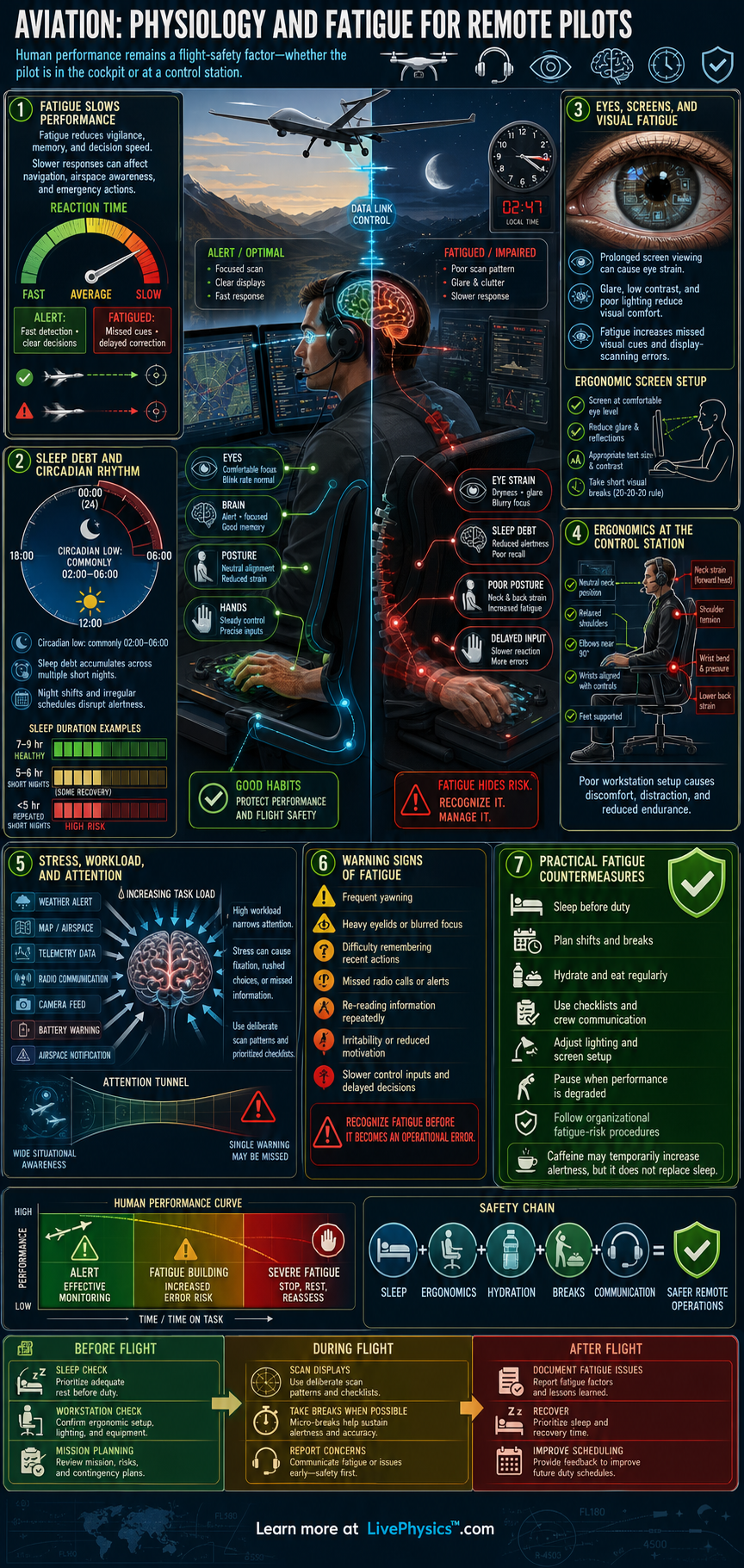
Remote pilots operate aircraft from ground control stations, but their bodies still face many of the limits of flight operations. Long periods of screen viewing, sustained attention, irregular schedules, and time pressure can reduce performance. A small drop in alertness can delay a control input or make a warning harder to notice.
Human physiology is therefore part of unmanned aircraft safety.
Fatigue changes attention, memory, reaction time, and judgment. Eyes can become dry or strained when shifting between displays, while poor posture can cause discomfort that competes for attention. Stress may raise heart rate and narrow focus onto one urgent task.
Good remote pilot operations use scheduling, display design, breaks, checklists, and self-monitoring to reduce these risks.
Understanding Aviation, Physiology and Fatigue for Remote Pilots
A remote pilot is physically on the ground, yet the job has many aviation stressors. The pilot may monitor aircraft position, weather, airspace, payload data, communications, and system health at the same time. Unlike a pilot in an aircraft, the remote pilot receives the outside world mainly through screens, sensors, maps, and radio reports.
This creates a risk of reduced situation awareness. The pilot must build an accurate mental picture from incomplete information. A display can show a correct value while the pilot misunderstands what that value means for the mission.
Fatigue is more than feeling sleepy. It is a reduced ability to maintain effective performance after insufficient sleep, extended wakefulness, demanding work, or disruption of the body clock. Sleep pressure rises the longer a person stays awake.
The circadian rhythm creates predictable low-alertness periods, often during the night and early afternoon. Night shifts can be especially difficult because the work schedule conflicts with normal sleep timing. Caffeine may briefly improve alertness, but it does not replace sleep or fully restore sound judgment.
Visual workload is a major issue at a ground control station. Pilots must scan displays without staring at one item for too long. Extended near-screen work reduces blinking, which can lead to dry eyes and blurred vision.
Bright screens in dark rooms can cause discomfort and make it harder to adapt when looking away. Display layout matters because important alerts should be easy to find and interpret. Color alone should not carry a warning because color vision varies and tired eyes may miss subtle changes.
Posture and movement affect mental performance over a long shift. A fixed seated position can produce neck, shoulder, back, wrist, or hand discomfort. Pain and discomfort consume attention that should be available for the aircraft.
The workstation should support a neutral posture, with the screen near eye level and controls within easy reach. Short planned movement breaks can reduce stiffness and provide a chance to reset attention. Breaks must be coordinated so that aircraft monitoring and communication coverage remain continuous.
Stress can be useful at a low level because it increases readiness, but high stress can degrade decisions. During an emergency, a remote pilot may fixate on a single warning and neglect fuel state, airspace, weather, or communication tasks. Checklists help by giving the pilot a structured sequence during high workload.
Crewmembers and supervisors can support safety by reporting fatigue early without blame. Students should learn to recognize performance signs such as repeated rereading, missed radio calls, slowed responses, irritability, and difficulty tracking several tasks. These signs call for a controlled safety response, not willpower alone.
Key Facts
- Fatigue can reduce reaction time, attention, working memory, and decision quality.
- Sleep pressure generally increases with time awake and decreases with adequate sleep.
- Circadian low points commonly occur during the night and can occur again in the early afternoon.
- Heart rate = beats per minute, and a rising rate can be one sign of stress or high workload.
- Work = force × distance, so poor workstation setup can increase physical effort during long tasks.
- A useful scanning habit is to check aircraft control, navigation, communication, and system status in a planned repeating pattern.
Vocabulary
- Fatigue
- Fatigue is a state of reduced physical or mental performance caused by sleep loss, long work, demanding tasks, or body clock disruption.
- Circadian rhythm
- The circadian rhythm is the internal daily body clock that influences sleepiness, alertness, temperature, and hormones.
- Situation awareness
- Situation awareness is understanding what is happening now, what it means, and what may happen next.
- Fixation
- Fixation is prolonged attention on one display item or problem while other important information is neglected.
- Ergonomics
- Ergonomics is the design of tools and workspaces to fit human abilities and physical limits.
Common Mistakes to Avoid
- Treating fatigue as simple sleepiness. A pilot can feel awake yet have slower reactions, poorer memory, and weaker judgment.
- Using caffeine as a substitute for sleep. Caffeine can temporarily increase alertness but cannot remove accumulated sleep debt or restore all cognitive performance.
- Staring continuously at one display. This reduces broad scanning, increases eye strain, and can cause important warnings or communication changes to be missed.
- Ignoring discomfort from a poor workstation setup. Neck, back, wrist, and eye discomfort compete for attention and can become worse over a long shift.
Practice Questions
- 1 A remote pilot has been awake for 18 hours before beginning a demanding night shift. Identify two likely performance effects and state one operational control that could reduce risk.
- 2 A pilot takes a 10 minute movement and eye-rest break after every 50 minutes of continuous console work during a 6 hour shift. How many complete work-break cycles occur, and how many minutes are spent on breaks in those complete cycles?
- 3 During an abnormal event, a pilot watches one red engine warning for several minutes and misses two radio calls. Explain the human-factors problem and describe how a checklist or crewmember could help.