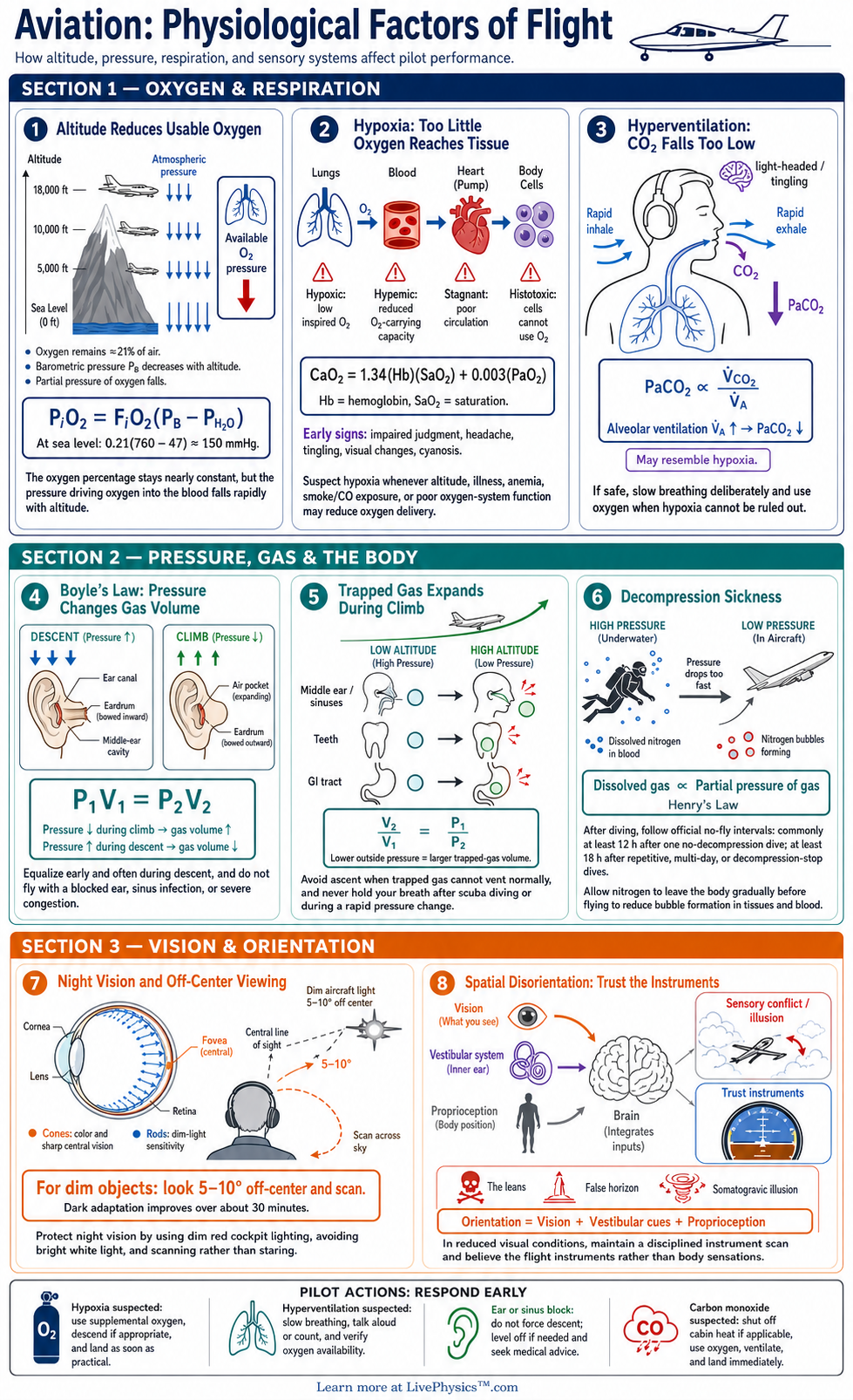
Physiological factors of flight describe how altitude, motion, aircraft conditions, and workload affect the human body. Pilots need this cheat sheet because small physical changes can reduce judgment, vision, coordination, and safety. Recognizing symptoms early helps a pilot take the correct action before a condition becomes dangerous.
Key Facts
- Hypoxia is a shortage of oxygen reaching body tissues, and the immediate response is to use oxygen if available and descend to a lower altitude.
- Although oxygen remains about 21 percent of the atmosphere, its partial pressure decreases as altitude increases.
- Hyperventilation lowers carbon dioxide in the blood because breathing is faster or deeper than the body requires.
- A pilot can reduce hyperventilation by deliberately slowing breathing and using a regular, controlled breathing pattern.
- During descent, increasing outside pressure compresses trapped gas in the ears and sinuses, which can cause a painful block.
- Night vision improves through off-center viewing because rod cells are more sensitive away from the center of the retina.
- Carbon monoxide binds to hemoglobin more strongly than oxygen, reducing the blood's ability to carry oxygen.
- When body sensations conflict with instruments in limited visibility, pilots should trust the flight instruments.
Vocabulary
- Hypoxia
- Hypoxia is a condition in which body tissues receive too little oxygen to function normally.
- Hyperventilation
- Hyperventilation is breathing faster or deeper than needed, causing an excessive loss of carbon dioxide.
- Partial pressure
- Partial pressure is the share of total air pressure contributed by one gas, such as oxygen.
- Spatial disorientation
- Spatial disorientation is a pilot's inability to correctly determine the aircraft's position or motion.
- Night adaptation
- Night adaptation is the process by which the eyes become more sensitive in low-light conditions.
- Carbon monoxide
- Carbon monoxide is a colorless, odorless gas that prevents blood from carrying enough oxygen.
Common Mistakes to Avoid
- Assuming hypoxia will always feel obvious is wrong because impaired judgment may prevent a pilot from recognizing the symptoms.
- Treating hyperventilation as harmless nervousness is wrong because dizziness and tingling can seriously affect aircraft control and decisions.
- Forcing an ear equalization when severe pain occurs is wrong because excessive force can injure the ear and does not remove a blockage safely.
- Looking directly at a faint object at night is wrong because the center of the retina is less sensitive in dim light than the area slightly off center.
- Following a bodily sensation instead of the instruments in cloud is wrong because the inner ear can give inaccurate signals during sustained turns and accelerations.
Practice Questions
- 1 At 12,500 feet, a pilot develops headache, unusual fatigue, and poor judgment. Identify the likely condition and state two immediate actions.
- 2 A student pilot breathes 24 times per minute while anxious, compared with a normal controlled rate of 12 breaths per minute. By what factor has the breathing rate increased?
- 3 During descent, outside pressure rises from 800 hectopascals to 1000 hectopascals. By how many hectopascals has the outside pressure increased?
- 4 Explain why a pilot flying in cloud should rely on flight instruments even when the body strongly feels that the aircraft is turning.
Understanding Physiological Factors of Flight
The atmosphere becomes less dense as altitude increases. Oxygen still makes up about 21 percent of the air, but the pressure that drives oxygen into the blood becomes lower. This lowers the amount of usable oxygen available to body tissues.
Hypoxia is the resulting oxygen shortage. Its early signs can include headache, poor judgment, sleepiness, tingling, and reduced night vision.
Symptoms vary between people and may be difficult to notice because hypoxia can create a false sense of well-being. Supplemental oxygen and prompt descent are the primary protections when flying at high altitude.
Hyperventilation can look similar to hypoxia, but it has a different cause. It happens when a person breathes faster or deeper than the body needs, often because of stress, fear, pain, or excitement. Too much carbon dioxide leaves the blood.
This can cause dizziness, tingling, hot or cold feelings, and muscle cramps. A pilot should slow breathing deliberately and use a controlled breathing rhythm. If there is any uncertainty about the cause of symptoms at altitude, using oxygen and descending remain the safest actions.
Pressure changes also affect air trapped in body spaces. The middle ear and sinuses normally equalize pressure through small passages. During descent, outside pressure rises and air spaces become compressed.
A blocked passage can cause severe pain and tissue damage called a block. Swallowing, yawning, or gently equalizing pressure can help if done early.
Flying with a bad cold, sinus infection, or severe congestion increases this risk. Dental pain can also occur when gas trapped beneath a filling expands or contracts.
Vision has important limits in flight. At night, the eye uses rod cells more than cone cells, and rods provide poor color detail and weaker sharp central vision. Looking slightly away from a dim object helps because the rods are more sensitive away from the center of the retina.
Bright white light reduces night adaptation, while dim red light has less effect. Carbon monoxide from an exhaust leak is especially dangerous because it attaches to blood more readily than oxygen. Headache, dizziness, nausea, and confusion may develop gradually, so cabin heat problems or exhaust smells require immediate action.
The balance system can also give false information. The inner ear senses acceleration and turns, but it cannot always distinguish a turn from straight flight after motion has continued for some time. Clouds, haze, darkness, and a featureless horizon remove visual references that normally correct these errors.
This produces spatial disorientation and dangerous illusions such as the leans or a false sensation of climbing. Instrument-trained habits are the defense. Pilots should trust the flight instruments, keep a steady scan, avoid abrupt control movements, and limit flying when fatigue, illness, alcohol, or medication reduces performance.